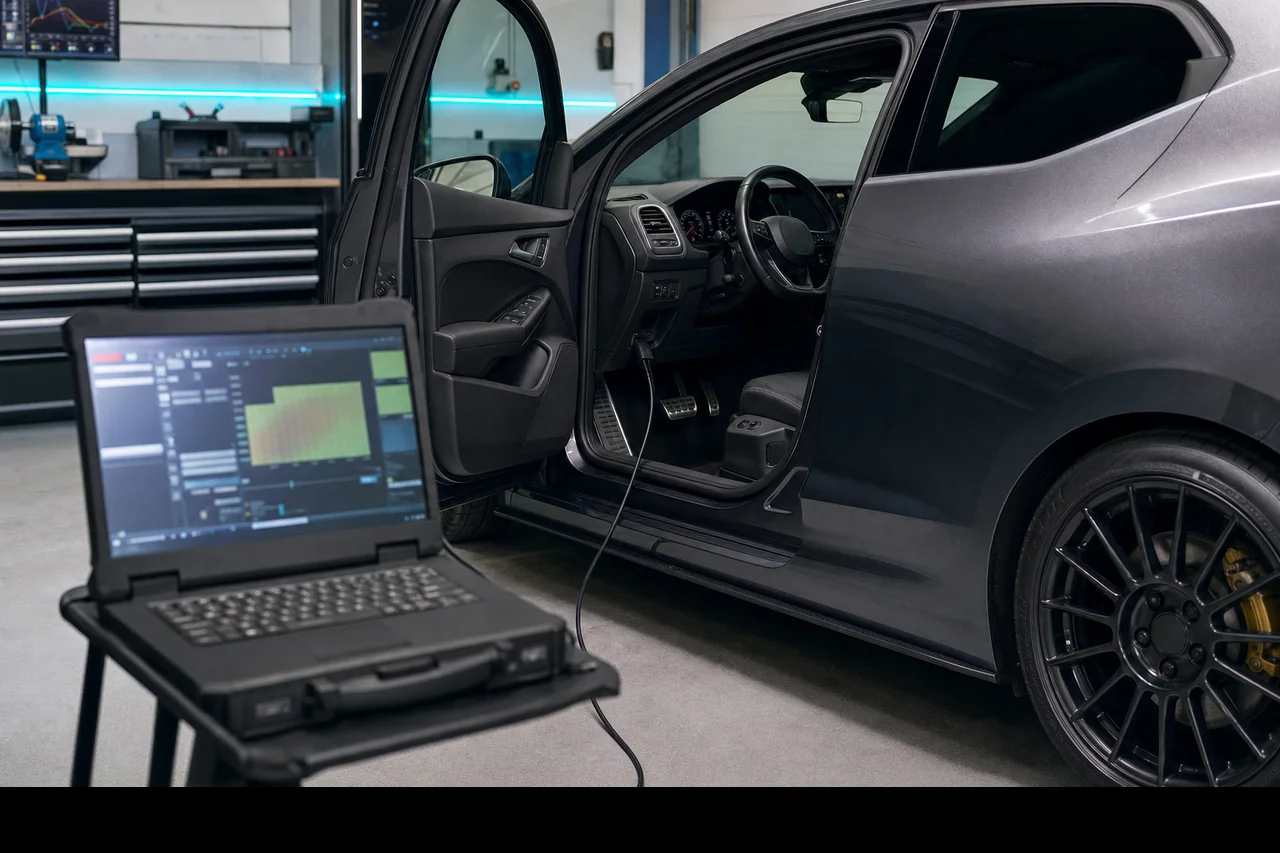
A standard FLR remap appointment runs diagnostics first, backs up your factory ECU file, writes a custom calibration, then verifies and hands over — typically one to two hours total. You need keys, a charged battery, OBD access and a safe parking space. Mobile and workshop appointments follow the same process; only the location differs. Stage 1 from £150, DSG from £150, ECU + DSG bundle £275 — diagnostics included in every standard remap.
The Short Answer
What happens at a remap appointment? We connect diagnostic and tuning equipment to your car, run a full health check, save your original factory ECU software, write a custom map built for your specific vehicle, verify the write completed correctly, and walk you through what changed before you drive away.
That sequence is the same whether you visit us in Haslingden or we come to your driveway via our mobile service. Most appointments take one to two hours from first connection to handover. You cannot drive the car during the write itself — the ignition will be on at various points and the ECU must not lose power mid-flash — but once we confirm everything, you leave with a car ready to drive immediately.
If anything in diagnostics flags a problem — weak battery, active fault codes, a turbo that is not healthy enough to tune — we tell you before writing anything. That is why diagnostics is never skipped, even when you booked a Stage 1 from £150 and expected to be in and out in an hour flat.
Before You Arrive — What To Prepare
A smooth appointment starts with five minutes of preparation at home. Most delays we see on the day come from missing keys, flat batteries or parking that is not workable — all avoidable.
When you booked, you should have confirmed your VRN, engine details and any existing modifications. If anything changed since — new exhaust, recently cleared fault light, insurance declaration still pending — tell us before we arrive or before you set off to the workshop.
Fill up fuel if you are planning a road verification afterwards. Not essential, but running low during a long idle session is unnecessary stress. Remove personal items from the footwell if you prefer — we need access to the OBD port, usually under the dashboard on the driver side, not a full interior clear-out.
On The Day — Step By Step
Here is what actually happens from arrival to keys back in your hand. Timings are typical for a healthy Stage 1 on a mainstream diesel or petrol — DSG adds a TCU write, and some ECU types take longer on security handshakes. If you have never watched an ECU flash before, the appointment feels quieter than you might expect: mostly connection time, diagnostic review, then a steady wait while the write completes.
Arrival and introduction
Mobile: we confirm parking, set up equipment beside the car and introduce what we are about to do. Workshop: you drop off or wait on site — your choice when booking. We confirm the VRN matches the job record and walk through any last questions before connecting. If you mentioned a recent battery replacement, new exhaust or cleared fault code since booking, now is the moment to say so — maps are built for the car as it sits today, not as it was three weeks ago on the quote form.
Connection and initial scan
Diagnostic cable to the OBD port, ignition on, communication established with the ECU. A quick initial read confirms we are talking to the correct control unit and notes the current software version. If the car was previously tuned by someone else, we may see signs of that here — we discuss before proceeding. Some vehicles require the bonnet open for battery access even though the OBD port is inside the cabin; we mention it if yours is one of them.
Your role during the appointment
You do not need to stand over the laptop, but keys must stay available. The ignition cycles on and off at defined points. For mobile jobs, most customers wait indoors, carry on working from home, or get on with their day — we knock when we need you or when handover is ready. For workshop visits, our waiting area or a local café in Haslingden works fine for the usual one-to-two-hour window. Children and pets around the car during the write are a distraction we ask you to manage — the process is safe, but the OBD connection must not be disturbed.
What you will notice happening
Dashboard lights may cycle. Fans can run. You might hear the fuel pump prime. These are normal on many platforms during an ECU write. Unusual warning lights that stay on after handover are not — tell us immediately if anything looks wrong before you leave. We re-scan after every write specifically to catch that before you drive away.
Diagnostics First — Always
Every standard FLR remap includes a full diagnostic health check. Standalone diagnostics is £40 if you want assessment without committing to a tune the same day — but on remap appointments, it is part of the package.
We scan for active and stored fault codes across engine, transmission and relevant modules. Live data review checks fuelling, boost, temperatures and sensor behaviour at idle and sometimes under brief load. The goal is simple: confirm the car is a safe candidate before we write anything.
What stops a job on diagnostics:
- Active fault codes that indicate a mechanical or sensor problem needing repair first
- Weak battery voltage that could drop during an ECU write — a bricked ECU is the worst-case scenario we refuse to risk
- Signs of existing bad tuning — overboost, limp mode history, mismatched hardware
- Mechanical issues — tired turbo, slipping clutch, DPF problems on a diesel — that tuning would stress further
We would rather defer or cancel a remap than flash a car that is not ready. That protects you and our reputation across Lancashire. If diagnostics reveals work needed first, you leave with a clear picture and no modified file on a unhealthy car. Read more about our standalone service at diagnostics.
The Backup and Write Process
Once diagnostics clears the car, the core work begins. This is the part most customers picture when they think “remap appointment” — but everything before it is what separates professional tuning from a rushed flash.
Factory file backup
Your original ECU software is read and saved securely before any modified calibration is written. That file is your reversibility — restore to stock before a dealer visit, sale or whenever you need factory calibration back. We do not skip this step. Ever.
Custom calibration write
We write a map built for your specific car — engine code, hardware, fuelling system and any declared modifications. Never a generic file pulled from a forum. Stage 1 stays within factory component limits on a healthy car. If you booked DSG work, the TCU receives its own backup and custom write — from £150 standalone or as part of the ECU + DSG bundle from £275.
During the write — what you must not do
Do not disconnect the battery, switch off the ignition unless we ask, or attempt to start the car mid-write. Do not plug other devices into the OBD port. Voltage is monitored throughout; if we need a battery stabiliser, we use one. Interruptions during a write can corrupt the ECU — rare with professional equipment, catastrophic if it happens.
How long the write takes
Depends on ECU type. Some European diesel units flash in under twenty minutes; newer encrypted platforms take longer on security protocols. Engine plus DSG on a bundle job allow up to two hours total. For typical timings by vehicle type, see our guide on how long a remap takes.
After Handover — What To Expect
Write complete, we confirm successful flash, clear any codes triggered by the process itself, and re-scan to verify clean communication with the ECU. Handover is not a silent nod — we explain what changed in plain English. You should leave knowing how the car will feel on the first drive, what to watch for in the first few miles, and how to reach us if something does not feel right.
What we cover at handover
- Power and torque changes — realistic expectations for your engine and fuelling type; we avoid fantasy figures
- MPG and driving style — heavier right foot uses more fuel regardless of map quality; gentle cruising often matches or beats old habits
- Run-in guidance — gentle driving for the first miles while adaptations settle on some platforms
- Documentation — written spec on request for insurance declaration; ask at booking if you know your insurer wants paperwork
- Reversibility reminder — your stock file is saved; contact us before dealer visits if you want factory software restored
- Follow-up — genuine support if something feels off in the first week; bad tuners disappear after payment — we do not
First drive
You may notice smoother delivery, stronger mid-range pull, or sharper throttle response depending on the car. Some platforms feel subtle; others transform daily driving on the A56 or M65 commute. Avoid full-throttle heroics for the first few miles on cars where adaptations need to settle — not because the map is fragile, but because calm verification beats discovering an unrelated pre-existing fault at maximum boost.
If anything feels wrong — unexpected lights, limp mode, unusual noises — contact us immediately. Genuine issues after a professional write are rare on healthy cars; we investigate properly rather than dismissing concerns. Keep our number saved: 01706 404 357.
DSG-specific handover
Gearbox tuning changes shift points, kickdown behaviour and sometimes launch feel. First few drives may feel different as the TCU adapts to your style. We explain what normal looks like for your specific DSG generation so you are not second-guessing every shift on the way home to Rawtenstall or Accrington.
Mobile vs Workshop — Same Process, Different Logistics
Calibration quality is identical. The appointment structure — diagnostics, backup, write, verify — does not change. What changes is where you wait, power supply, and weather exposure.
| Factor | Mobile | Workshop |
|---|---|---|
| Location | Your driveway, workplace or agreed parking | FLR Haslingden base (BB4) |
| Your time | No travel — wait at home or work | Travel to us or drop-off |
| Weather | Light rain OK; heavy rain may reschedule | Sheltered — all conditions |
| Power | Outdoor socket ideal; we carry stabilisers | Mains on site |
| Pricing | Same — Stage 1 £150, DSG £150, bundle £275 | Same |
| Process | Identical backup-first FLR process | Identical |
Most customers across Rossendale, Hyndburn and Greater Manchester choose mobile for convenience. Workshop suits anyone who prefers drop-off, needs shelter on a foul weather day, or wants face-to-face time in our unit. Tell us your preference when you request a quote — we accommodate both every week.
What To Bring, Pricing and Common Mistakes
Aside from the checklist above, a few practical items reduce friction on the day.
- Both keys if you have a spare — some cars need key presence for ECU security pairing
- Logbook or VRN confirmation — we match software to your exact vehicle
- Modification list — intercooler, decat, intake, tuning box history — maps must account for hardware
- Insurance confirmation if you declared before booking — we do not check your policy, but you should have declared if required
- Extension lead for mobile — speeds setup if outdoor power is available
Common mistakes we see:
- Booking with a dying battery — address it first or tell us so we plan stabiliser support
- Assuming a remap fixes mechanical faults — tuning optimises healthy hardware; it does not replace a failing turbo
- Forgetting insurance declaration — separate from the appointment itself but your responsibility before you drive away tuned
- Parking on a steep slope or busy road — mobile needs safe, flat access to the front of the car
Transparent pricing
No surprise add-ons on the day:
- Stage 1 ECU remap: from £150 — diagnostics, backup, custom write and verification included
- DSG / TCU remap: £150 — same inclusions on the gearbox control unit
- ECU + DSG bundle: £275 — both units, one appointment where scheduling allows
- Standalone diagnostics: £40 — health check without a remap
Duration: one to two hours for most Stage 1 jobs; up to two hours for bundle work. Arrive on time, checklist complete, and the appointment runs smoothly. For a deeper breakdown of timing factors — ECU generation, encryption, DSG pairing — read how long does a remap take?
So — What Happens at a Remap Appointment?
What happens at a remap appointment? Diagnostics first, factory backup saved, custom calibration written, verification and honest handover — one to two hours on a typical healthy car. Mobile or workshop, the FLR process is the same. You need keys, good battery, OBD access, declared insurance if required, and a sensible parking space.
We are based in Haslingden and serve drivers across Lancashire and the North West. We would rather turn a job away on diagnostics than flash a car that is not ready — because what happens after a bad remap on a unhealthy car is never worth the hour saved upfront.
Ready to book? Request a quote with your VRN and preferred mobile or workshop slot, call 01706 404 357, or explore our mobile remapping service and Haslingden workshop.
Remap Appointments — Common Questions
Most Stage 1 appointments take one to two hours from connection to handover. ECU plus DSG bundle jobs may take up to two hours. Exact timing depends on ECU type and whether any diagnostic issues need discussion first.
Yes. Mobile customers often wait indoors or carry on at home while we work outside. Workshop customers can wait on site or drop off and collect later — tell us your preference when booking.
Confirm your VRN, ensure the battery is healthy, clear access to the OBD port, list any modifications, declare insurance if required, and arrange safe flat parking for mobile or plan your journey to Haslingden for workshop visits.
We stop before writing any modified file and explain what needs addressing first. You leave with a clear diagnostic picture. Standalone diagnostics is £40; on standard remap bookings the health check is included.
Identical — diagnostics, backup, custom write and verification. Only location and logistics differ. Pricing is the same for both: Stage 1 from £150, DSG £150, bundle £275.
Yes during the ECU write — the ignition must stay on and the car stationary. Once we complete verification and handover, you can drive immediately. Plan for one to two hours without needing the car.
Yes — backup before write is standard on every FLR job. Your stock file is stored for future restore requests before dealer visits, sales or if you simply want factory calibration back.
Yes. Standalone diagnostics is £40 — full fault scan and health assessment without committing to a tune. Useful if you are unsure whether your car is ready or want a baseline before deciding.