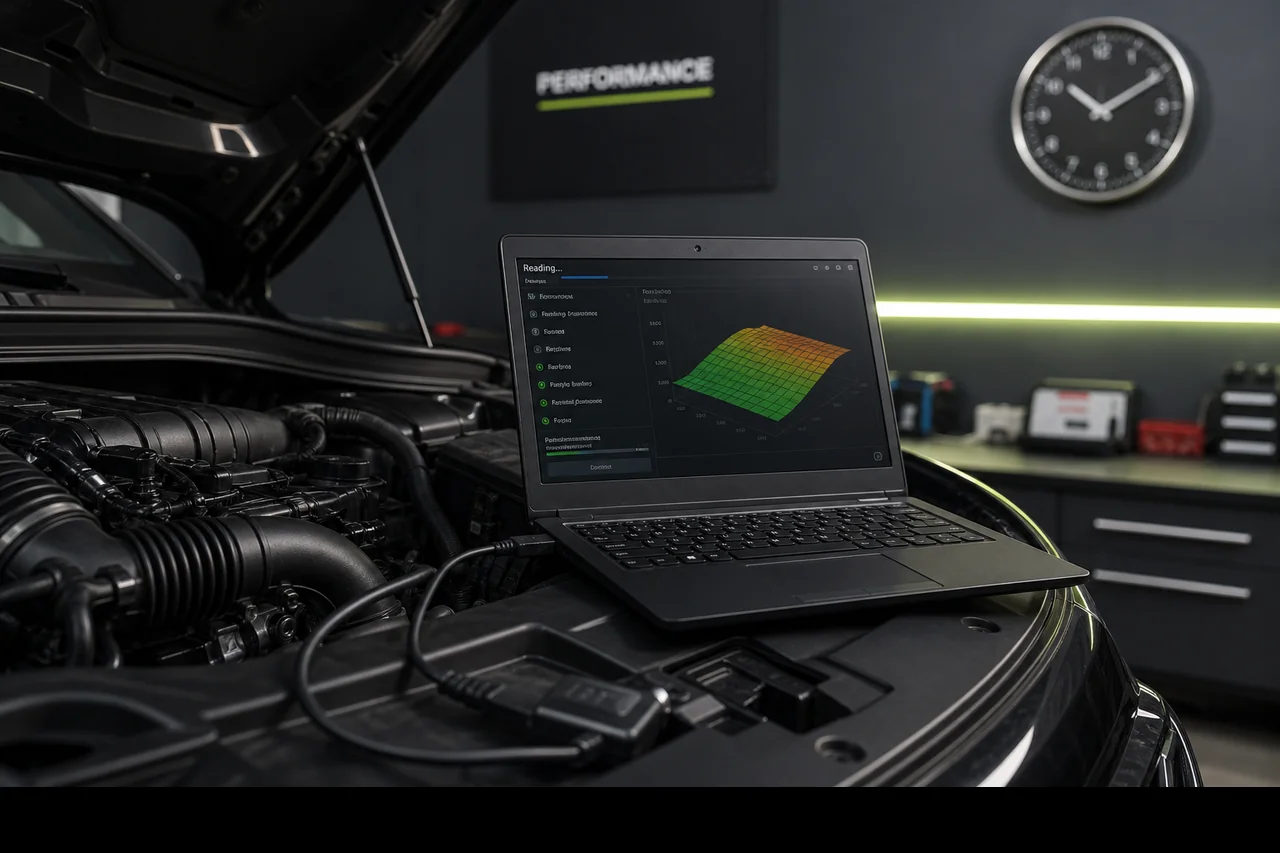
A standard Stage 1 ECU remap at Finish Line Remaps typically takes 2–3 hours from arrival to handover — including diagnostics, backup, custom calibration, write and verification. DSG/TCU tuning adds roughly 45–60 minutes. Mobile appointments follow the same process at your home or workplace across Lancashire. Rushed 15-minute flashes skip health checks and backups; we do not offer those.
The Short Answer
How long does an ECU remap take? Plan for two to three hours for a standard Stage 1 on most mainstream vehicles. That includes a full diagnostic health check, reading and backing up your factory file, writing a custom calibration, flashing the ECU and verifying everything before you drive away.
Some cars flash faster; some take longer — older VAG platforms, certain BMW modules and van ECUs with additional security steps can extend the calibration phase. We quote realistic time when you book so you are not watching the clock in a supermarket car park wondering what is happening.
Based in Haslingden, we offer mobile remapping across Lancashire and the North West. The process takes the same time whether we are on your drive in Rawtenstall or at our base — the difference is convenience, not corners cut.
The FLR Appointment Timeline
Every remap follows the same four-stage process. Here is what happens and how long each stage typically takes on a healthy Stage 1 booking.
Total on the day: roughly 2–3 hours. Add 45–60 minutes if you are booking DSG/TCU tuning alongside the ECU — our ECU + DSG bundle is from £275 (Stage 1 £150 + DSG £150 separately).
For a deeper walkthrough of what to expect on the day, see our remap appointment guide.
What Happens at Each Stage
Contact and quote — before the day
This happens when you first get in touch — not while you wait on the drive. Send your VRN, mileage, fuel type and any modifications. We confirm compatibility, explain options and give clear pricing. Stage 1 from £150, DSG £150, diagnostics-only £40 if you want a health check before committing.
That upfront work means appointment day is about the car, not admin. If we spot a compatibility issue or advise waiting until a fault is fixed, we tell you before you book time off — not halfway through a flash.
Diagnostics — the step rushed tuners skip
Before any file is written, we connect professional diagnostic equipment and scan for fault codes, review live data and confirm the vehicle is fit for tuning. Turbo health, rail pressure, EGT behaviour, DPF status and gearbox adaptations all feed into the decision.
This stage takes 30–45 minutes on a typical car. If we find active faults or borderline components, we stop and explain — we do not flash power onto a car that should be in for repair first. That is what diagnostics from £40 is for, and it is included on standard remap bookings.
Calibration — backup, write and verify
We read your factory ECU software and save a secure backup. Your custom calibration is written for your specific engine variant — never a generic file pulled from a folder. The flash itself may take 15–40 minutes depending on ECU type; writing and verifying the map adds time on top.
Some platforms require bench work or additional security handling — rare on standard Stage 1 road cars, but we factor it in when quoting. Van ECUs, certain Mercedes modules and older Bosch units can sit at the longer end of the 45–90 minute calibration window.
Handover — not just "done, off you go"
We verify the flash completed correctly, check for new fault codes, and walk you through what changed. A short road verification confirms throttle response, boost delivery and — if applicable — DSG behaviour feel right before we hand the keys back.
You leave knowing how to drive the car during the first few miles of adaptation and who to call if something feels off. That is 15–30 minutes well spent.
How to Prepare — Save Time on the Day
A little preparation keeps your appointment inside the two-to-three-hour window. Use this checklist before we arrive.
A weak battery is the most common cause of delays. ECU writes draw steady power — a borderline battery on a cold morning in Lancashire can turn a straightforward job into a wait for jump leads. If your battery is older than five years, consider checking it beforehand.
What Makes a Remap Take Longer?
Not every car fits the standard window. We quote per vehicle because a 2014 Golf 2.0 TDI and a 2019 Mercedes C220d do not flash at the same pace — different ECU generations, different security layers, different access points. Transparency at quote stage means no awkward phone call halfway through your morning saying we need another hour.
Factors that extend appointment time include:
- ECU + DSG bundle — two control units, two backups, two writes; add 45–60 minutes
- Active fault codes — we diagnose before tuning; fixing or deferring adds time or reschedules the remap
- Difficult ECU access — some vehicles need trim removal or boot-mounted module access
- Security gateway vehicles — certain newer platforms require additional authentication steps
- Custom tuning projects — big turbo builds, multi-stage calibration and dyno-verified work are separate from standard Stage 1 timing
- Cold or wet conditions — we may extend verification for safety; we do not rush handover in poor visibility
We tell you if your specific reg is likely to run long when you quote. Surprises on the day usually mean something needs attention — and we would rather find it during diagnostics than after a flash.
Typical Timing by Vehicle Type
These are realistic FLR appointment windows for healthy cars — not best-case marketing figures. Your reg may differ; we confirm when you book.
- VAG 2.0 TDI / 1.4–2.0 TSI (2008–2019) — 2–2.5 hours Stage 1; ECU access straightforward on most platforms
- BMW / Mercedes diesel (2015+) — 2.5–3 hours; some modules need additional authentication or boot access
- Ford Transit / Ranger 2.0 EcoBlue — 2.5–3 hours; allow time for thorough diagnostics on high-mileage fleet vans
- DSG / S-Tronic bundle (any platform) — add 45–60 minutes for TCU backup, write and shift verification
- Diagnostics-only appointment — 30–45 minutes; no calibration phase unless faults need deeper investigation
If you are booking multiple vehicles — a fleet morning at your yard in Bury or Blackburn — we schedule sequentially with realistic gaps. Two Stage 1 vans back-to-back is a full morning, not a single slot.
What To Do While We Work
Mobile appointments happen on your drive or company car park. You do not need to stand over the bonnet — but you do need to be available for a ten-minute handover at the end. Many customers work from home, grab a coffee locally or carry on with their day while we handle diagnostics and calibration.
What we need from you during the job:
- Keys available for ignition cycles and road verification
- Access to the OBD port — usually unobstructed under the dash
- Bonnet release if ECU access requires it on your platform
- A quick signature or confirmation on handover when we explain what changed
We keep you updated if diagnostics reveal something that changes the plan — a fault that needs fixing first, or an ECU that needs longer than expected. No silent overruns without a call.
Mobile vs Workshop — Same Time, Different Location
Mobile remapping does not mean a quicker or thinner process. We bring the same diagnostic tools, backup workflow and custom-write standards to your home, workplace or fleet yard. The clock runs the same way.
What mobile saves is your time travelling to a workshop — not our process steps. For customers in Haslingden, Rossendale, Bury, Blackburn and across the M65 corridor, that convenience is the point. You still need a flat surface, safe access to the OBD port and roughly three hours blocked.
Workshop appointments at our base suit customers who prefer a fixed location or have limited drive space. Duration is identical; choose what fits your diary.
Why "15-Minute Remaps" Should Worry You
You will see adverts promising remaps in fifteen minutes for £99. That is not professional calibration — it is a generic file download with no meaningful health check and often no backup of your original software.
What gets skipped in a rushed flash:
- Diagnostic scan and live data review
- Secure backup of your factory ECU file
- Custom calibration for your engine variant and mileage
- Post-flash verification and fault code check
- Handover explaining what changed and aftercare
Those steps are where the time goes — and where the safety lives. A car flashed in fifteen minutes on a driveway with active fault codes is a liability, not a bargain. Our £150 Stage 1 includes the full process because cutting corners costs more later.
Scheduling Tips — Pick the Right Slot
Timing your appointment well saves friction on the day. Book a morning slot if you want the rest of the day to drive and adapt — useful before a weekend away. Avoid booking directly before an MOT unless diagnostics have already confirmed the car is healthy; you want headroom if we find something that needs attention first.
Winter mornings in Lancashire mean cold batteries and longer warm-up periods. A spring or summer slot is not faster on paper, but cold-start diagnostics on a diesel sat on a Rossendale drive all night can extend the first phase. If your battery is marginal, replace it before we arrive — that single step prevents more delays than any other preparation.
Evening appointments are available for mobile customers who cannot take morning time off. The process takes the same duration — plan for us to finish before dark so road verification is safe and you can ask questions at handover without torchlight.
After the Appointment — Adaptation and First Drive
The clock does not stop entirely at handover. Modern ECUs adapt over the first 50–100 miles after a remap — learning new fuelling and boost behaviour. The car may feel progressively smoother as adaptations settle.
We advise sensible driving for the first session — no full-throttle launches on cold oil, no towing at maximum load until you have felt how the car responds. If anything feels wrong, call us. A proper handover includes a direct line back to the person who wrote your file, not a call centre.
DSG-equipped cars may need a few miles for shift adaptations to fully align after TCU tuning. That is normal — not a sign the job was rushed.
The First Week After Your Remap
Most customers ask whether they need to "run in" a remap. You do not need a formal bedding-in procedure like a rebuilt engine — but sensible habits in the first week help adaptations settle cleanly.
- Varied driving — mix town, motorway and hills so the ECU learns across load ranges
- Avoid constant full throttle on cold starts — oil and turbo need normal warm-up regardless of tuning
- Monitor fuel consumption — many drivers see improved economy with lighter right feet; heavy use shows the opposite
- Watch for new warning lights — rare on a healthy car, but contact us immediately if the EML appears
- DSG owners — allow the gearbox to adapt through normal driving before judging shift behaviour on day one
If something feels wrong after a week — hesitation you did not notice at handover, new smoke, unexpected limp mode — call us before visiting a generic garage. We know what was changed and can diagnose faster than a third party guessing at a mystery tune.
Bottom Line — Plan Your Diary Realistically
How long does an ECU remap take? Block two to three hours for a standard Stage 1, add an hour for DSG, and send your VRN early so quote day is not appointment day. The process — Contact, Diagnostics, Calibration, Handover — exists because your car deserves more than a quick flash.
We are based in Haslingden and cover Lancashire mobile. Stage 1 £150, DSG £150, bundle £275, diagnostics £40. Straight timing, straight pricing. Unsure what Stage 1 includes? Read our Stage 1 remap guide.
Ready to book? Request a quote, call 01706 404 357, or read our full appointment guide for what to expect on the day.
Remap Duration — Common Questions
Typically 2–3 hours from start to handover on a healthy car — including diagnostics, backup, custom calibration write, verification and a short road check. Some ECU types take longer; we advise when you quote.
Plan for 3–4 hours total. The ECU and TCU each need backup, write and verification. Our ECU + DSG bundle is from £275 versus £150 each separately.
No — the process is identical. Mobile saves you travel time, not diagnostic or calibration steps. Block the same 2–3 hours for a standard Stage 1 at your home or workplace.
Only if someone skips diagnostics, backup and verification — which we do not do. Fifteen-minute flashes are generic file downloads, not professional custom tuning. They create the fault-code and limp-mode stories you read online.
We stop and explain before writing any performance file. Some faults must be repaired first; others mean deferring the remap. Diagnostics from £40 standalone, or included on standard remap bookings.
Not for standard Stage 1. Most appointments complete within a morning or afternoon slot. Custom tuning projects and complex builds are booked separately with their own timelines.
Charge or replace a weak battery, provide VRN and mileage when quoting, ensure flat safe access for mobile visits and block 2–3 hours in your diary. See the pre-appointment checklist in this guide.
Most drivers notice improvements immediately. ECU adaptations may continue refining over the first 50–100 miles. DSG cars may need a few miles for shift logic to fully settle after TCU tuning.