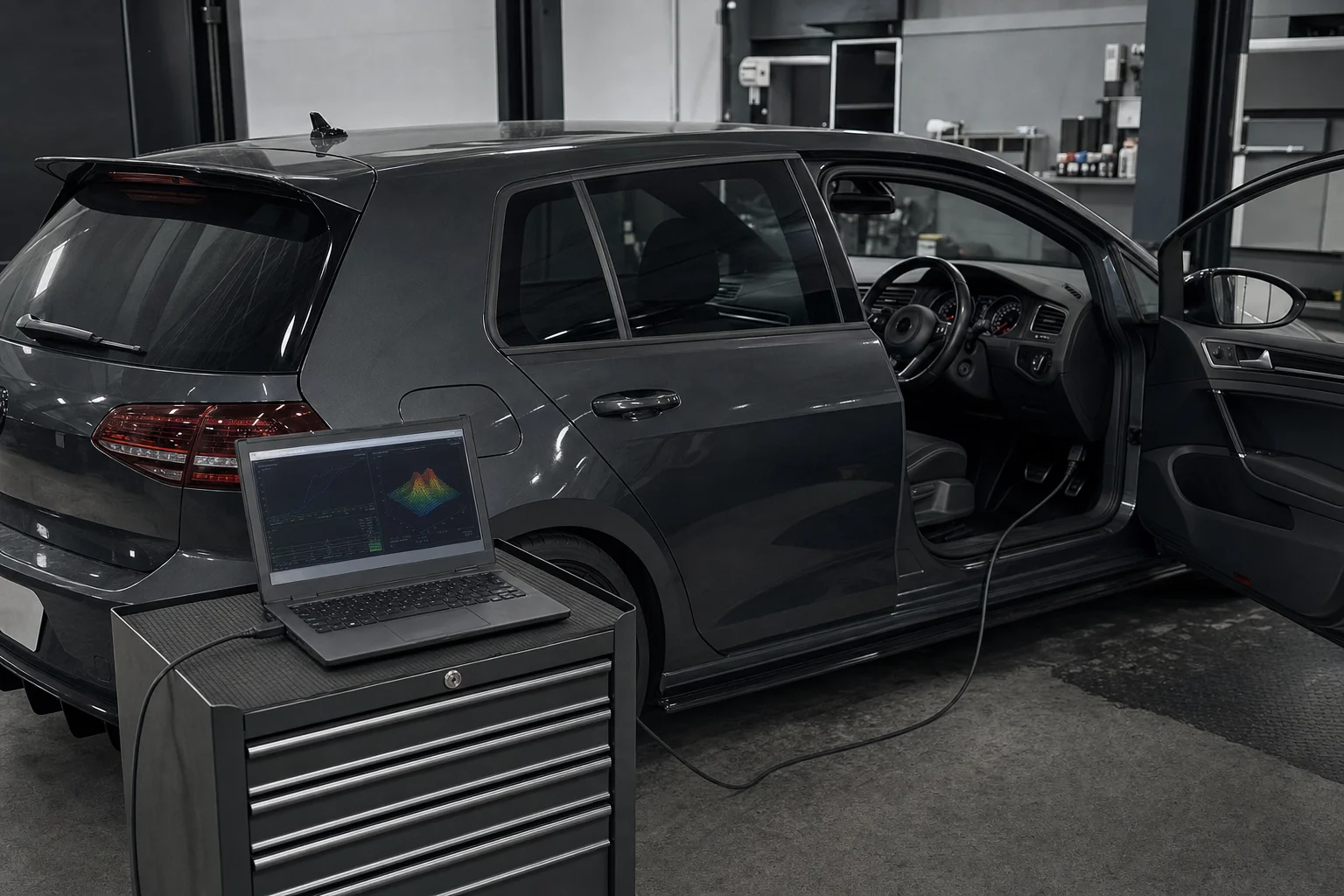
Generic maps are written once and sold to fit as many cars as possible — cheap, but they ignore your exact engine variant, mileage, modifications and condition. Custom-written remaps start from your factory file and are adjusted for your specific car. That is why Finish Line Remaps diagnostics first and never flashes off-the-shelf files.
The Short Answer
A generic remap file is a one-size-fits-all calibration — often labelled "2.0 TDI Stage 1" and flashed onto every car that vaguely matches. A custom-written remap reads your factory ECU software, adjusts parameters for your exact engine, fuel type, mileage and any modifications, then verifies the result.
The price difference between cheap generic flashes and professional custom tuning exists for a reason. Generic maps cut corners on diagnostics, backup and individual calibration. Custom maps include all three as standard at Finish Line Remaps.
How Generic Map Packs Work
Generic tuning files are created once — sometimes by competent engineers, often not — and sold repeatedly. The operator downloads the file, connects to your OBD port and flashes it with minimal or no health checking.
Because the map was never written for your car specifically, it cannot account for:
- Your exact engine variant and software version
- Mileage and wear on turbo, injectors and sensors
- Existing modifications — or lack of them
- UK fuel quality and driving conditions
- Active fault codes or borderline components
- Local terrain — hills, gradients and real-world load
That is why generic remaps are cheap. The tuner is not writing anything — they are reselling someone else's file and spending fifteen minutes on your driveway.
Our Knowledge Centre covers why to avoid generic remap files in more detail.
What Custom-Written Means at Finish Line Remaps
Every FLR calibration follows the same process:
- Diagnostic health check — fault codes, live data, suitability confirmed before any file is written
- Read and backup your factory file — full reversibility from day one
- Custom calibration — parameters adjusted for your engine, fuel type, mileage and hardware
- Write and verify — confirm the flash completed correctly, check for new fault codes
- Road verification — calibrations tested on real roads, including Pennine gradients from our Haslingden base
We never download a generic "Stage 1" pack and hope for the best. That is the FLR standard on every job — whether it is a Stage 1 remap from £150 or a more involved custom tuning project. Read what a Stage 1 remap actually does before you book.
Real-World Differences You Will Feel
Generic and custom maps can show similar peak numbers on a dyno. The difference shows up where you actually drive.
- Hill climbing — generic maps often hesitate on sustained inclines when fuelling and boost control were not calibrated for real load
- Part-throttle driving — custom maps feel smooth and predictable; generic maps can surge or flat-spot in everyday cruising
- Cold starts and warm-up — factory-emissions strategies interact with tuned maps; custom work respects these transitions
- DSG and auto boxes — increased torque exposes lazy shift logic; custom ECU work should consider TCU behaviour
- Smoke and limp mode — classic symptoms of generic fuelling on a car with worn injectors, a tired turbo or unresolved fault codes
Flat-land generic maps that feel fine on a straight motorway often fall apart the first time they meet a damp Pennine incline. We would rather find that on Grane Road before you do.
Red Flags of Generic Tuning
How to spot an operator likely using generic files:
- No diagnostic check before flashing
- Fixed price with no VRN confirmation or vehicle-specific questions
- Cannot explain what was changed in the calibration
- No backup of your original file offered
- Same quoted gains for every car on a platform regardless of mileage or condition
- Rushed appointment — in and out in fifteen minutes
For a full checklist on choosing a tuner, read our guide to choosing a remapper in Lancashire.
Can Generic Maps Ever Be Safe?
Occasionally, a decent generic file on a low-mileage, healthy car works without immediate problems. But "works" and "optimal" are different things. Even when nothing breaks, you are leaving performance, smoothness and safety margin on the table — and taking unnecessary risk if your car differs from the template.
The horror stories — smoked turbos, limp mode, failed MOT emissions — come from generic files on cars that were never suitable candidates. Diagnostics-first custom tuning eliminates most of that risk before a single parameter is changed.
Read more on real remapping risks and is remapping safe in our Knowledge Centre.
Why Custom Costs More — And What You Get
Custom-written remaps cost more because they take longer, require better equipment and involve genuine expertise. At FLR, Stage 1 still starts from £150 — we are not the cheapest, but we are not charging premium prices for generic work either.
What the extra value buys you:
- A file written for your car, not a database match
- Full factory backup and reversibility
- Diagnostic health check included
- Road-tested calibration on local terrain
- A technician who will answer the phone if something does not feel right
The FLR Difference
We are based in Haslingden and every map we write is shaken down on the roads our customers drive — not validated on a flat dyno run alone. That matters on Lancashire's gradients.
We are IMI qualified, we diagnostics first, we backup every file and we say no when a car is not ready. That is what custom-written means in practice — not a marketing label on the same generic file everyone else sells.
Ready to Book?
If you want a remap written for your car — not a random file from a folder — send your VRN or call 01706 404 357. Read more in our safety guide or explore the generic vs custom FAQ.
Custom vs Generic — Common Questions
Sometimes on a healthy, low-mileage car — but even then it is rarely optimal. Generic files cannot account for your exact variant, condition or modifications. The risk rises sharply on higher-mileage cars or platforms with known weak points. Custom-written calibration is the safer default. See is remapping safe.
If you did not receive a backup of your original file, the tuner could not explain what was changed, or the price seemed too good to include diagnostics — it may be generic. A reputable tuner will confirm custom-written work and show you the process. If in doubt, book diagnostics and ask us to assess the current calibration.
Yes — at FLR we save your factory file before writing anything. You can return to stock for dealer visits, warranty work or resale. Generic tuners often skip this step entirely.
Custom work includes diagnostics, individual calibration time, professional equipment and a backup of your original software. Cheap flashes resell pre-written files with minimal checking. At FLR, Stage 1 custom remaps start from £150 — see our cost guide for full context.
Yes — every standard FLR remap includes a full diagnostic health check before any file is written. Standalone diagnostics without remapping start from £40 if you only want a health check first.
Your VRN, mileage, fuel type and any modifications — intercooler, downpipe, intake and so on. That lets us confirm compatibility and write the right calibration first time. Request a quote with those details and we respond with a clear price and recommendation.