A Stage 1 remap is software-only tuning on stock hardware — no bolt-ons required. Typical gains on turbo engines: +15–30% power and +25–35% torque, felt most in low- and mid-range driving. At Finish Line Remaps, Stage 1 starts from £150 with diagnostics, a custom-written file and your original ECU backup archived for life. Best for healthy daily drivers who want stronger pull without modifying the car. Still deciding? Read is a Stage 1 remap worth it?
What Is a Stage 1 Remap?
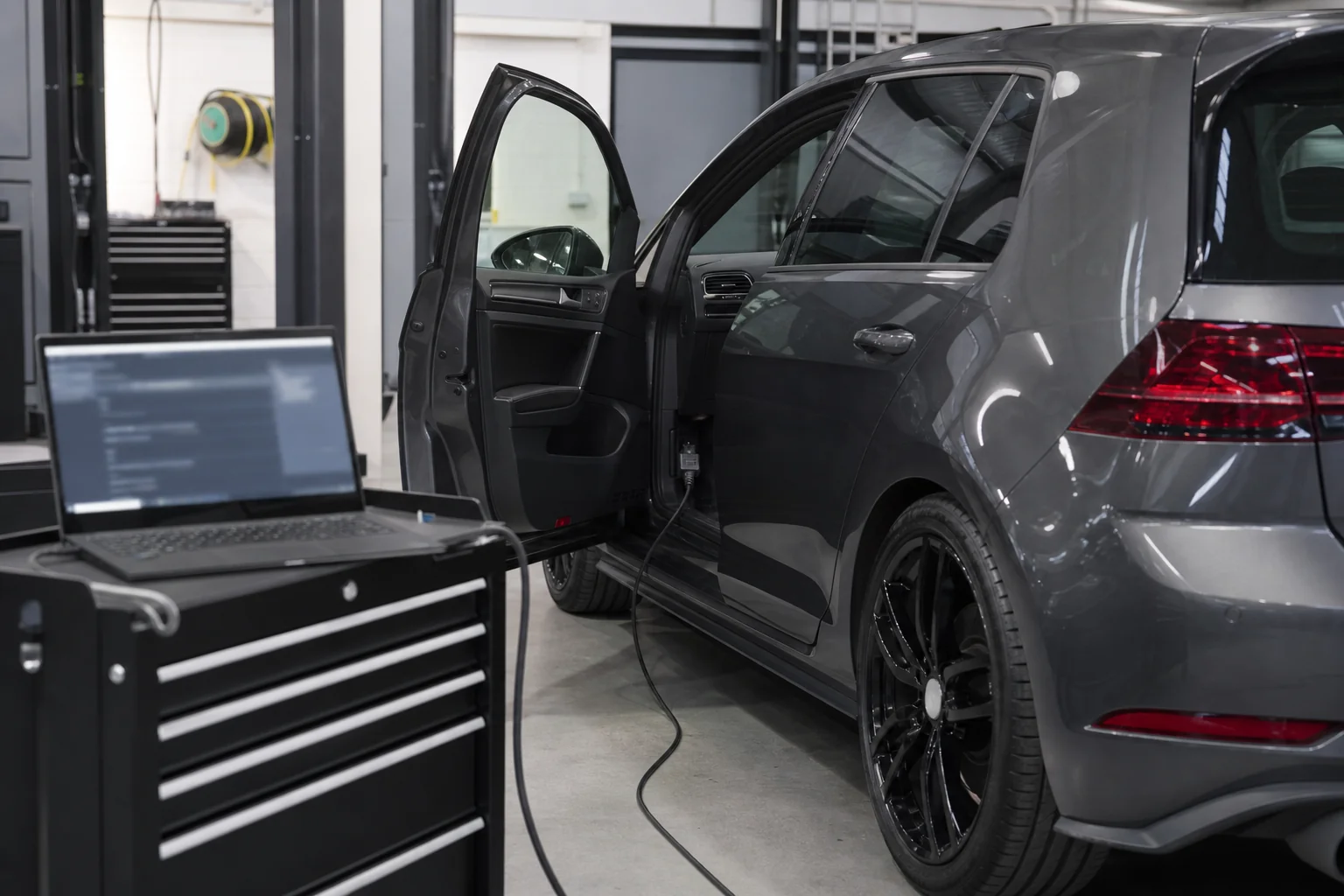
A Stage 1 remap is a software-only ECU calibration for a standard, unmodified vehicle. The tuner connects to your engine control unit, reads the factory file, adjusts the maps that govern boost pressure, fuelling, ignition or injection timing and torque delivery, then flashes the updated calibration back to the car. No exhaust swap, no intake kit, no intercooler upgrade — nothing physical changes on the car.
Manufacturers deliberately leave headroom in factory maps so one calibration can suit different fuel grades, climates and emissions targets worldwide. Stage 1 claims that margin back properly — within what your stock turbo, injectors, fuelling system and cooling can support on UK roads.
Remap stages describe the extent of work, not a mandatory ladder you must climb in order. Stage 1 is the sensible starting point for almost every daily driver on standard hardware. If you are comparing stages — Stage 1 vs Stage 2 hardware, or Stage 1 vs Stage 1+ — those are separate topics: see our Stage 1 vs Stage 2 guide and the Knowledge Centre on Stage 1 vs Stage 1+.
Ready to book? See our Stage 1 ECU remap from £150. For a shorter FAQ-style answer, read what Stage 1 remapping is in the Knowledge Centre.
What Actually Changes in Your ECU
Your ECU is not a single "power setting." It is a network of maps — tables that tell the engine how much boost to request, how much fuel to inject, when to fire the spark or start injection, and how much torque the gearbox and drivetrain are allowed to see at any given RPM and load.
On a Finish Line Stage 1 calibration, we typically adjust:
- Boost pressure targets — raised within the turbo's efficient operating range, not chased as a peak number
- Fuelling and lambda — rescaled to match increased airflow, keeping mixtures safe under full load
- Ignition or injection timing — optimised where knock margin (petrol) or burn efficiency (diesel) allows
- Torque limiters — recalibrated so the ECU stops fighting the engine's natural output
- Throttle mapping — sharper response without the lazy pedal feel many factory maps have below 2,000rpm
Crucially, every factory protection stays armed. Knock control, overboost cuts, temperature protection and limp-home logic remain exactly as the manufacturer designed them. That is the entire philosophy of Stage 1: use the engineering headroom, never the safety net.
One thing worth understanding before you book: headline peak BHP figures sell remaps, but usable mid-range torque is what you feel on a Lancashire A-road or motorway incline. A map that delivers a high peak for 300rpm but goes flat everywhere else is worse than a map with a wider, flatter torque curve — even if the peak number is lower. We calibrate for real-world pull, not dyno-sheet bragging rights. See the parameter breakdown on our Stage 1 service page.
Typical Stage 1 Gains — Petrol vs Diesel
Gains vary by engine code, turbo size and how conservative the factory map was — but these patterns hold across most cars we remap from our base in Haslingden:
| Engine type | Typical Stage 1 benefit | Best for |
|---|---|---|
| Turbo diesel (TDI, dCi, CDTi, HDi) | Large torque increase from low revs; possible MPG gain when driven calmly | Motorway miles, towing, loaded SUVs and vans |
| Turbo petrol (TSI, EcoBoost, T-GDI) | Stronger mid-range and top-end; sharper throttle response | Enthusiast daily drivers, hot hatches, turbo SUVs |
| Non-turbo petrol | Modest gains — mostly throttle feel and small timing improvements | Often poor return on investment; assess case-by-case |
Across turbocharged engines, expect roughly +15–30% power and +25–35% torque — but the torque increase is what transforms daily driving. Stronger pull from 1,500–2,500rpm means less gear-changing, easier overtakes and a car that feels lighter on its feet without you driving it harder.
For a deeper engine-type breakdown, read our petrol vs diesel remapping guide. Want model-specific numbers instead of ranges? Our VW Golf remap guide lists typical Stage 1 figures in bhp for every Mk7 to Mk8 engine — TSI, TDI, GTD, GTI and R.
Stage 1 vs Stage 2 vs Stage 3
Stages are industry shorthand for how far you are pushing the car — not a strict upgrade path. Here is how Finish Line Remaps defines each level:
| Stage | Hardware | Map type | Typical use |
|---|---|---|---|
| Stage 1 | Stock — none required | Software only | Daily drivers; best value |
| Stage 1+ | Stock | Enhanced software | Sharper daily performance without bolt-ons |
| Stage 2 | Intake, exhaust/downpipe, intercooler (typical) | Matched to mods | Enthusiast builds; hardware first |
| Stage 3 | Turbo, injectors, internals (varies) | Custom / dyno | High performance; fully bespoke |
Stage 2 is not "Stage 1 but more aggressive." It is a different category of tune written around hardware that improves airflow, exhaust flow and charge cooling beyond factory specification. Flashing Stage 2 software onto a car with stock hardware is how turbos get cooked and limp mode gets triggered — we will not do that.
Most owners asking about remap stages only need standard Stage 1 from £150. If you want more later, you can upgrade when you add hardware — your factory file stays backed up throughout. For stage comparisons, use our Stage 1 vs Stage 2 guide (hardware path) or Stage 1 vs Stage 1+ (sharper software on stock parts) — not this page.
Is a Stage 1 Remap Worth It for Daily Drivers?
For most healthy turbocharged daily drivers, yes. Stage 1 delivers the strongest real-world improvement per pound of any performance modification — and you keep the car completely stock from the outside.
The pros
- Stronger mid-range torque — easier overtakes, less planning on slip roads and motorway inclines
- Sharper throttle response — less lag below 2,000rpm on many turbo platforms
- No hardware costs — no intake, exhaust or intercooler to buy and fit
- Reversible — your original ECU file can be restored; the car returns to factory calibration
- Possible fuel savings on diesel — when you use the extra torque to hold higher gears at lower revs, not when you drive harder because the car feels sharper
The cons
- Insurance — a remap is a material modification in the UK; you should declare it
- Warranty — manufacturer goodwill on powertrain claims may be affected
- Clutch and gearbox load — more torque stresses worn clutches and tired gearboxes faster
- Fuel use — if you drive harder because the car feels better, you will use more fuel
- Quality varies — cheap generic files cause more problems than no remap at all
When to think twice
- DPF problems or frequent regens — fix the root cause first; a map is not a cure for a blocked filter
- Known mechanical faults — smoking, misfiring, boost leaks or slipping clutch
- Short-trip diesel use only — if the car never warms through, tuning will not fix soot or DPF troubles
- Full manufacturer warranty you rely on — understand the trade-off before flashing
Who benefits most
- Daily commuters — stronger pull in traffic, less gear-changing, easier junction exits
- Motorway drivers — safer half-throttle overtakes, calmer cruising at lower revs
- Towers and loaders — extra low-down torque for hills, caravans and horseboxes (see our towing guide)
- Track or autocross — Stage 1 alone may hit heat limits; consider Stage 2 with cooling upgrades instead
How Much Does a Stage 1 Remap Cost in the UK?
Nationally, a quality Stage 1 remap from a reputable UK tuner typically costs £250–£500 depending on the vehicle, ECU type and what's included in the appointment. Budget operators advertising £99 flashes often skip diagnostics, use generic downloaded files and do not save your original ECU backup — corners that matter when something goes wrong.
At Finish Line Remaps in Haslingden, Stage 1 starts from £150. That price includes:
- Full pre-tune diagnostic health check
- Original ECU file read and archived for life
- Custom calibration written for your exact engine code
- Post-flash live-data verification
- Road test and written spec sheet
We confirm your fixed quote from your registration before you book — no surprises on the day. For a full UK pricing breakdown including Stage 2, DSG bundles and economy remaps, read our remap cost guide.
Stage 1 Remap Risks — Warranty, Insurance, MOT and Clutch
A properly written Stage 1 on a healthy car is safe — but safe and consequence-free are different conversations. Here is the honest picture:
| Risk | What it means | How to reduce it |
|---|---|---|
| Warranty | Manufacturer may decline engine-related goodwill claims | Understand before booking; original file can be restored. See warranty guide |
| Insurance | Remap is a material modification in the UK | Declare to your insurer; get confirmation in writing. See insurance guide |
| Clutch / gearbox | More torque = more load on worn components | Diagnostics-first; fix known issues before tuning |
| MOT | Poor maps can increase smoke or emissions readings | Road-legal Stage 1 keeps factory emissions systems active. See MOT facts |
| Generic maps | Off-the-shelf files ignore your engine's condition | Custom-written, live-data verified — the FLR standard. See safety guide |
A road-legal Stage 1 leaves DPF, EGR and AdBlue systems fully active. Software that removes or defeats emissions monitoring is a separate illegal modification — not part of responsible Stage 1 tuning on a car you drive on UK roads.
What Happens When You Book Stage 1 at Finish Line Remaps
Every Stage 1 appointment follows the same diagnostics-first process — whether you come to our workshop in Haslingden or we come to you via mobile remapping across Lancashire and the North West.
- Contact and quote. Send your VRN and vehicle details. We confirm compatibility, explain options and provide a clear, no-obligation quote.
- Diagnostic health check. Before any remap begins, we scan for fault codes and review live data. If the car is not healthy enough to tune, we tell you — before any money changes hands.
- Custom calibration. We read your ECU, save the factory file permanently, and write a calibration built for your exact engine code, fuel type and any modifications on the car. Never a generic downloaded file.
- Verification and handover. Post-flash live-data check, road test on local Pennine roads, written spec sheet and aftercare advice. Most Stage 1 jobs take 1–2 hours including diagnostics.
We road-test calibrations on the roads we know — Grane Road, the A56, the long pulls through Rossendale. If a Stage 1 map feels smooth and strong here, it will feel right on your daily routes too.
Explore the full Stage 1 service page, read about our base in Haslingden, or request a quote with your registration. Call 01706 404 357 if you prefer to talk it through first.
Stage 1 Remap — Common Questions
A Stage 1 remap is a software-only ECU calibration on stock hardware. The tuner adjusts boost, fuelling, timing and torque maps within what your factory components can support. No physical modifications are required. At FLR, Stage 1 starts from £150.
For most healthy turbocharged daily drivers, yes — Stage 1 is the strongest value-per-pound performance upgrade available. You get noticeably stronger mid-range torque and sharper response without buying or fitting any hardware. It is less worthwhile on non-turbo petrols or cars with existing mechanical faults. Read the full decision guide: is a Stage 1 remap worth it?
Yes — when the car is healthy, the map is custom-written for your engine code, and factory protections like knock control and temperature limits stay active. Problems arise from skipping diagnostics or flashing generic files. Read our full guide on ECU remapping safety.
On typical turbocharged engines, expect roughly +15–30% power and +25–35% torque. Diesel gains are felt most from low revs; turbo petrol gains are strongest in the mid-range. Exact figures depend on your engine code — we confirm expected gains when quoting from your VRN.
Nationally, quality Stage 1 remaps typically cost £250–£500. At Finish Line Remaps, Stage 1 starts from £150 including diagnostics, custom file, backup and verification. See our full UK price guide for context.
It can affect manufacturer goodwill on powertrain-related claims because remapping is a modification — but it does not automatically cancel your entire warranty overnight. The impact depends on your car's age, your risk tolerance and whether you have a reversible backup. Read our warranty guide for the full picture.
Yes. In the UK, an ECU remap is a material modification and you are expected to declare it to your insurer. Failure to disclose can invalidate your policy. Some insurers add a small premium; others will not cover tuned vehicles. See our insurance guide.
Yes. We read and archive your original factory ECU file before flashing anything. The car can be returned to stock calibration at any point. Read more in our guide on remap reversibility.
Stage 1 is software-only on stock hardware. Stage 2 requires supporting modifications — typically intake, downpipe and upgraded intercooler — and a calibration written specifically for that hardware. Flashing Stage 2 software on a stock car is unsafe. Read our Stage 1 vs Stage 2 comparison.