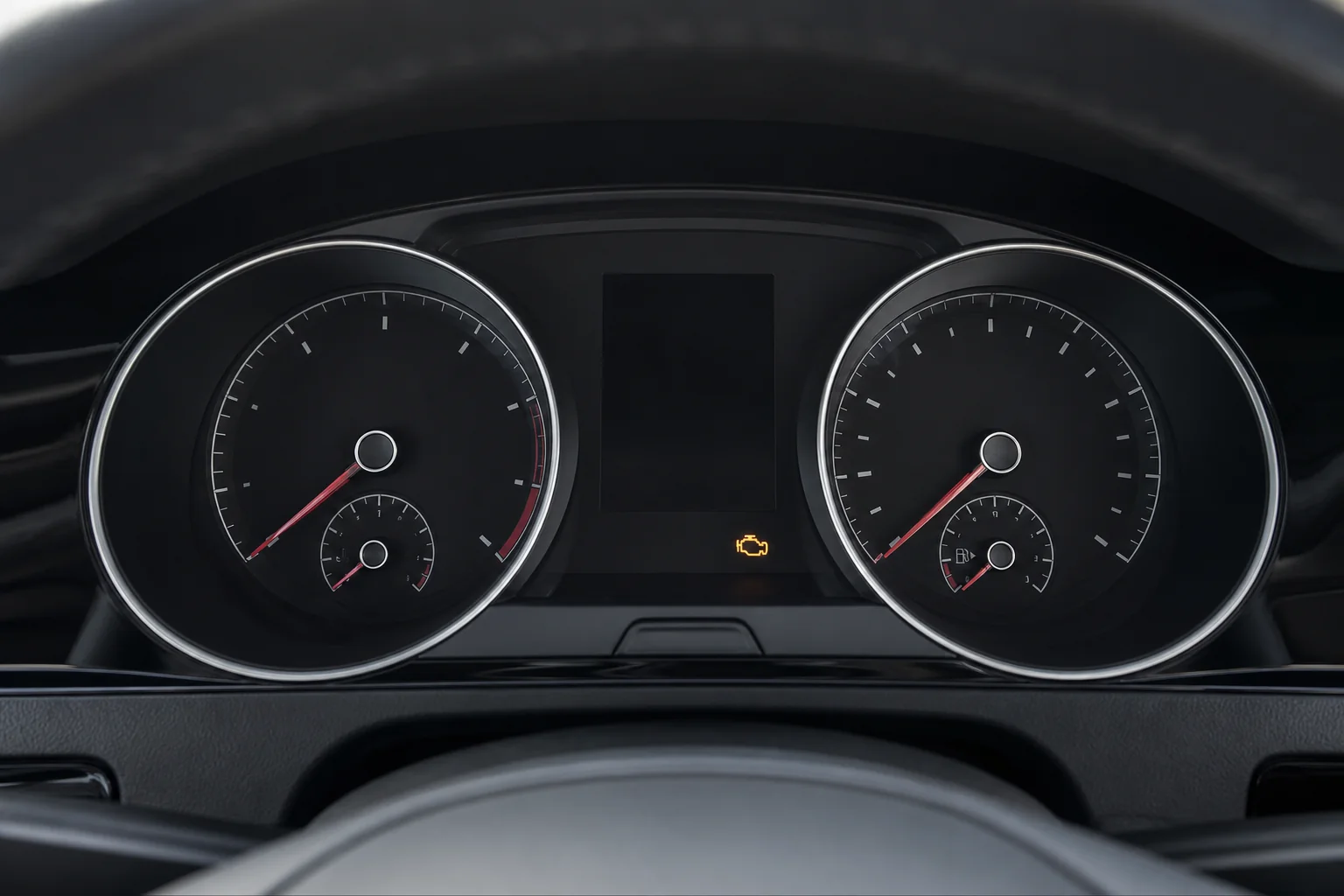
Limp mode means the ECU has found a fault serious enough to cut power in self-defence, and the stored fault codes tell you what it saw. The usual suspects: P0299 (underboost), P0234 (overboost), P2002/P2453 (DPF), P0401 (EGR flow), P0087 (fuel pressure), P0300 (misfires) and P20EE (SCR/AdBlue efficiency). Every one of them must be diagnosed and fixed before tuning — a remap raises the demands on exactly the systems these codes say are failing. Clearing the code is not fixing the fault. We diagnose with codes plus live data, from £40 standalone, and we do not flash unhealthy cars.
What Limp Mode Actually Is
Limp mode (reduced power mode) is a deliberate protection strategy. When the ECU detects readings outside safe limits — boost pressure it did not ask for, fuel pressure it cannot achieve, exhaust backpressure that should not exist — it caps power, often limits revs, and sometimes locks the gearbox in a single gear. The point is to let you limp home or to a workshop without the fault becoming a catastrophic failure.
Two things follow from that. First, limp mode is a symptom, never the disease — the disease is whatever tripped it, and the fault codes are the ECU's note about what that was. Second, a car that keeps entering limp mode is a car whose ECU is already fighting to protect the engine at factory power levels. Adding a remap raises the load on precisely the systems that are struggling. That is why "remap it to get rid of limp mode" is exactly backwards. For the fuller background on causes and what to do when it strikes, see our limp mode explained guide — this page focuses on the specific codes behind it.
P0299 — Turbo Underboost
Plain English: the ECU asked the turbo for a certain boost pressure and did not get it. The engine is making less boost than commanded, so power is down and the ECU suspects a leak or a lazy turbo.
Typical causes: split or popped-off boost hoses and leaking intercooler connections are the classic ones — cheap fixes when caught. Beyond those: a sticking turbo actuator or wastegate, seized variable-vane mechanism on VNT turbos, a failing boost pressure sensor, or in the worst case a genuinely worn turbo.
Why it must be fixed first: a remap asks the turbo for more boost. Writing that request into a system that cannot meet factory targets guarantees the code returns harder — and if the underlying cause is a tired turbo, extra demand finishes it. This is the single most common code we find on "it needs a remap" cars, and half the time the fix is a £20 hose clamp and an honest conversation.
P0234 — Turbo Overboost
Plain English: the opposite problem — boost pressure exceeded the maximum the ECU allows. Overboost spikes cylinder pressures and exhaust temperatures, which is why the ECU reacts to it aggressively, usually with immediate limp mode.
Typical causes: a sticking wastegate or VNT mechanism that will not open to dump pressure, a faulty boost control solenoid, a misreading boost sensor — or a previous bad tune commanding pressure the hardware was never meant to hold.
Why it must be fixed first: overboost is mechanically dangerous in a way underboost is not — uncontrolled pressure breaks pistons and head gaskets. No responsible tuner writes a file over an active overboost fault, because the boost control system demonstrably is not doing what it is told. Control first, calibration second.
P2002 & P2453 — DPF Efficiency and Pressure Sensor
Plain English: P2002 says the diesel particulate filter is no longer trapping soot efficiently — usually meaning it is loaded past the point of normal regeneration. P2453 points at the DPF differential pressure sensor, the component the ECU relies on to judge how full the filter is; when it misreads, regeneration logic falls apart.
Typical causes: for P2002, a filter overloaded by short-trip driving, failed regenerations, or an upstream fault (injectors, EGR) producing excess soot. For P2453, a failed sensor or blocked/split sensor hoses — a small part that causes outsized chaos, because the ECU regenerates too often, too rarely, or not at all based on its readings.
Why they must be fixed first: a remap changes fuelling and exhaust behaviour, and doing that on top of a compromised DPF system risks pushing the filter past recovery. The fix is legal DPF work — assessment, forced regeneration, sensor repair, root-cause diagnosis — never removal, which is illegal for UK road use and an automatic MOT failure. The honest full picture is in our DPF and remapping facts guide.
P0401 — EGR Insufficient Flow
Plain English: the ECU commanded the EGR valve to recirculate exhaust gas and measured less flow than expected. Something in the EGR path is restricted or not moving.
Typical causes: carbon build-up is the overwhelming favourite — the valve or its passages caked shut by years of soot and oil vapour, especially on short-trip diesels. Also: a failed valve motor or position sensor, or a blocked EGR cooler.
Why it must be fixed first: EGR affects combustion temperatures and emissions behaviour that the calibration assumes are working. A tune written over a carboned-up EGR circuit is a tune written for an engine that does not exist. The legal fix is cleaning, repair or replacement — EGR deletes, like DPF deletes, are not road-legal in the UK and we do not do them.
P0087 — Fuel Rail Pressure Too Low
Plain English: the fuel system cannot maintain the rail pressure the ECU is asking for. On a common-rail diesel that is a serious flag — injection depends on precise, very high pressure, and the ECU cuts power fast when it cannot hold it.
Typical causes: a failing high-pressure fuel pump, a leaking pressure regulator or control valve, worn injectors bleeding pressure back, a clogged fuel filter starving the pump, or a lazy low-pressure lift pump.
Why it must be fixed first: nearly every remap asks for more fuel at more pressure at more moments. Writing that demand into a fuel system that cannot hold factory pressure is asking a struggling pump to sprint. P0087 cars need fuel-system diagnosis and repair before tuning is even a conversation — no exceptions.
P0300 — Random or Multiple Misfires
Plain English: cylinders are failing to combust properly, and not in one predictable place — the ECU is seeing misfires scattered across the engine. Unburned fuel heads down the exhaust, which can destroy the catalytic converter, so the ECU treats persistent misfires seriously.
Typical causes: on petrols, worn spark plugs and failing coil packs top the list, followed by weak injectors, vacuum leaks, low fuel pressure and — the one nobody wants — low compression from mechanical wear.
Why it must be fixed first: a misfiring engine has a combustion problem, and remaps work by optimising combustion. More boost and more fuel through an engine that cannot burn cleanly amplifies the misfire and the damage it causes. Plugs and coils are cheap; a melted cat and a hammered engine are not. Fix the misfire, then talk tuning.
P20EE — SCR NOx Efficiency Below Threshold
Plain English: on diesels with AdBlue, the SCR system that converts NOx is not achieving the efficiency the ECU expects. Left unresolved, AdBlue-system faults escalate beyond limp mode — the car can refuse to restart once a countdown expires, by legal design.
Typical causes: a failed NOx sensor (very common and often the whole story), a faulty AdBlue injector or crystallised deposits around it, a failing AdBlue pump or heater, or genuinely degraded catalyst efficiency.
Why it must be fixed first: the emissions calibration a remap adjusts sits alongside the SCR logic — tuning over an active P20EE solves nothing and muddies later diagnosis. And to say it plainly: AdBlue delete or bypass is illegal for UK road use, exactly like DPF and EGR removal. The legal fix is diagnosing which component failed — usually cheaper than owners fear, since NOx sensors are the frequent culprit.
How We Diagnose — Codes Plus Live Data, Not Code-Clearing
A fault code is a starting point, not a diagnosis. P0299 tells you boost was low; it does not tell you whether the cause is a £20 hose or a £1,200 turbo. This is where cheap "plug in and clear it" diagnostics fail you — clearing a code does not fix a fault, it just deletes the note the ECU left about it. The fault trips again, usually at the worst moment, somewhere on the M65 in the outside lane.
At our Haslingden workshop, diagnostics — from £40 standalone — means reading the codes and watching live data while the engine works: commanded versus actual boost, fuel rail pressure under load, EGR flow, DPF differential pressure, misfire counters per cylinder. Live data shows the difference between a sensor lying and a component failing, which is the difference between a £60 fix and an unnecessary £600 one. Where the cause runs deeper, our fault-finding service takes it through to root cause — testing components, tracing wiring, proving the fix rather than guessing at it.
Then, and only then, does tuning enter the conversation. Every remap we write starts with this health check, a custom-written file for your exact engine code, and your factory ECU backup archived for life. Cars with active limp-mode codes get a diagnosis and a repair plan — not a flash. If you are unsure whether what you are feeling is a fault or just a flat factory calibration, our guide to the signs your car needs a remap helps you tell them apart.
When Not to Remap — The Simple Rule
If any of the codes on this page is active or recurring, the car is not ready for tuning. Full stop. That includes cars where the code "goes away for a few weeks" after clearing — intermittent faults are still faults, and boost leaks in particular love to hide until the engine is asked to work hard. It also includes cars with the warning light bulb mysteriously absent, which we see more often than you would hope on recently bought used cars.
The good news: most of these faults are neither exotic nor ruinous to fix. Hoses, sensors, coils, filters and cleaning account for a large share of the limp-mode cars we see. Fix the fault, prove the fix with live data, and the same car becomes a genuinely good tuning candidate — often the best kind, because you know its health in detail before the file is written.
Next Steps
If your car is in limp mode now, or codes keep returning after clearing, book a diagnostic session and get the real answer — send us your registration and symptoms or call 01706 404 357. We cover Haslingden, Rossendale and the wider Lancashire area from our workshop just off the A56. For quick answers on limp mode, fault codes and what happens during diagnostics, the Knowledge Centre is the place to start. And once the car has a clean bill of health — that is when a remap becomes worth talking about, not before.
Limp Mode Fault Codes — Common Questions
No. Limp mode is the ECU protecting the engine from an active fault, and a remap cannot repair that fault — it increases the demands on the failing system. The fault must be diagnosed and fixed first; only a healthy car should ever be tuned.
P0299 means turbo underboost — the ECU asked for boost pressure it did not receive. The most common causes are split boost hoses and leaking intercooler connections, followed by sticking actuators and, less often, a worn turbo. Live data testing separates the cheap fixes from the expensive ones.
P2002 means the diesel particulate filter is below efficiency — usually soot-loaded past normal regeneration. Removal is not an option: DPF deletes are illegal for UK road use and an automatic MOT failure. Legal fixes include forced regeneration, sensor repair and addressing the root cause of the soot build-up.
No — clearing a code only deletes the record of the fault, not the fault itself. If the underlying problem remains, the code returns, often accompanied by limp mode at an inconvenient moment. Diagnosis means finding out why the code set, not making it temporarily disappear.
Because a code tells you what went out of range, not why. Watching commanded versus actual values while the engine works — boost, rail pressure, EGR flow, misfire counters — shows whether a sensor is lying or a component is genuinely failing. That distinction is the difference between a small repair and an unnecessary big one.
Limp mode exists so you can get home or to a workshop safely at reduced power — it is not a mode to live with. Continuing to drive for weeks risks turning a contained fault into a bigger one, and some faults, such as AdBlue system errors, escalate to a no-restart condition by design.
Standalone diagnostics at Finish Line Remaps starts from £40, including a full code read and live data assessment with a plain-English explanation of what we find. Deeper root-cause investigation comes under our fault-finding service, quoted honestly before any work begins.
Yes — often it becomes an excellent candidate, because its health has been verified in detail. We re-check with live data after the repair, confirm the systems hold their targets, and only then write a custom file for your exact engine code, with your factory backup archived for life.