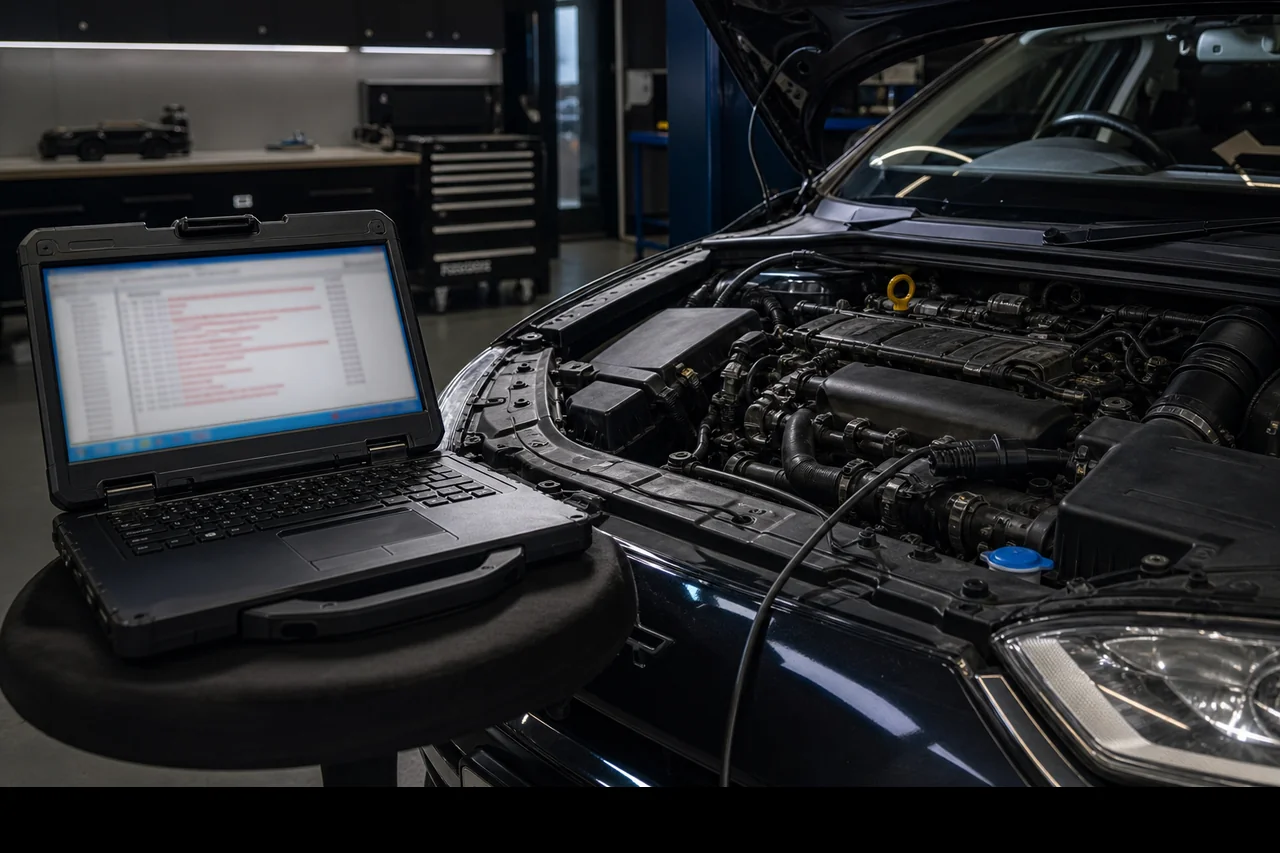
Signs a remap could help: flat mid-range power, heavy turbo lag, poor towing performance, DSG hesitation, high fuel use on diesels you drive gently, and factory-downrated engines that feel strangled. Signs you need diagnostics first: limp mode, smoke, warning lights, rough idle, falling MPG with no driving change, and any fault codes. FLR diagnostics from £40 standalone or included on remap bookings — we do not flash power onto unhealthy cars. Stage 1 from £150 when the car is fit.
The Short Answer
Your car might benefit from a remap if it feels slower than it should for the engine size — especially under load, uphill or when overtaking — and diagnostics confirm no underlying faults. Turbocharged petrol and diesel engines often leave factory performance headroom unused. A custom calibration unlocks torque and response the hardware already supports.
Your car needs diagnostics — not a remap — if warning lights are on, limp mode appears, smoke increases, idle is rough, or consumption has dropped suddenly without a driving-style change. Those symptoms point to mechanical or sensor problems remapping will not fix and may worsen.
At Finish Line Remaps in Haslingden, we health-check every vehicle before writing software. If faults are present, we diagnose first at £40 standalone or as part of a standard remap booking. Read is ECU remapping safe for why that order matters.
Performance Signs a Remap Could Help
These symptoms often mean factory calibration is conservative — not that your engine is failing. Remapping addresses software limitation when mechanical health checks pass.
- Sluggish overtakes — you floor it and wait for power that arrives too late for safe gaps
- Heavy turbo lag — long pause before boost builds, especially from low rpm
- Flat mid-range — power arrives in a narrow band then dies away unexpectedly
- Towing strain — caravan, trailer or loaded van feels underpowered on hills despite healthy mechanicals
- Factory-downrated feel — same engine as a higher-power model in the range but noticeably slower
- Throttle delay — pedal input does not translate to immediate response, especially on modern fly-by-wire systems
These complaints are the bread and butter of Stage 1 enquiries across Rossendale and Greater Manchester. Customers describe the same roads — Grane Road pulls, M66 on-ramps, long climbs out of Haslingden — where factory maps feel tame. A custom-written remap targets the behaviour you actually feel, not just peak BHP on a graph.
If you ticked several performance signs and your car has no warning lights or limp mode, a remap consultation is reasonable. Three or more ticks with a clean diagnostics scan is a strong indicator Stage 1 will transform daily driving — read is a Stage 1 remap worth it? for the honest daily-driver verdict, or our Stage 1 remap guide for the technical deep-dive. Zero ticks but you still feel something is wrong — diagnostics, not assumptions.
Keep a short note of when symptoms appear — cold start only, uphill only, full load only — and share that when you quote. Context helps us distinguish map limitation from mechanical wear before you book a slot. A symptom that appears only when towing is a different conversation from one that appears at every junction.
Drivability and Gearbox Signs
Not all remap motivation is peak power. Many FLR customers want the car to feel cohesive — especially on DSG and automatic gearboxes where factory shift logic can feel lazy once you have experienced sharper calibration.
DSG and auto hesitation
DSG hesitation under load — pauses before downshifts, slow upshifts when you want to maintain pace, clutch slip feel on tuned engines still on stock TCU logic — often improves with a TCU remap. Engine-only remaps increase torque faster than gearbox software expects. DSG tuning is from £150 standalone or from £275 bundled with Stage 1.
Economy without aggression
Diesels that consume heavily despite gentle driving sometimes benefit from economy-focused calibration — more low-down torque means less throttle to maintain speed. This is not a remap for every high-MPG complaint; sudden MPG drops need diagnostics first. But chronic "I never floor it yet fuel is poor" on a healthy diesel can be a remap conversation.
After hardware changes
Intercooler upgrades, downpipes, intake changes and hybrid turbos change what the ECU needs to know. If you added hardware and the car feels worse or throws codes, you need recalibration — not just the original factory map. That crosses into Stage 2 territory; send your mod list when quoting.
Post-service flatness
Some customers report the car feels flat after a major service — new air filter, dealer software update, emissions-related adaptations reset. Occasionally factory updates or adaptation resets change throttle feel. Diagnostics confirms whether behaviour is normal for a refreshed calibration state or whether a fault developed during service. Do not assume remap is the answer until the scan is clean.
When Symptoms Mean Something Else — Not a Remap
Booking a remap when the car needs repair wastes money and risks damage. These signs need diagnostics first — remapping comes later only if the car is healthy after repair.
- Limp mode or power loss — ECU actively limiting power due to detected faults
- Warning lights on dashboard — EML, DPF, glow plug, ABS — scan before any flash
- Increased smoke — especially black smoke under acceleration on diesels
- Rough idle or misfire feel — fuelling or ignition problems, not calibration limitation
- Sudden MPG drop — consumption fell recently without driving change; mechanical or sensor issue
- Strange noises — whining turbo, knocking, rattling — mechanical inspection first
- Overheating or high EGT — cooling system or turbo health problem
Customers sometimes describe limp mode as "it needs a remap." Limp mode is the ECU protecting itself. Flashing more power onto that state is how horror stories start. We scan, explain findings, and only proceed when the car is fit — see is ECU remapping safe for the full process.
Do not confuse wear with software limitation
A worn clutch slips under load — that feels like power loss but remapping makes it worse. Turbo bearing wear causes lazy boost — feels like lag but is mechanical. Injector imbalance causes rough running and smoke — not fixed by fuelling tables alone. Diagnostics separates "the map is conservative" from "a component is failing." That distinction saves customers from spending £150 on software when £400 of mechanical repair was the real need.
Diagnostics Before Remap — Non-Negotiable at FLR
Every FLR remap starts with professional diagnostics — fault codes, live data, turbo response, rail pressure on diesels, adaptation values. Standalone diagnostics is £40 if you want a health check without committing to a remap. Included on standard remap bookings when we proceed to calibration.
Diagnostics answers two questions: is remapping appropriate, and what calibration goal fits — Stage 1 performance, economy focus, DSG alignment, or defer until repair. That step takes 30–45 minutes on a typical car and prevents flashing onto hidden problems.
We turn work away when cars are not healthy enough. That protects your engine and our reputation on the roads we test on — not generic flat-land maps that fail the first damp incline out of Haslingden.
High-Mileage Owners — Extra Caution
High mileage does not disqualify a car from remapping. Many of our best Stage 1 results are 120,000–180,000-mile diesels with documented service history and healthy components. Mileage raises the importance of diagnostics, not the impossibility of remapping.
Borderline turbos, tired injectors and worn clutches show up on live data before they show up dramatically on the road. We explain when a mild economy map is appropriate versus when Stage 1 asks too much of tired hardware. Sometimes the answer is "service these injectors first, then remap in six months."
Generic file flashed onto a high-mileage car without health checks is how online horror stories happen. Custom-written calibration on a verified healthy car at 150,000 miles is routine FLR work across Lancashire.
When mileage means economy, not Stage 1
Not every high-mileage owner wants maximum torque. Some want smoother delivery and better fuel use on long commutes — economy-focused calibration on a healthy diesel can be the right tool. Others want full Stage 1 feel and accept that components must pass strict health checks first. We advise per car, not per forum consensus.
Fleet, Towing and Commercial Use
Vans, tow cars and fleet vehicles show remap need differently. A Transit that cannot maintain motorway pace with a full load is a commercial problem, not a weekend hobby. Builders and logistics firms across the North West book when drivers report constant downshifting on hills or inability to hold motorway speed without high rpm.
Tow car owners — caravans, horse boxes, trailer loads — often enquire after a summer trip where factory power felt dangerous on inclines. Stage 1 on a healthy diesel tow car transforms confidence without necessarily chasing peak BHP figures.
Fleet managers should diagnostics each vehicle individually. One van in a yard may need injectors; another may be a perfect remap candidate. Batch quoting without per-reg checks is how fleets get burned.
Seasonal towing and caravan season enquiries
Every spring we see a spike in tow car enquiries after owners take caravans or trailers on first trips of the year and realise factory power felt marginal on the M62 gradients. If the car is healthy and symptoms match performance limitation — not faults — Stage 1 transforms towing confidence. If the caravan season exposed smoke, overheating or limp mode, diagnostics identifies the mechanical cause before any map is discussed.
FLR's Verdict — Do You Need a Remap?
If you tick performance signs, have no active faults, and your turbocharged car feels strangled by factory calibration — a remap is likely worthwhile. Stage 1 from £150, DSG £150, ECU + DSG bundle £275, diagnostics £40 standalone.
If warning lights, limp mode, smoke or sudden MPG drops are present — book diagnostics first. We fix the diagnosis path before the sales path every time.
Describe your symptoms via contact, call 01706 404 357, or read custom vs generic remap to understand what quality calibration looks like. Based in Haslingden — mobile across Lancashire.
Signs You Need a Remap — Common Questions
Common signs include sluggish overtakes, heavy turbo lag, flat mid-range power, poor towing performance, DSG hesitation, high fuel use on gently driven diesels, and throttle delay. These suggest factory calibration is conservative — when diagnostics confirm the car is mechanically healthy.
No — limp mode means the ECU is limiting power due to detected faults. Book diagnostics first to find and fix the cause. Remapping a car in limp mode can worsen problems and waste your money.
Always diagnose first if warning lights are on, smoke has increased, idle is rough, or MPG dropped suddenly. FLR includes diagnostics on standard remap bookings — standalone diagnostics is £40 if you want a health check before deciding.
Often yes — when hesitation comes from lazy shift logic rather than mechanical clutch wear. A TCU remap (from £150 at FLR, or from from-£275 bundled with Stage 1) aligns gearbox behaviour with engine torque. Worn clutches need mechanical repair, not software alone.
Mileage alone does not disqualify a car — condition matters more. High-mileage diesels with healthy injectors, turbos and DPF systems remap well. We diagnostics thoroughly above 120k miles and advise repair first when components are borderline.
Not always. Sudden MPG drops need diagnostics — mechanical or sensor faults are the usual cause. Chronic poor economy on a healthy diesel you drive gently can sometimes improve with economy-focused calibration. Context determines the right path.
Diagnostics separates calibration limitation from mechanical problems. Live data, fault codes and turbo response tell the story. Do not assume a remap fixes sluggishness until a health scan confirms the car is fit for tuning.
Full health scan — fault codes, live data, turbo behaviour, rail pressure on diesels, gearbox adaptations. We save your factory file before writing anything. See is ECU remapping safe for our full safety process.