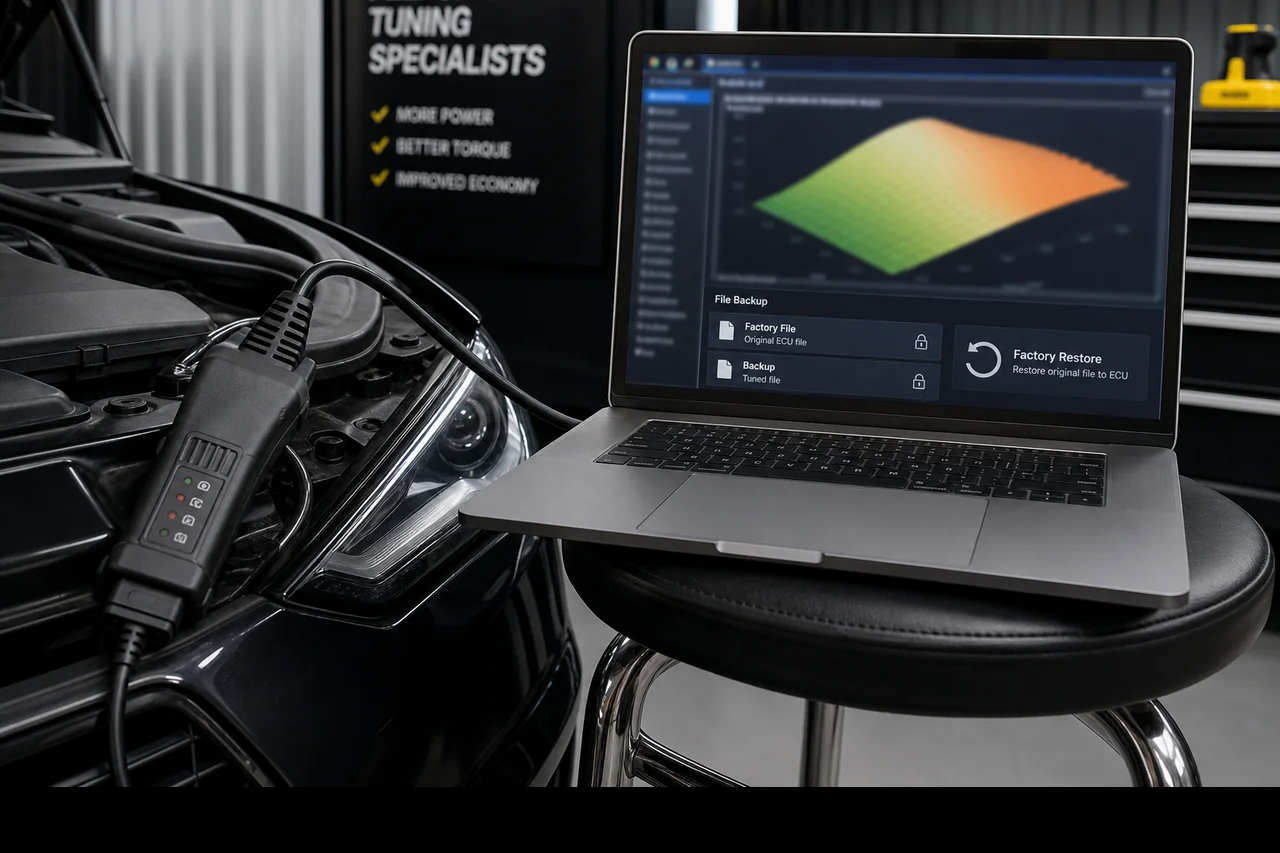
Yes — a remap can be reversed by reflashing your saved factory ECU file. Every Finish Line Remaps job starts with a full backup before any calibration is written. Reversal removes the active modified map from the ECU; it does not always erase every historical trace a main dealer might find on a deep forensic check. If your previous tuner skipped the backup, reversal may not be possible without sourcing a stock file from elsewhere.
The Short Answer
Can a remap be reversed? Yes — when your tuner read and saved your original factory ECU software before writing the modified calibration. Reversal means writing that stock file back to the ECU through the same OBD diagnostic port used for the original remap. The car returns to factory power, fuelling and torque limits as it left the production line — at least in terms of active software.
What reversal does not guarantee is complete invisibility. Some ECUs log software change events, adaptation values or diagnostic history that a main dealer may review on a large warranty claim or forensic assessment. Restoring stock removes the modified map running on the car today; it is not a guaranteed wipe of every digital footprint. For routine services, MOTs and many dealer visits, a proper stock restore is exactly what most owners need.
At Finish Line Remaps in Haslingden, backup-before-write is non-negotiable on every job — Stage 1 from £150, DSG from £150, or the ECU + DSG bundle from £275. If you are weighing remapping against future dealer visits or a sale, you deserve a tuner who gives you a real exit path, not a shrug when you ask this question six months later. See Stage 1 remap explained for how reversibility works on a typical booking.
How ECU Remap Reversal Actually Works
Understanding the mechanics helps you ask the right questions before anyone flashes your car — and spot red flags when a tuner is vague about backups.
Reading the factory file
Before any modified calibration is written, a professional tuner connects diagnostic and tuning equipment to your OBD port (or in some cases, directly to the ECU on the bench). The current software image is read from the ECU and saved as a file — your stock backup. That file is unique to your vehicle's hardware and software version. It is not a generic download from a forum; it is a snapshot of your car's factory calibration at that moment.
If the car was already modified when you bought it and nobody has a stock backup, reversal becomes harder. You may need to source a matching stock file from a database, a dealer flash, or a specialist who holds verified files for your ECU type. That is why we always recommend a diagnostics session — £40 standalone, included in every standard remap — before assuming you know what is already on the ECU.
Writing the modified map
Once the backup is secure, the tuner writes a custom calibration tailored to your engine, fuelling hardware and goals. Stage 1 work stays within factory component limits on a healthy car. The modified file replaces the active software on the ECU — but your original file remains stored separately with a responsible tuner.
Restoring stock
Reversal is the same process in reverse: connect, verify battery stability, and write the saved factory file back to the ECU. On most modern cars this takes roughly the same time as the original remap write — often 30 to 90 minutes depending on ECU type, security protocols and whether both engine ECU and TCU need restoring. At FLR we do not treat reversal as an afterthought; it is part of the standard service relationship.
TCU and DSG reversals
Gearbox remapping is separate software on the transmission control unit. If you had a DSG or TCU tune alongside engine work, both units need their respective stock backups restored for a full return to factory behaviour. Our bundle customers get both backed up and both can be reversed independently or together.
Why the Stock File Backup Matters
The entire reversibility question hinges on one step: did anyone save your factory file before writing?
Professional tuners treat the backup as sacred. Cheap mobile flashes, forum-purchased files and tuners who skip the read step leave you in a worse position. Without your original file, options narrow to:
- Sourcing a verified stock file for your exact ECU hardware and software ID — not always straightforward on newer locked ECUs
- Main dealer reflash — possible on some brands, expensive, and not always available for every model year
- Living with the modified map or paying for a custom reversion tune that approximates stock — not a true factory restore
We store your backup against your vehicle registration and job record. When you need stock restored — dealer visit, sale, or simply changed your mind — contact us with your VRN and we retrieve the file. That is standard on every FLR remap, not a paid optional extra bolted on later.
If you bought a used car and suspect it is remapped but have no documentation, book a diagnostics session first. We can assess whether tuning is present, check mechanical health, and discuss whether a stock file exists or needs to be sourced before you plan anything else.
What if nobody saved your stock file?
Used car buyers discover this situation more often than you might think. Previous owner remapped the car, sold it without documentation, and the new owner inherits a modified ECU with no backup and no idea who wrote it. Your options depend on the ECU: diagnostics to confirm tuning, verified stock file databases matched by hardware and software ID, main dealer reflash on some platforms, or specialist bench recovery for locked units. None of these are as clean as having your own backup from before the map was written. If you are buying used, ask the seller directly: was it remapped, by whom, and is there a stock file?
Will Reversing Hide the Remap From a Dealer?
This is the follow-up question almost everyone asks — and the honest answer matters more than a comforting yes.
Restoring your factory file removes the active modified calibration. For many routine dealer services — oil change, brake fluid, annual inspection — the car presents as stock software and nobody goes hunting. That is the practical reality for the majority of dealer visits our customers make after a restore.
On a large warranty claim — engine failure, turbo replacement, gearbox fault under manufacturer cover — assume deeper scrutiny. Dealers and manufacturers may review:
- Diagnostic event logs showing software write history
- Adaptation values that differ from expected factory baselines even after a stock flash
- Software version fingerprints compared against known stock identifiers
- Physical evidence of supporting modifications — intakes, exhausts, lowered suspension — that imply tuning history
- Specialist detection tools used by some franchises and assessors
Reversal is the right professional step before a dealer visit; it is not a guarantee against every form of detection on every claim. We would rather tell you that upfront than sell you a remap on a false promise of total invisibility. For the full warranty picture, read does remapping void your warranty? — reversal and warranty are closely linked topics.
When Should You Restore Stock?
Not every remapped car needs to go back to factory calibration — but certain situations make it the sensible move.
Before a main dealer service or recall
Routine services rarely involve deep software forensics. Many owners still prefer stock software on the ECU for peace of mind — especially if the car is under remaining manufacturer cover. Book the restore a few days before your dealer appointment so you are not rushing the day before.
Before selling privately or part-exchanging
Buyers expect factory behaviour unless tuning was advertised. Restoring stock avoids test drives where boost delivery surprises someone who expected standard power. You remain obliged to answer honestly if asked whether the car was ever remapped.
When warranty or finance inspection is imminent
PCP end-of-contract inspections and warranty assessments are situations where stock software reduces friction. Reversal does not replace disclosure where your contract requires it — but it removes the modified map from the ECU on the day of inspection.
When you simply want to go back
Tastes change. You might prefer factory smoothness after a year of extra torque, or you are passing the car to a family member who did not ask for a tune. Reversal is your prerogative — another reason the backup matters from day one.
When you probably do not need to
Independent garage services, MOT tests, tyre and brake work — none of these typically involve ECU forensic analysis. If your car is out of warranty, declared on insurance, and you are happy with the map, there is no routine reason to restore stock.
What Reversal Costs and How Long It Takes
At Finish Line Remaps, restoring stock for a customer whose map we wrote is handled as part of our ongoing service — contact us for current arrangements on your specific job. If another tuner mapped your car and you need help sourcing or writing a stock file, that is a separate diagnostics-led appointment.
Time on the day broadly mirrors the original write:
- Engine ECU only: typically 30 to 90 minutes including connection, verification and fault code check
- DSG / TCU only: similar window depending on gearbox control unit type
- ECU + TCU bundle restore: allow up to two hours for both units plus road verification
Battery stability matters during any write — we monitor voltage throughout. A weak battery should be addressed before reversal, just as before the original remap. If you are comparing the cost of reversal against the cost of remapping in the first place, remember that a tuner who includes lifetime backup and restore support offers meaningfully better long-term value than the cheapest flash on Facebook Marketplace.
Pricing for a new Stage 1 from £150 includes diagnostics, backup, custom write and verification. The DSG tune is £150 standalone or from-£275 bundled with engine work — all with the same backup-first philosophy.
FLR’s Backup-First Process
Every calibration we write follows the same sequence — reversal is built in from the first minute, not improvised later.
- Quote confirmed — VRN, engine code, existing mods and your goals documented
- Full diagnostic health check — fault codes, live data, baseline mechanical assessment
- Original ECU (and TCU if applicable) backup — saved before any modified file is written
- Custom-written calibration — never a generic off-the-shelf map
- Verification and handover — write confirmed, codes cleared, road check where appropriate
That backup file is your reversibility insurance. Tuners who jump straight to writing without reading first — or who use slave tools without saving your original — create problems that surface exactly when you need stock back: dealer visit Monday, buyer viewing Wednesday, finance inspection Friday.
We serve drivers across Haslingden, Rossendale, Hyndburn and the wider North West from our BB4 base, with mobile appointments available across Lancashire. Same process at your driveway or our workshop — backup always comes first.
So — Can a Remap Be Reversed?
Can a remap be reversed? Yes — reliably and safely when your tuner saved your factory ECU software before writing anything. That single step separates professional remapping from a gamble you cannot undo. Restoring stock removes the active modified map and returns factory calibration to the ECU; it helps before dealer visits and sales but does not guarantee invisibility on every forensic check.
Before you book any remap — with us or anyone else — ask one question: will you save my original file before you write? If the answer is vague, walk away. The map is not the only thing you are buying; you are buying reversibility, documentation and a tuner who will still answer the phone when you need stock back.
Questions about your reg and situation? Request a quote, call 01706 404 357, or read the reversibility FAQ in our Knowledge Centre.
Remap Reversal — Common Questions
Most can — if the original factory file was saved before the modified map was written. Without that backup, reversal depends on sourcing a verified matching stock file for your ECU type, which is not always straightforward on newer locked control units.
Yes. Backup before write is standard on every FLR remap — engine ECU, DSG TCU, or both on bundle jobs. Your factory file is stored against your vehicle record for future restore requests.
It removes the active modified calibration, which is sufficient for most routine services. On large warranty claims, dealers may still find historical traces through logs or specialist tools. Reversal is the right step — not a guaranteed invisibility cloak.
Typically 30 to 90 minutes for an engine ECU restore, similar to the original write time. ECU plus TCU restores may take up to two hours including verification on both units.
Many sellers do — it avoids surprising buyers with modified behaviour during test drives. You should still answer honestly if asked whether the car was ever remapped, even after restoring factory software.
Yes. The TCU gearbox control unit is flashed separately and needs its own stock backup. FLR saves both files on bundle jobs and can restore engine and gearbox software independently or together.
Book a diagnostics session. We check for signs of existing tuning, fault codes and mechanical health. If it is remapped with no backup, we discuss options to source or restore stock before you commit to anything else.
No. Insurance is about modification history and risk — not just current ECU state. If your insurer asks about past tuning, declare honestly. See our insurance guide for the full UK picture.