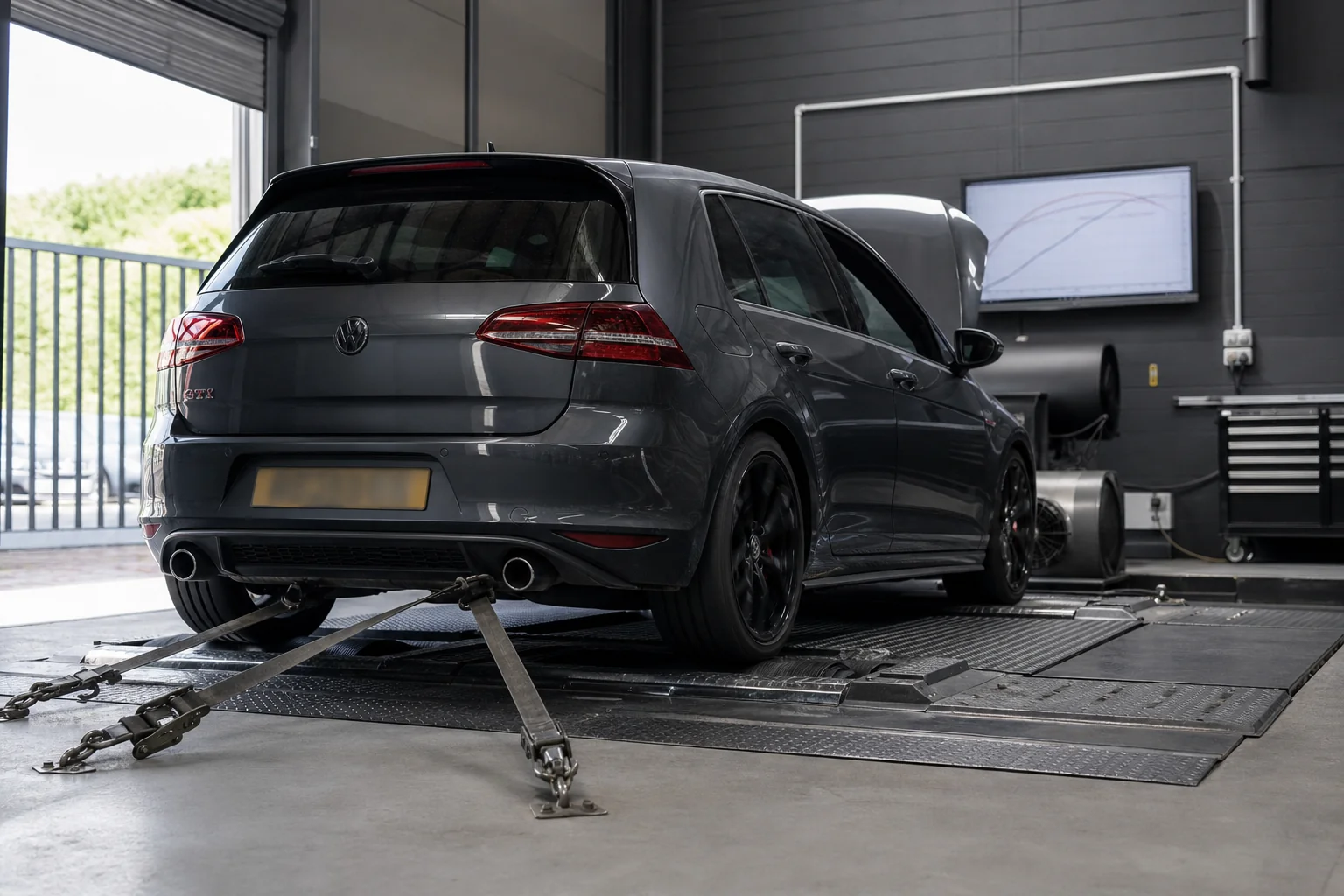
Dyno remap vs road remap: neither is automatically better. A dyno measures output under controlled load; road tuning verifies real-world drivability with live datalogging. A great tuner produces a safe, strong map either way — a poor tuner produces a bad one on the best dyno in the country. At FLR we custom-write every file, verify it with live data, and road-test on Lancashire gradients. Stage 1 from £150 with diagnostics included, factory backup kept for life, fully reversible.
The Short Answer
Neither method is inherently superior. A dyno is a measuring tool; a road session is a verification environment. The map — the actual calibration written into your ECU — is the same kind of file whichever way it is checked. What matters is whether that file was custom-written for your engine code and verified with live data, or downloaded generic and flashed blind.
We say this as a workshop that road-tunes with full datalogging and refers customers to rolling roads when a job genuinely needs one. There is no commercial reason for us to pretend one method is magic. If anything, the "dyno = always better" claim is mostly marketing — and we will explain exactly why below.
If you are still getting your head around what a remap actually changes, start with our Stage 1 remap explained guide and come back — this article assumes you know the basics.
What a Dyno Actually Verifies
A dynamometer — rolling road, hub dyno or engine dyno — applies a controlled, repeatable load to the drivetrain and measures the output. Done properly, that gives you:
- Load-cell measurement — actual torque figures under steady, sustained load rather than estimates
- Before/after power curves — a baseline run and a post-map run on the same machine, same day, same conditions
- Steady-state tuning cells — the ability to hold the engine at a fixed rpm and load while adjusting fuelling or timing
- Full-throttle safety in a controlled space — sustained wide-open-throttle pulls without traffic, cameras or speed limits
- A printed graph — genuinely useful evidence for big custom builds where power delivery shape matters
For heavily modified cars — hybrid turbos, big injectors, Stage 3 builds — that controlled environment is close to essential. When we take on that level of custom tuning work, dyno time is part of the conversation.
But note what a dyno does not verify: how the car drives. Strapped to rollers, there is no headwind, no gradient, no gearchange under real load, no part-throttle tip-in on a damp roundabout. A dyno cell in still air at a fixed fan speed is not the A56 on a wet Tuesday.
What Road Tuning Actually Verifies
Road tuning means flashing the calibration, then driving the car through real conditions while datalogging live sensor values — boost pressure against target, fuel trims, air-fuel ratio, exhaust gas temperature, timing corrections and knock activity. What it verifies:
- Real-world load — genuine gradients, real gear ratios, actual vehicle weight, true airflow at speed
- Drivability — throttle tip-in, part-throttle behaviour, overtaking response, how the car pulls from low rpm in a high gear
- Hill performance — sustained load climbing, which is where weak calibrations show up first
- Heat soak in traffic — how the map behaves after ten minutes of stop-start, not just on a cold pull
- Transient response — the messy real transitions between load states that a steady-state dyno cell never exercises
Around our Haslingden base we are spoilt for test roads: the long climbs out of Rossendale, Grane Road's sustained gradient, motorway merges on the M65 and M66. If a calibration holds boost cleanly, keeps fuel trims tight and stays knock-free on those pulls, it will behave on your commute — because it was proven on roads like yours, not in a sealed room.
Dyno vs Road — Side by Side
| Factor | Dyno tuning | Road tuning |
|---|---|---|
| Measures peak output | Yes — load-cell accurate | Estimated from logs, not measured |
| Verifies drivability | Limited — no real transitions | Yes — real roads, real load |
| Real airflow & cooling | Fan-simulated | Genuine at-speed airflow |
| Safety monitoring | Live data in a controlled cell | Live data on the move |
| Typical extra cost | Dyno hire adds to the bill | Included in the job |
| Best suited to | Big custom builds, evidence runs | Stage 1 and daily-driver calibration |
Notice the pattern: the dyno wins on measurement, the road wins on realism. For a sensible Stage 1 on a healthy car, realism is what you live with every day.
Why the File Matters More Than the Method
Here is the part the "dyno vs road" argument always skips. The calibration file is written before either test happens. A tuner who starts from a generic downloaded map and flashes it untouched has not tuned your car — whether they then strap it to rollers or drive it round the block makes little difference to a file that was never written for your engine's condition in the first place.
The things that actually decide whether your remap is safe and strong:
- Custom-written calibration for your exact engine code, fuel quality and hardware — not a one-size file
- Diagnostics before the flash — fault codes and live data checked so problems are found before power is added
- Factory protections left active — knock control, temperature limits and limp-home logic untouched
- Verification after the flash — logged data reviewed against targets, on a dyno or on the road
- A permanent factory backup — so the car can always go back to stock
We cover this distinction in depth in custom vs generic remapping — it is the single biggest quality question in this industry, and it has nothing to do with rollers.
The Marketing Myths, Called Out
A few claims you will hear, and the honest response to each:
- "Dyno tuning is always safer." Safety comes from live-data monitoring and conservative calibration — both available on the road. An aggressive file is dangerous on rollers and tarmac alike.
- "A road tune is just a guess." Not with datalogging. Modern logging captures the same sensor channels a dyno operator watches — boost, lambda, timing, knock — at real load.
- "You need a dyno graph to prove gains." A graph proves output on that machine, that day. Dyno figures vary meaningfully between machines and correction settings, which is why the same car can "make" different numbers at two shops in the same week.
- "Mobile tuners can't do it properly." The laptop, the tools and the file are identical. Method quality is about process, not premises.
None of this is anti-dyno — we rate a good rolling road session for the right job. It is anti-nonsense. If a tuner's main argument is the equipment rather than the calibration process, ask more questions. Our guide on whether ECU remapping is safe lists the questions worth asking.
When a Dyno Genuinely Earns Its Keep
To be fair to the rollers, there are jobs where we would want dyno time:
- Stage 2/3 and hardware-changed builds — new turbo, injectors or fuel pump where the safe operating window has moved and steady-state mapping cells help
- Before/after evidence — when an owner specifically wants a measured baseline and result on the same machine
- Diagnosing a down-on-power complaint — a controlled load run can separate calibration issues from mechanical ones
- Cars that cannot be safely loaded on the road — very high-power builds where full-throttle pulls at legal road speeds simply do not load the engine enough
For a standard Stage 1 on a healthy daily driver, though, dyno time mostly adds cost and theatre. The national average for a quality remap sits around £250–£500; at FLR, Stage 1 starts from £150 with diagnostics included — and the money you are not spending on dyno hire is going into the bit that matters, which is the file.
How We Verify a Map at Finish Line Remaps
Every remap we do — workshop or mobile — follows the same discipline:
- Diagnostics first. Full fault-code scan and live-data health check before anything is flashed. Unhealthy cars get diagnosed, not tuned.
- Factory file read and archived. Your original calibration is backed up and kept for life — the remap is fully reversible.
- Custom-written file. Calibrated for your exact engine code, never a generic download.
- Live-data road verification. Logged pulls on real Lancashire gradients — Grane Road climbs, M66 merges, sustained load out of Rossendale — checking boost against target, fuel trims and knock activity.
- Honest handover. We talk you through what was changed, what we logged, and remind you to declare the remap to your insurer — that is a legal expectation in the UK, not optional.
Expected gains are quoted as typical ranges for your engine, never as a promised BHP figure — any tuner promising an exact number before seeing your car is guessing.
Common Misconceptions
Three quick corrections that come up in almost every conversation on this topic:
- "Dyno figures are absolute." They are not. Correction factors, strapping tension, tyre pressures and ambient conditions all move the number. Treat dyno figures as comparative, not gospel.
- "Road tuning means thrashing the car on public roads." Proper road verification uses normal, legal driving with logging — sustained gradient pulls at sensible speeds tell us more than heroics.
- "The method changes what is legal." It does not. DPF, EGR or AdBlue removal is illegal for UK road use however the car is tuned, and no verification method changes that. We do not offer illegal deletes on any platform.
More basics answered in our Knowledge Centre if you want the wider picture.
Which Should You Choose?
| Your situation | Sensible choice |
|---|---|
| Healthy daily driver wanting Stage 1 | Road-verified custom remap — realistic, thorough, no dyno-hire premium |
| Modified build with hardware changes | Custom tuning with dyno time where the job warrants it |
| You specifically want a measured graph | Book dyno runs — just make sure the file behind them is custom-written |
| Tuner leads with equipment, not process | Keep shopping — ask about diagnostics, backups and file origin first |
Whichever way you go, the questions to ask are the same: Is the file custom-written? Is there a diagnostic check first? Is my factory file backed up? Is the result verified with live data? Get four yeses and the dyno-vs-road debate mostly evaporates.
Next Steps
If you want a remap that has been proven on the same hills you drive every day, send us your registration. We will confirm what your engine typically gains, quote a fixed price, and book you in at our Haslingden workshop or mobile across Lancashire and the North West. Request a quote or call 01706 404 357 — and if you are weighing up whether tuning is right for your car at all, is ECU remapping safe? is the honest place to start.
Dyno Remap vs Road Remap — Common Questions
Not automatically. A dyno measures output under controlled load; road tuning verifies real-world drivability with live datalogging. Both produce excellent results when the file is custom-written and properly verified — and poor results when it is not. The quality of the calibration matters far more than the method.
A dyno applies a controlled load through a load cell and measures torque, from which power is calculated. It produces repeatable before/after curves on the same machine — useful evidence, though figures vary between different dynos and correction settings, so treat them as comparative rather than absolute.
Through live datalogging while driving: boost pressure against target, fuel trims, air-fuel ratio, timing corrections and knock activity are all recorded under real load — gradients, motorway merges, sustained climbs. These are the same sensor channels a dyno operator watches, captured in genuine conditions.
Yes — proper road verification uses normal, legal driving with logging equipment. Sustained gradient pulls at sensible speeds load the engine well within legal limits. It does not involve racing around; the data does the work, not the speedometer.
Mainly for heavily modified builds — upgraded turbos, injectors or fuel systems — where steady-state mapping cells and controlled full-load pulls genuinely help, or when an owner wants measured before/after evidence. For a standard Stage 1 on a healthy car, road verification with live data is thorough and realistic.
Usually, because there is no dyno-hire fee added to the job. Nationally a quality remap averages £250–£500; at Finish Line Remaps Stage 1 starts from £150 including diagnostics, a custom-written file, a permanent factory backup and road verification.
Be wary of anyone promising exact figures before seeing your car. A dyno gives a measured number for that machine on that day; road tuning gives logged data rather than a headline figure. We quote typical gain ranges for your engine code and verify the calibration behaves safely — that is the honest approach.
Yes. A remap is a material modification in the UK regardless of how it was verified, and you are expected to declare it to your insurer. Undeclared tuning can invalidate your policy entirely.