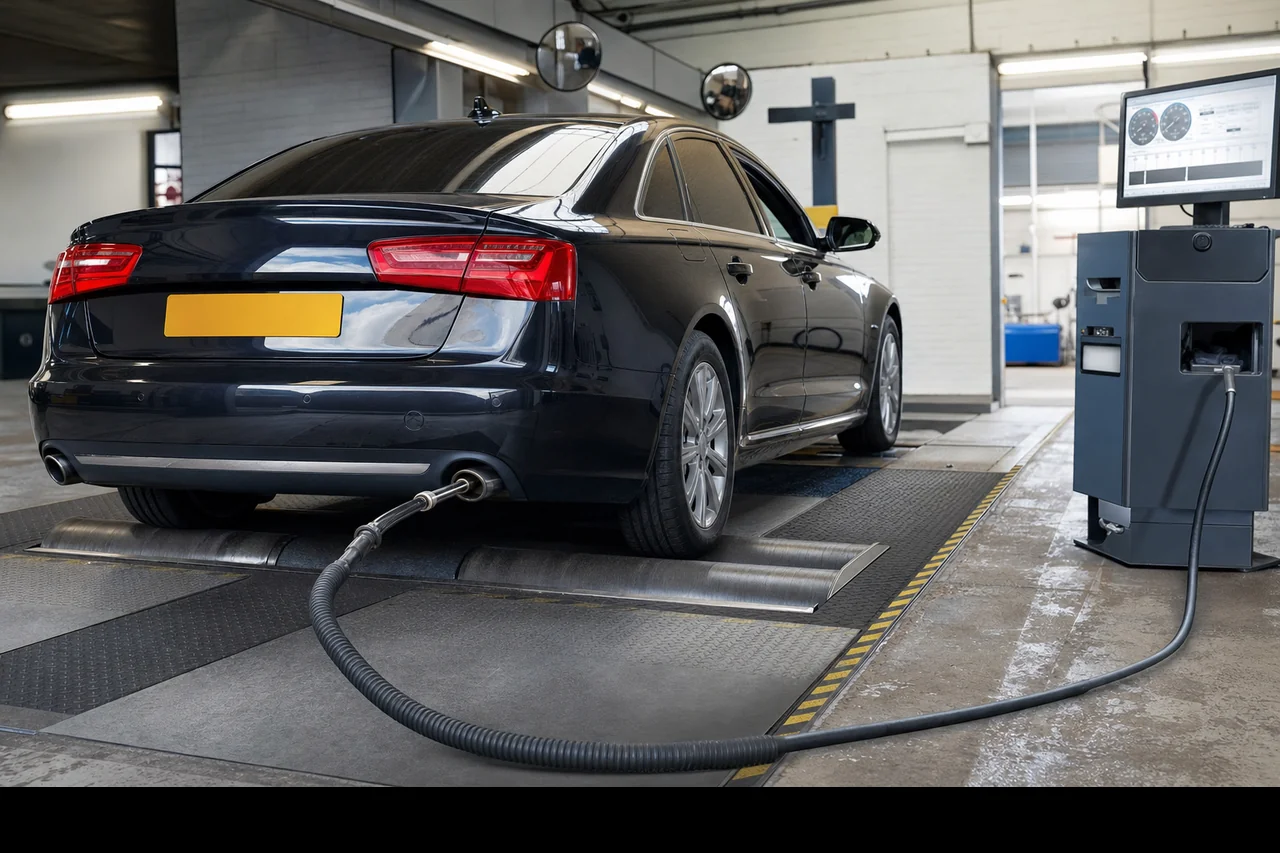
MOT testers check emissions limits, visual smoke, DPF presence and dashboard warning lights — not whether your ECU file was modified. A custom road remap on a mechanically sound car should pass the same as it would factory. Failures linked to tuning usually involve excessive smoke, removed DPF/EGR hardware, EML illuminated or pre-existing faults exposed by added power. We diagnostics first and tune for road use — we do not offer illegal emissions deletes for UK road vehicles.
The Short Answer
Will remapping affect my MOT? A well-written road calibration should not cause a failure on its own. The MOT does not scan for ECU tuning software — it checks whether the car meets emissions standards, passes the diesel smoke test, has required emissions equipment fitted and carries no relevant warning lights.
Where remapping and MOT collide is behaviour, not software labels. A bad map can produce visible smoke. A healthy car with a deleted DPF will fail regardless of map quality. An engine management light on the dashboard is an automatic fail — and tuning can expose underlying issues that were borderline before.
At Finish Line Remaps in Haslingden, we tune for UK road use and flag emissions concerns during diagnostics from £40. We will not remap a car we believe is unfit, and we do not perform illegal DPF or EGR deletes on road-going vehicles. Road-legal Stage 1 keeps factory emissions systems active — see our Stage 1 remap guide for how that works.
What the MOT Actually Checks
Understanding the test removes a lot of forum panic. The annual MOT — governed by DVSA MOT testing standards — is a roadworthiness and emissions compliance check, not a tuning audit.
Emissions testing
Petrol and diesel vehicles undergo tailpipe emissions checks against limits that depend on vehicle age and fuel type. Diesel cars also face a visual smoke assessment — excessive black or blue smoke during acceleration is a fail. The tester is measuring output, not interrogating ECU file versions.
Exhaust and emissions equipment
Testers visually inspect that required emissions components are present and appear standard — including diesel particulate filters on vehicles that were factory-equipped. Removed, gutted or bypassed DPF hardware is an MOT failure on road vehicles. The same applies to clearly deleted EGR systems where the equipment should be fitted.
Dashboard warning lights
An illuminated engine management light (EML/MIL), ABS, SRS or other mandated warning lamps fail the test. If remapping triggers new fault codes or illuminates the EML, that fails — but so would any unresolved fault on a stock car.
What is not checked
Standard MOT procedures do not include ECU readouts for tuning detection, rolling-road power verification or insurance modification status. Dealers may dig deeper during warranty work; MOT stations generally do not.
Remapping and Emissions — How They Interact
Factory ECU calibrations balance power, economy, emissions and component protection. A road-focused remap adjusts fuelling, boost and torque within limits that respect those constraints — not a free-for-all smoke map.
Well-written Stage 1 calibrations on healthy turbo diesels and petrols typically remain within MOT emissions windows because the car still uses its DPF, cats, EGR and sensors as designed. The ECU still monitors lambda, rail pressure and DPF soot load — we change targets, not delete the monitoring.
Problems appear when:
- Maps are poorly written — excessive fuelling causes visible smoke on diesel smoke test
- Hardware is already failing — tired injectors, cracked DPF, blocked EGR pass factory limits barely; added load pushes them over
- Emissions equipment was illegally removed — no map fixes missing DPF on an MOT test
- Tuning boxes crude-override fuelling — rail pressure spikes produce smoke unrelated to proper ECU calibration
That is why we diagnostics first on every job. If your DPF is overloaded or EGR is sticky, we tell you before flashing power — not after your MOT station sends you away with a fail sheet.
Petrol vs Diesel — Different MOT Emissions Rules
Petrol and diesel vehicles face different MOT emissions checks — and remapping interacts with each differently.
Diesel smoke and opacity
Diesel MOT includes a visual smoke assessment during acceleration. Excessive black smoke is an immediate fail — regardless of whether tailpipe ppm readings pass. This is where crude tuning hurts most: a map or box that over-fuels under load creates visible smoke even when the car feels fine at cruise. Proper road calibration avoids that on healthy injectors.
Petrol lambda and cat efficiency
Petrol vehicles are tested against lambda and cat efficiency limits for their age. A Stage 1 petrol remap on a car with a healthy catalytic converter typically stays within limits because fuelling remains within closed-loop control. Failing cats, lambda sensor faults or exhaust leaks fail MOT whether you are remapped or stock — but added load can push a borderline cat over the edge sooner.
DPF-specific diesel checks
Diesel cars factory-fitted with a DPF must have the filter present and not obviously modified. A car with DPF delete software and hollowed hardware fails on inspection alone — before any smoke test result matters. If your DPF warning light has been on for months, fix that before MOT or remapping; the test will not pass with an active emissions fault.
DPF, EGR and the Law — Road vs Off-Road
This section matters because DPF and EGR come up in every remapping and MOT conversation — and the legal line is clear for UK road vehicles.
UK road vehicles
Removing, bypassing or gutting a DPF or EGR system on a vehicle used on public roads is illegal under construction and use regulations. It will fail MOT where the equipment is required. It creates insurance and liability problems beyond the test itself. Finish Line Remaps does not offer DPF delete or EGR delete services for UK road-going vehicles.
What we do offer legally
For road cars, we provide DPF diagnostics, forced regeneration support and cleaning to restore filter function where possible — addressing the fault, not deleting the hardware. Diagnostics identify whether your DPF issue is soot loading, sensor failure or underlying engine problems causing excessive regeneration cycles.
Off-road, motorsport and export
Off-road software solutions for motorsport, agricultural or export vehicles where UK road MOT rules do not apply are a separate conversation with different legal frameworks. We scope those jobs individually — they are not blanket offers on road dailies in Lancashire.
If a tuner offers you a "DPF off" map for your daily commute on the M66, that is not a grey area — it is illegal for road use and it will fail MOT. Walk away.
MOT Myths About Remapping
MOT season brings predictable myths to Facebook groups across Rossendale. Here is the FLR fact check.
Recent MOT Rule Changes — What Remapped Drivers Should Know
DVSA updates MOT standards periodically. Stricter emissions scrutiny on older diesel vehicles and clearer failure categories for dashboard warnings mean the bar has not loosened — even though tuning detection is still not part of the test.
Practical impact for remapped drivers in Lancashire:
- EML classification — major fail; no grace for "it goes off after warm-up"
- DPF tampering — visual inspection failures are flagged clearly; "hidden" deletes are not hidden to a trained tester
- Smoke opacity on older diesels — tighter scrutiny on higher-mileage cars that may already be borderline before any tune
- AdBlue / SCR warnings — illuminated SCR warnings fail on applicable vehicles; remapping does not fix low AdBlue
Staying current with GOV.UK MOT guidance is sensible regardless of tuning status. A remap does not exempt you from any of the above — but a healthy car with proper road calibration should meet the same standards it would factory.
Before Your MOT — Remapped or Not
Whether you are remapped or stock, the same preparation improves pass rates:
- Fix known faults first — EML on means fail; diagnose before the test, not after
- Drive the car hot — a properly warmed diesel completes regeneration cycles and produces cleaner smoke readings
- Check AdBlue level on SCR-equipped vehicles — low fluid triggers warnings on some platforms
- Allow time after remap — ECU adaptations settle over the first 50–100 miles; booking MOT the same afternoon as a flash is unnecessary pressure
- Use quality fuel — cheap fuel on a tuned diesel at MOT time is false economy
If you are due MOT and considering a remap, completing the test first gives you a clean baseline. Remapping after a pass on a healthy car is the lowest-friction sequence — though a proper Stage 1 on a sound vehicle should not change the outcome either way.
If You Failed MOT After Remapping
A fail is frustrating — but it is data. Common fail reasons linked — directly or indirectly — to tuning:
- Visible smoke — may indicate crude map, injector wear or turbo oil consumption; diagnostics required
- EML illuminated — read fault codes; could be DPF, EGR, sensor or unrelated issue exposed by added load
- DPF missing or modified — legal road repair means refitting correct hardware, not another map
- Emissions over limit — underlying engine health problem; power add did not cause it alone but may have revealed it sooner
Bring the fail sheet when you book diagnostics. We read what the tester recorded and advise honestly — sometimes that means repairs before keeping the map, sometimes it means restoring stock temporarily while hardware is fixed. Reversibility matters here; we save your factory file on every FLR remap. See our warranty and reversibility guide for the restore process.
Insurance, Warranty and MOT — Three Different Boxes
Drivers often conflate three separate questions. Clarifying them saves confusion at MOT time.
MOT
Roadworthiness and emissions compliance at test time. Remapping is not a checked item; outputs and equipment are.
Insurance
You must declare a remap regardless of MOT outcome. Undeclared tuning voids cover — unrelated to whether the car passed emissions. Read our insurance guide if you have not declared yet.
Warranty
Manufacturer powertrain claims may be scrutinised after tuning — separate from MOT pass/fail. A car passes MOT and still faces warranty questions on a later engine claim. See does remapping void warranty?
Passing MOT does not answer insurance or warranty questions. Handle all three honestly.
Tuning Boxes at MOT Time — A Separate Note
Customers sometimes ask whether removing a tuning box before MOT avoids problems. Removal stops box-induced smoke if crude fuelling was the cause — but it does not address illegally deleted hardware, pre-existing EML faults or insurance non-disclosure.
If you are switching from a tuning box to a proper ECU remap, book diagnostics first. Boxes can leave fault codes and adaptation oddities that need clearing before a clean MOT. We see cars where the box masked underlying DPF load issues — remove the box, the warning returns, and MOT fails until the root cause is fixed legally.
A custom remap replaces box behaviour with coherent calibration. For most owners, that is the cleaner long-term path — and MOT outcome on a healthy car should be identical to factory once adaptations settle.
How FLR Approaches Remapping and MOT
Our process is built around road-legal, diagnostics-first tuning for drivers in Lancashire and the North West:
- Full diagnostic health check before any remap — fault codes, live data, emissions-related readings
- Custom-written road calibrations — not smoke maps, not generic downloads
- No illegal DPF or EGR deletes on UK road vehicles
- DPF diagnostics and legal regeneration support where filters are struggling
- Factory file backup and restore capability if you need stock for any reason
- Honest deferral when the car is not fit to tune
Stage 1 £150, DSG £150, ECU + DSG bundle £275, standalone diagnostics £40. We would rather turn away a booking than flash power onto a car heading for MOT failure.
Bottom Line — ECU Remapping and MOT
Will ECU remapping affect your MOT? A properly written road remap on a healthy car with all emissions equipment intact should not cause a failure by itself. The MOT tests outputs and hardware — not tuning software. Failures happen when maps are poor, equipment is illegally removed, warning lights are on or mechanical faults push emissions outside limits.
We are based in Haslingden and serve drivers across Lancashire and the North West. Straight advice, legal road tuning, diagnostics before power.
Questions about your reg and MOT timing? Request a quote, call 01706 404 357, or read the official MOT test guide on GOV.UK.
Remapping & MOT — Common Questions
A properly written road-focused remap on a healthy car should not cause an MOT failure by itself. The test checks emissions output, smoke, equipment presence and warning lights — not ECU software. Failures usually involve smoke, EML, removed DPF/EGR or underlying mechanical faults.
Standard MOT procedures do not include ECU tuning detection. Testers measure tailpipe emissions, assess diesel smoke visually and inspect that required emissions hardware is fitted. Dealers may investigate software on warranty claims — MOT stations generally do not.
Either works on a healthy car. Completing MOT first establishes a clean baseline. If you remap first, ensure no EML is illuminated and diagnostics show no active emissions faults. Allow ECU adaptations to settle before testing if possible.
Not if the map is properly written and the engine is healthy. Excessive visible smoke fails the test — caused by crude fuelling, worn injectors, turbo oil consumption or DPF problems, not responsible Stage 1 calibration on a sound car.
Removal stops box-related smoke if that was the cause — but MOT pass does not replace insurance declaration obligations. Undeclared modifications remain an insurance issue. ECU remaps with saved factory backups can also be restored if needed.
No. Removing or bypassing a DPF on a UK road vehicle is illegal and fails MOT where the filter is required. We offer DPF diagnostics and legal regeneration support — not road-going deletes. Off-road and export solutions are scoped separately.
Not until diagnosed. An illuminated EML fails MOT and indicates a fault that should be repaired first. Book diagnostics from £40 — we identify the cause and advise before any performance work.
No — they are separate. MOT confirms roadworthiness at test time. You must still declare a remap to your insurer regardless of MOT outcome. See our remapping and insurance guide for declaration steps.