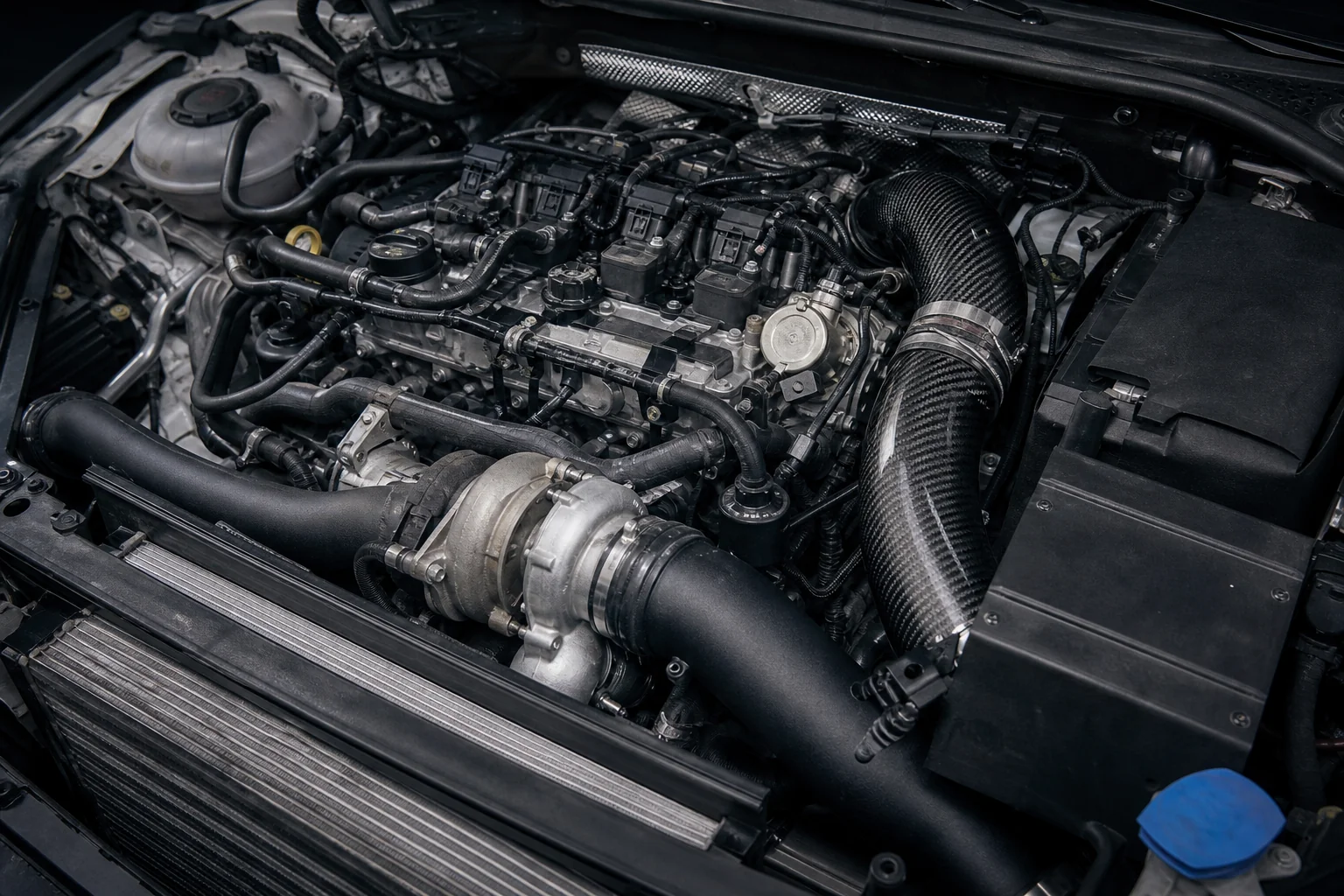
Stage 1+ = a more aggressive software calibration than Stage 1, running on essentially stock hardware that is in verified good health — healthy intake, strong fuelling, good boost system — sometimes with an uprated intercooler recommended to hold the numbers consistently. Gains over standard Stage 1 are real but smaller than the jump from stock to Stage 1. If someone quotes you Stage 1+ money for what is really a Stage 1 file, ask what changed. Diagnostics first, custom-written file, factory backup kept for life — as always.
What Stage 1+ Actually Means
Stage 1+ is a calibration that pushes closer to the sensible limit of factory hardware than a standard Stage 1 does. Where Stage 1 leaves comfortable margin everywhere, Stage 1+ trims that margin where the data says it is safe to — slightly higher boost targets, sharper torque delivery, more aggressive throttle mapping — while keeping every factory protection system active.
The "+" is earned by the car, not the invoice. A Stage 1+ file only makes sense on an engine whose intake is flowing properly, whose fuel system is delivering what the map asks for, and whose boost system holds pressure without leaks. On some platforms we will also recommend an uprated intercooler — not because the map requires it to run, but because better charge cooling lets the calibration hold its numbers on a hot day or the third overtake in a row, instead of quietly pulling timing.
If you have not read our Stage 1 remap explained guide yet, start there — Stage 1+ only makes sense once you understand what the baseline stage does.
Where It Sits Between Stage 1 and Stage 2
Think of the stages as answers to one question: how much of the factory hardware's headroom are we using?
| Stage | Hardware | Calibration approach | Best for |
|---|---|---|---|
| Stage 1 | Fully stock | Conservative margins everywhere | Most daily drivers |
| Stage 1+ | Stock, verified healthy; intercooler sometimes recommended | Tighter margins where data supports it | Enthusiasts not ready for hardware spend |
| Stage 2 | Intercooler, exhaust, intake — matched parts | Written for the new airflow | Committed builds with a real budget |
The full comparison between the outer two stages lives in our Stage 1 vs Stage 2 guide. Stage 1+ is the honest middle: more than a standard flash, much less than a hardware project. If you are already pricing intercoolers and downpipes, skip ahead to the complete Stage 2 guide instead.
Who Stage 1+ Actually Suits
- Enthusiast daily drivers who have run Stage 1 and want a sharper edge without committing to hardware
- Owners of well-maintained, healthy cars — recent service, strong fuel trims, no boost leaks — with headroom left to use
- Hot hatch owners on platforms known to respond well to tighter calibration on stock parts
- Drivers planning Stage 2 later who want an interim step — the software can be revised when the hardware arrives
Who it does not suit: anyone whose car has active faults, tired components or an unknown history. Trimming safety margin on an unhealthy engine is exactly how tuning gets its bad reputation, and it is why every FLR booking starts with diagnostics — we would rather lose a Stage 1+ sale than flash a marginal car.
What You Feel Over Standard Stage 1
Honest framing: the step from stock to Stage 1 is the big one. The step from Stage 1 to Stage 1+ is a refinement — noticeable if you know the car well, invisible if you are expecting another transformation. Typically you get:
- Stronger mid-range pull — the map holds boost more assertively through the rev range
- Sharper throttle calibration — pedal response tuned closer to the enthusiast end of the scale
- Better consistency under repeated load — especially with an uprated intercooler fitted, on the long climbs out of Rossendale or a loaded run down the A56
Never let anyone promise you a specific BHP number for the "+" — gains vary by engine code and condition, and on some platforms the honest answer is that Stage 1 already uses most of the safe headroom. We will tell you which camp your car is in before you spend a penny.
The Diminishing Returns Conversation
This is the section most tuning sites skip. Every engine has a curve: the first slice of calibration effort buys a lot of performance, the next slice buys less, and the slice after that buys hot intake temperatures and stressed components. Stage 1 sits on the steep, generous part of that curve. Stage 1+ sits further along, where each extra unit of boost buys less usable performance and costs more margin.
That does not make Stage 1+ a bad product — it makes it a product for people who understand what they are buying. If you want the best value-per-pound in tuning, standard Stage 1 wins and it is not close. If you want the most your stock hardware can sensibly give, and your car has earned it, Stage 1+ is the honest way to get there. What we will not do is dress up a standard file with a "+" and charge extra for the keystroke — that happens in this industry more than anyone admits.
What Stage 1+ Costs
For context: quality remaps average £250–£500 nationally, and FLR's standard Stage 1 starts from £150 with diagnostics included. Our Stage 1+ calibration is priced per vehicle from your VRN, because the work involved genuinely varies — some platforms need extensive logging passes to trim margins safely, others are well-documented. If you run a DSG or other tuned automatic, pairing engine and gearbox software makes sense at this level; the Stage 1+ bundle combines both, and our standalone DSG/TCU tuning starts from £150.
Every quote includes the same non-negotiables as every FLR job: diagnostic health check first, a custom-written file for your exact engine code, your factory ECU backup archived for life, and live-data verification with a road test before handover. The map is fully reversible whenever you need stock back.
Risks and Trade-Offs — Straight Answers
- Thinner margins — by definition. On a healthy car this is fine; on a neglected one it is not, which is why the health check gates the product.
- Heat sensitivity — without improved charge cooling, expect some performance tail-off in hot conditions or under sustained load. This is the ECU protecting itself, and it is working as designed.
- Insurance — like any remap, Stage 1+ is a material modification and must be declared to your insurer. No exceptions.
- Warranty — manufacturer goodwill on powertrain claims may be affected, same as any stage.
- Clutch and driveline load — more torque finds weak clutches faster. If yours is marginal, fix it first.
- Emissions systems stay active — a road-legal Stage 1+ keeps DPF, EGR and AdBlue systems fully functional. Removing or defeating them is illegal for UK road use and we do not do it.
Common Misconceptions
- "Stage 1+ needs hardware." No — that is Stage 2. Stage 1+ runs on stock parts in good health; an intercooler is sometimes recommended for consistency, not required to function.
- "The + means +50 BHP." The plus describes calibration aggression, not a fixed number. Gains vary by platform and nobody honest promises a figure before reading your car.
- "It's just marketing." Sometimes, from some tuners — which is why you should ask what specifically differs from their Stage 1 file. A real Stage 1+ involves more logging, tighter targets and stricter health requirements.
- "You can't go back." Every FLR map is reversible. Your factory file is archived for life and can be restored for dealer visits, resale or a change of heart.
When NOT to Choose Stage 1+
- Any active warning lights, limp mode or stored fault codes — diagnose and fix first
- Unknown service history or a recently purchased used car — baseline it with diagnostics before tuning anything
- A slipping clutch, tired turbo or weeping boost hoses — hardware health before software aggression
- You mainly want economy and relaxed driving — a standard Stage 1 or economy-focused calibration fits better
- You are about to buy Stage 2 hardware anyway — save the money and do it once, properly
Next Steps
The honest path is simple. Send your VRN through our contact page and tell us how you drive. We will confirm whether your platform has genuine Stage 1+ headroom, whether an intercooler is worth recommending, and what the calibration costs — or tell you plainly that standard Stage 1 is the smarter buy for your car. Browse the Knowledge Centre for straight answers on insurance, warranty and reversibility, and if you want the workshop rather than the website, we are in Haslingden, minutes from the M66, with mobile coverage across Lancashire and the North West.
Stage 1+ Remap — Common Questions
A Stage 1+ remap is a more aggressive calibration than standard Stage 1, written for a car whose stock hardware is in verified good health. It trims conservative margins where logging data supports it, while keeping all factory protection and emissions systems active.
No hardware is required — that is what separates it from Stage 2. The car's intake, fuelling and boost system must be healthy, and on some platforms we recommend an uprated intercooler so the map holds its numbers consistently, but the calibration runs on stock parts.
It varies by engine code and condition, and the honest answer is: less than the jump from stock to Stage 1. Expect a refinement — stronger mid-range, sharper response — rather than a second transformation. We confirm realistic expectations from your VRN before booking.
On a healthy, verified engine with a custom-written file — yes. Margins are tighter than Stage 1, which is exactly why we gate it behind a diagnostic health check and live-data verification. On an unhealthy or unverified car, no stage is safe, including this one.
Priced per vehicle from your VRN, because the logging and calibration work genuinely varies by platform. For context, FLR Stage 1 starts from £150 with diagnostics included, and quality remaps average £250–£500 nationally. Engine-plus-gearbox bundles are available for DSG cars.
If you have the budget and commitment for matched hardware — intercooler, exhaust, intake — go Stage 2 and do it once. If you want the most from stock parts without hardware spend, Stage 1+ is the honest middle ground. Buying it as a stepping stone works too; the software gets revised when hardware arrives.
Yes. Any ECU remap is a material modification in the UK and must be declared to your insurer. Undeclared tuning can invalidate your policy entirely, whatever the stage.
Yes. Your original factory ECU file is read and archived for life before anything is flashed, and the car can be returned to stock calibration at any point — for dealer visits, resale or simply changing your mind.