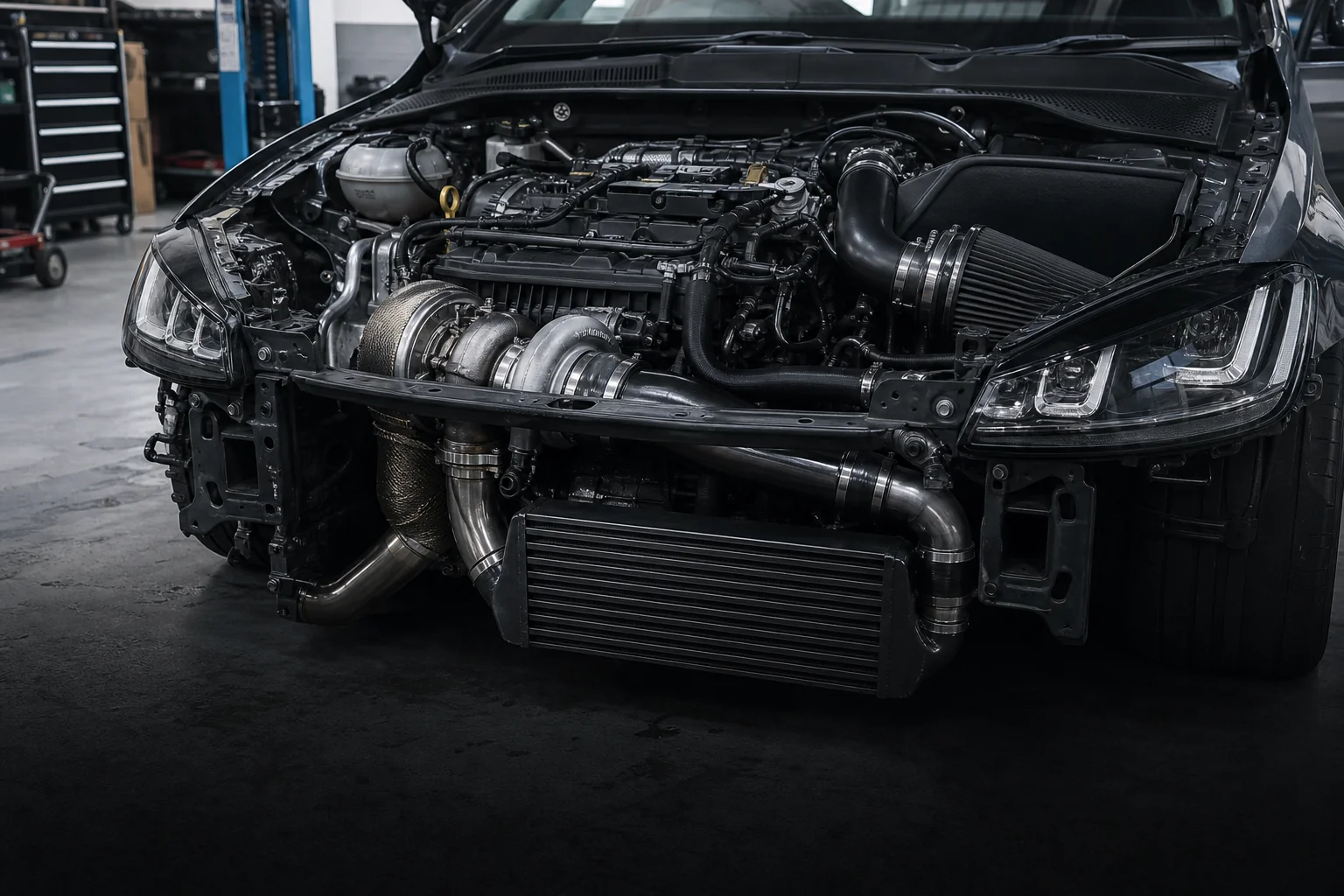
A Stage 2 remap = supporting hardware + a calibration matched to that hardware. Typical parts: uprated intercooler, high-flow exhaust (any de-cat or decat downpipe is off-road only), performance intake, and sometimes an uprated clutch. Budget for hardware and mapping — the software alone does not make it Stage 2. Most daily drivers get everything they need from Stage 1. If your car is stock and healthy, read our Stage 1 vs Stage 2 comparison before spending anything.
What a Stage 2 Remap Actually Is
Strip away the forum bravado and the definition is simple: Stage 2 is a calibration written for a car with supporting modifications. Stage 1 works within the limits of factory hardware. Stage 2 assumes you have removed some of those limits — more airflow in, more exhaust flow out, better charge cooling in between — and the map is written to use that headroom.
That word "written" matters. Flashing a generic Stage 2 file onto a car with a random mix of parts is guesswork, and guesswork at higher boost pressures is how engines get hurt. Every Stage 2 job we do at Finish Line Remaps in Haslingden starts with diagnostics, then a custom-written file for your exact engine code and your exact hardware list, with your factory ECU backup archived for life. The difference between custom and off-the-shelf files is covered in depth in our custom vs generic remap guide.
One misconception to kill early: stages are not a loyalty ladder. Nobody "graduates" to Stage 2. It is a different product for a different owner — someone who wants hardware-matched performance and accepts the cost and trade-offs that come with it.
The Hardware Stage 2 Actually Needs
There is no single legal definition of Stage 2, but on most turbocharged cars the sensible supporting parts list looks like this:
- Uprated intercooler — the single most valuable Stage 2 part on most cars. Higher boost makes more heat; a bigger, more efficient intercooler keeps intake temperatures stable so the map can hold its numbers on the third hill, not just the first.
- High-flow exhaust / downpipe — reduces back-pressure so the turbo works less hard for the same boost. Important caveat: a de-cat or decat downpipe is for off-road use only in the UK. For road cars, a high-flow sports cat keeps the vehicle MOT-compliant and road-legal. We do not fit or map around illegal emissions removal for road use — that includes DPF, EGR and AdBlue systems.
- Performance intake — a proper cold-air or enclosed induction kit. Worth having; rarely transformative on its own. An open cone sucking hot engine-bay air can actually be worse than the factory airbox.
- Uprated clutch (sometimes) — manual cars making significantly more torque than factory will eventually find the limit of the standard clutch. On some platforms this is a "budget for it soon" item rather than a day-one requirement; we will tell you honestly which yours is.
Notice what is not on the list: a bigger turbo, injectors, forged internals. Those belong to Stage 3 territory. Stage 2 uses the factory turbo — it just feeds it better.
Why the Calibration Must Match the Hardware
Hardware changes what the engine can do. Software decides what it actually does. Fit a bigger intercooler and free-flowing exhaust without remapping and you gain almost nothing — the ECU is still targeting factory boost and fuelling. Flash an aggressive map without the hardware and you push heat and back-pressure past what the stock parts manage comfortably.
A matched Stage 2 calibration adjusts boost targets, fuelling, ignition or injection timing and torque limits to suit the actual airflow the new parts provide — verified with live data logging on real roads. Our road testing happens on the routes we know: the long pulls out of Rossendale, Grane Road, the M66 slip roads. If the map holds boost and temperature there, it will hold them on your commute.
Expect meaningful gains over Stage 1 on most platforms — but be suspicious of anyone quoting exact BHP figures before reading your car. Gains vary by engine code, fuel quality and hardware choice, which is why we quote typical ranges and confirm from your VRN.
Stage 2 Cost Reality — Hardware Plus Mapping
This is where honest advice saves you money. The map is only part of the bill:
| Item | Typical UK cost | Notes |
|---|---|---|
| Uprated intercooler | £300–£700+ fitted | Varies hugely by platform |
| Downpipe / exhaust (sports cat) | £300–£900+ fitted | Road-legal sports cat, not a de-cat |
| Performance intake | £100–£400 | Enclosed kits preferred |
| Uprated clutch (if needed) | £500–£1,200+ fitted | Platform-dependent |
| Custom Stage 2 calibration | Quoted from your VRN | Diagnostics, custom file, backup, road test included |
For context, a quality Stage 1 remap averages £250–£500 nationally, and at FLR Stage 1 starts from £150 with diagnostics included. A realistic Stage 2 build is usually a four-figure project once parts and fitting are counted. If that number makes you wince, that is useful information — it probably means Stage 1 is the right call for you, and there is no shame in that whatsoever.
What You Gain Over Stage 1
- More power and torque headroom — the calibration can target boost and fuelling the stock exhaust and intercooler could not support reliably
- Consistency — better charge cooling means the car performs the same on the tenth pull as the first, instead of pulling timing as temperatures climb
- Sharper turbo response — less back-pressure means the turbo spools sooner and recovers faster between gears
- Character — a properly built Stage 2 car feels purposeful in a way software alone cannot deliver
What you do not gain: reliability. At best a well-executed Stage 2 is neutral on engine longevity when the car is maintained properly. Anyone telling you more boost makes an engine last longer is selling something.
Risks and Honest Trade-Offs
- Driveline stress — clutches, gearboxes and mounts all carry more torque. Budget for wear items sooner.
- Insurance — Stage 2 is a significant declared modification. It must be disclosed, and premiums will reflect it. Undeclared tuning can void a policy entirely.
- Warranty — hardware plus software modifications give a manufacturer clear grounds to decline powertrain claims.
- Emissions compliance — this is the big one. Any de-cat, DPF removal, EGR delete or AdBlue defeat is illegal for UK road use, full stop. A road-legal Stage 2 keeps a functioning catalyst and all factory emissions systems active. Off-road-only builds exist, but they cannot be driven on the road, and we frame that honestly every time.
- Fuel appetite — driven enthusiastically, a Stage 2 car drinks more. Driven normally, consumption is often similar to stock, but nobody buys Stage 2 to drive normally.
Who Should Honestly Stay at Stage 1
We turn away Stage 2 enquiries more often than you would expect, because for a lot of owners it is simply the wrong product:
- Daily commuters — if the goal is easier overtakes on the M65 and stronger hill pulls, Stage 1 delivers that for a fraction of the spend
- Budget-capped builds — a full Stage 2 done on half a budget means corners cut on hardware or mapping, and both end badly
- Cars on PCP or lease — hardware changes are harder to reverse cleanly than software; a Stage 1 with the factory file archived is far simpler to unwind
- Owners who value warranty goodwill — bolt-on hardware is visible in a way software is not
- High-mileage engines — a healthy 150k-mile diesel can take a sensible Stage 1 all day; asking it for Stage 2 boost is pushing your luck
Still weighing it up? Our is Stage 1 worth it? guide covers the daily-driver decision in detail.
Notes From the Workshop
A few things we have learned mapping Stage 2 cars across Lancashire that the brochures do not mention. First, intercoolers matter more than exhausts on most modern turbo cars — if you can only afford one part, buy cooling. Second, mixed-brand parts cars are the hardest to map well, because each component was designed around different assumptions; buying a coherent set of parts saves calibration time and money. Third, the cars that make us happiest are the ones that arrive with a folder of receipts — fresh service, healthy plugs or injectors, good boost hoses. A custom calibration can only be as good as the engine underneath it.
And a plea: tell us everything that is fitted. Finding an undeclared intake mid-log is fine. Finding an undeclared downpipe changes the entire fuelling picture. Honest hardware lists get better maps.
When NOT to Go Stage 2
- Warning lights, limp mode or unresolved fault codes — diagnose first, always
- Clutch already slipping under Stage 1 torque — fix the driveline before adding load
- You cannot budget for the full parts list — a half-finished Stage 2 is worse than a complete Stage 1
- You will not declare it to your insurer — the financial exposure dwarfs the performance gain
- The car is your only transport and downtime hurts — hardware installs and setup take longer than a software flash
Next Steps
If Stage 2 sounds right for your car and your budget, start with a conversation, not a parts order. Send your VRN via our contact page and we will confirm what your platform responds to, which parts are worth the money, and what a matched Stage 2 calibration costs for your exact engine. If it turns out Stage 1 is the smarter buy, we will say so — the Knowledge Centre has honest answers to the questions we hear most, and every job starts with diagnostics whichever stage you choose.
Stage 2 Remap — Common Questions
A Stage 2 remap is a custom calibration written for a car fitted with supporting hardware — typically an uprated intercooler, high-flow exhaust and performance intake. The software is matched to the extra airflow those parts provide, unlocking gains the factory hardware could not support reliably.
On most turbocharged cars: an uprated intercooler, a freer-flowing exhaust or downpipe with a road-legal sports cat, and a proper intake. Some manual cars will also need an uprated clutch to hold the extra torque. Bigger turbos and injectors belong to Stage 3, not Stage 2.
Yes — when it keeps a functioning catalyst and all factory emissions systems active. What is not road-legal is any de-cat pipe, DPF removal, EGR delete or AdBlue defeat; those are off-road only. A properly built Stage 2 car passes an MOT.
Budget for hardware plus mapping. Parts typically run from several hundred pounds per component fitted, and quality remaps nationally average £250–£500 before hardware. A realistic full Stage 2 build is usually a four-figure project. We quote exactly from your VRN.
It varies by engine code, hardware choice and fuel quality — which is why we quote typical ranges rather than promising a headline BHP figure. Expect a meaningful step over Stage 1, verified with live data logging rather than optimistic marketing numbers.
No — that is just an over-aggressive Stage 1 with thinner safety margins. Without the airflow and cooling the map assumes, the engine runs hotter and harder for little extra gain. If you are staying on stock parts, a properly written Stage 1 is the right product.
Yes. Both the hardware and the software are material modifications in the UK and must be declared. Undeclared modifications can invalidate your policy entirely, including on claims unrelated to performance.
The software is — we archive your factory ECU file for life and can restore it at any point. The hardware has to be physically removed and refitted with original parts, which is why owners planning to return a car to stock often stay at Stage 1.