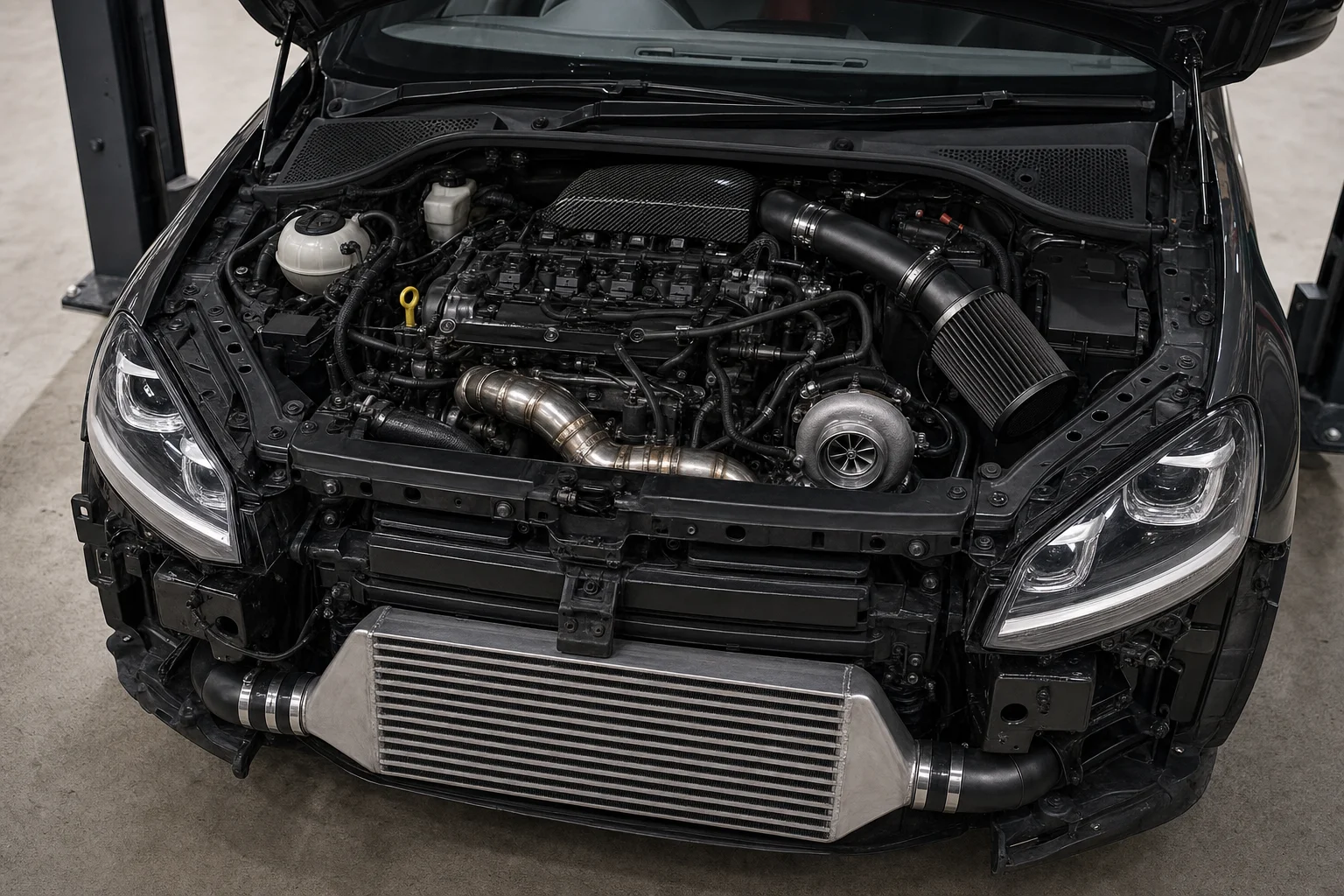
Stage 1 unlocks safe performance on factory hardware — no bolt-ons required. Stage 2 needs supporting mods (typically intake, downpipe and upgraded intercooler) and a map written specifically for that hardware. Most daily drivers only need Stage 1. Stage 2 is for owners who have already invested in airflow and cooling upgrades.
The Short Answer
A Stage 1 ECU remap rewrites your engine software to use more of the capability your turbo and fuelling system already have — on completely standard hardware. It is the right starting point for the vast majority of UK daily drivers.
A Stage 2 remap is a higher-output calibration written for a car that already has supporting modifications installed. Software alone cannot safely deliver Stage 2 gains; the hardware must be there first, and the map must be matched to exactly what is on the car.
At Finish Line Remaps, Stage 1 starts from £150. Stage 2 calibration starts from £250 plus the cost of hardware and any fitting — we scope that properly before quoting, not with a generic file on stock parts.
What Stage 1 Actually Does
Stage 1 is our core daily-driver calibration. The ECU already controls boost, fuelling, ignition timing and torque limits — manufacturers deliberately leave headroom so one map can suit different markets, fuel grades and emissions targets worldwide.
Stage 1 adjusts those parameters within what your stock hardware can support. On a typical turbo petrol or diesel that usually means stronger low-down torque, sharper throttle response and smoother power delivery — the kind of gains you feel pulling out of junctions and on motorway inclines, not just a headline BHP figure on a dyno sheet.
Nothing physical changes on the car. No intercooler upgrade, no exhaust swap, no intake kit. That is why Stage 1 is the most popular remap we book across Lancashire — strong, usable performance without turning a daily into a project car.
For a deeper definition, read our Stage 1 remap explained guide — or see the Knowledge Centre answer on what Stage 1 remapping is.
What Stage 2 Requires
Stage 2 is not "Stage 1 but more aggressive." It is a different category of tune written around hardware that improves airflow, exhaust flow and charge cooling beyond factory specification.
Common Stage 2 supporting modifications include:
- Performance air intake — colder, less restrictive airflow into the turbo
- Sports cat or decat downpipe — reduced exhaust back-pressure (road-legal options vary by platform)
- Upgraded front-mount intercooler — lower intake air temperatures under sustained boost
- Turbo inlet pipe or diverter valve — platform-dependent supporting parts
The exact list depends on your engine. A 2.0 TDI, a 2.0 TSI and a 1.4 TSI do not share the same Stage 2 hardware checklist. We assess what is on your car — and what is still needed — before quoting Stage 2 work. Read more in our hub on what modifications Stage 2 needs.
Flashing a Stage 2 map onto a car with stock hardware is how people cook turbos, trigger limp mode and end up on forums asking why their car smokes. We will not do that.
Where Stage 1+ Fits In
Stage 1+ is not Stage 2. It sits between them — still on stock hardware, but with a sharper, more engaging calibration for drivers who want stronger performance without bolt-ons.
Stage 1+ from £180 is the enhanced daily-driver map. Stage 2 is for when you have the hardware to support it. Confusing the two is common; the difference is whether anything physical has changed on the car.
Our Knowledge Centre covers Stage 1 vs Stage 1+ in detail if you are deciding between those two on stock hardware.
Stage 1 vs Stage 2 — Side by Side
- Hardware required: Stage 1 — none. Stage 2 — intake, exhaust/downpipe, intercooler (typical minimum).
- Calibration type: Both are custom-written at FLR — never generic off-the-shelf files.
- Typical use case: Stage 1 — daily commute, school runs, motorway cruising. Stage 2 — enthusiasts with supporting mods who want maximum safe output.
- Entry pricing at FLR: Stage 1 from £150. Stage 2 from £250 plus hardware costs.
- Reversibility: Both start with a full factory file backup — return to stock anytime.
- DSG implications: Either stage increases engine torque — DSG cars often benefit from a TCU remap to match. See our DSG remap guide.
When Stage 1 Is Enough
For most owners asking about Stage 1 vs Stage 2, Stage 1 is the correct answer. If your car is on standard hardware and you want stronger torque, better response and a more engaging drive without modifying the car, Stage 1 delivers exactly that.
A well-written Stage 1 typically frees 25–35% more torque low down — the range you actually use every day. That is a meaningful upgrade without touching a spanner.
We road-test every calibration on Pennine roads from our base in Haslingden. Grane Road, the A56, the long pulls through Rossendale — if a Stage 1 map feels smooth and strong here, it will feel right on your daily routes too.
When You Actually Need Stage 2
Stage 2 makes sense when you have already committed to hardware upgrades — or you are planning them as a package and want the calibration scoped properly from the start.
Typical Stage 2 customers:
- Already have intake, downpipe and intercooler fitted and want the map to match
- Want maximum safe output and accept the cost of supporting mods
- Track-day or enthusiast use where cooling and airflow headroom matter
- Planning a staged build — hardware first, then calibration
If you are buying hardware purely to justify a Stage 2 map, talk to us first. Sometimes Stage 1+ on stock hardware gives you 90% of the feel you want at a fraction of the cost.
Can You Upgrade From Stage 1 to Stage 2 Later?
Yes — and that is the sensible path for most people. Start with Stage 1, live with the car for a few weeks, decide if you want more. When you add hardware, we write a new Stage 2 calibration matched to your exact setup.
Your original factory file remains backed up throughout. Each stage is a fresh custom write — not a patch on top of a generic file.
Cost Comparison
Stage 1 is the most cost-effective performance upgrade on a standard car. Stage 2 costs more because you are paying for hardware, fitting and a more complex calibration — not because the tuner charges double for the same flash.
For a full UK pricing breakdown, read our remap cost guide. For Stage 2 specifically, we quote after confirming your hardware list — no guesswork.
Our Recommendation
Unless you already have Stage 2 hardware fitted, start with Stage 1. It is safer, cheaper and delivers real-world gains on the roads you actually drive. If you still want more after living with it — or you are building toward Stage 2 with proper parts — we will scope that honestly. New to Stage 1? Read our full Stage 1 remap guide first.
Request a quote with your VRN, call 01706 404 357, or explore more in our Stages Knowledge Centre zone.
Stage 1 vs Stage 2 — Common Questions
No — not safely. Stage 2 calibration assumes improved airflow and cooling from supporting modifications. Running Stage 2 software on stock hardware risks excessive exhaust gas temperatures, boost beyond safe limits and turbo damage. Start with Stage 1 or fit the hardware first. See what Stage 2 requires.
Yes — that is the recommended path for most drivers. Enjoy Stage 1, then when you add intake, downpipe and intercooler we write a fresh Stage 2 map matched to your exact hardware. Your factory backup stays on file throughout.
Not mandatory, but strongly recommended on DSG cars. Increased engine torque can expose gearbox hesitation and slow shifts. A TCU remap aligns shift strategy with your engine calibration. Our ECU + DSG bundle is £275. Read our DSG remap guide.
Stage 1 starts from £150 at FLR. Stage 2 calibration starts from £250 — but you also need supporting hardware (intake, downpipe, intercooler typically), which adds parts and fitting costs. Total Stage 2 investment is significantly higher than Stage 1. See our cost guide for context.
Yes — when the hardware matches the map and the calibration is custom-written within sensible limits. Stage 2 is not inherently dangerous; problems arise when software outpaces cooling, fuelling or mechanical capacity. We diagnostics first and scope honestly. More on remapping safety.
A legitimate Stage 2 calibration with road-legal emissions hardware should not cause an MOT failure by itself. Removing or defeating DPF, EGR or catalytic converter systems for road use is illegal and will likely fail. We keep road-legal setups compliant. See MOT and remapping in our Knowledge Centre.