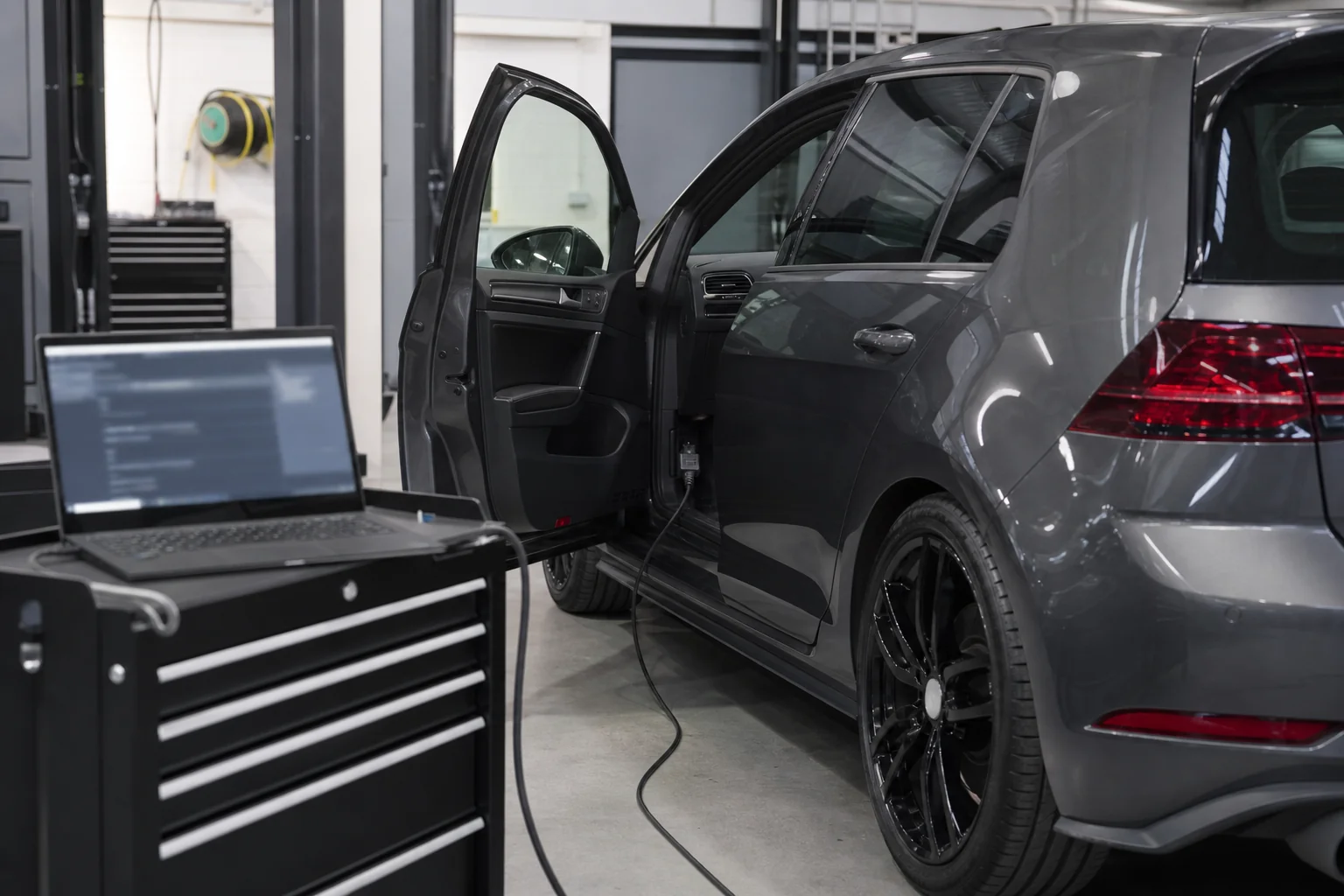
Is a Stage 1 remap worth it? For most healthy turbocharged daily drivers — yes. Software-only tuning from £150 at FLR delivers stronger low- and mid-range torque, sharper response and better overtaking confidence without bolt-ons. Skip it if warning lights are on, the clutch is slipping, you rely on factory warranty goodwill, or you drive a non-turbo petrol expecting big gains. Declare it to your insurer. Diagnostics first, always.
The Short Answer
Is a Stage 1 remap worth the money in the UK? On a healthy turbocharged daily driver, yes — it is the highest value-per-pound performance upgrade you can buy. No exhaust. No intake. No intercooler bill. Just properly written software that claims back the headroom manufacturers left in the factory ECU maps.
That is not hype. It is physics plus conservative factory calibration. Turbo diesels and turbo petrols both respond well when the car is mechanically sound and the map is custom-written for your engine code — not downloaded from a forum and flashed blind.
At Finish Line Remaps in Haslingden, Stage 1 starts from £150 including diagnostics, a custom file, permanent factory backup and post-flash verification. For the full technical definition of what Stage 1 actually changes, read our Stage 1 remap explained guide — this page answers whether you should book it.
What You Actually Feel Day-to-Day
Forget peak BHP for a moment. Stage 1 wins show up in the moments that annoy you now:
- Junction exits — torque from 1,500rpm instead of waiting for the turbo to wake up
- Motorway overtakes — the gap on the M66 closes before you have to abort the manoeuvre
- Hill pulls — fewer downshifts climbing out of Rossendale or loaded on the M65
- Throttle response — pedal input that actually matches what the car does, especially below 2,000rpm
- Towing confidence — caravan, trailer or loaded van that stops feeling like it is begging for mercy on inclines
- Fewer gearchanges — wider usable torque means you stay in a higher gear longer without labouring
These are the reasons customers call us after a Stage 1 — not because they gained 40 BHP on paper, but because the car finally drives like the engine size suggests it should. If none of those moments frustrate you on your current routes, Stage 1 may be lower priority. If you nodded reading the list, keep going.
Not sure whether your symptoms are map limitation or mechanical fault? Read signs your car needs a remap before you book.
Stage 1 Remap Pros — Why Owners Book It
- Best £/performance ratio — no hardware spend; software-only on stock components
- Usable torque, not just peak numbers — mid-range pull transforms daily driving more than a dyno screenshot
- Reversible — we archive your factory ECU file for life; stock can be restored for dealer visits or resale
- Diagnostics-first process — health check before any flash; we turn work away when the car is not fit
- Custom-written for your engine code — never a generic downloaded file (see custom vs generic remapping)
- Mobile service — we come to you across Lancashire and the North West via mobile remapping
- Quick turnaround — most Stage 1 jobs take 1–2 hours including diagnostics (timing guide)
- No mandatory upgrade path — Stage 1 is not a ladder to Stage 2; stages describe extent of work, not an order you must follow
Compare that to a £600 exhaust that sounds good in a car park but does not fix the flat mid-range you feel every morning on the A56. Value is subjective — but Stage 1 owners who booked for the right reasons rarely regret it when the car was healthy going in.
Stage 1 Remap Cons — Honest Trade-Offs
Every responsible tuner should tell you the downsides before you pay. Here they are, without sugar-coating:
| Trade-off | What it means | How to handle it |
|---|---|---|
| Insurance | Stage 1 is a material modification in the UK — you must declare it | Call your insurer before booking. See our insurance guide |
| Warranty | Manufacturer may decline powertrain goodwill claims | Understand risk vs car age. Read warranty facts |
| Clutch / gearbox load | More torque stresses worn clutches and lazy TCU logic | Diagnostics-first; fix known issues before tuning |
| Cheap generic maps | Off-the-shelf files ignore your engine's condition | Choose custom-written, live-data verified tuning — safety guide |
| MOT / emissions | Poor maps can increase smoke or fail emissions readings | Road-legal Stage 1 keeps factory emissions systems active — MOT facts |
| Non-turbo ROI | Atmospheric petrol gains are modest — mostly throttle feel | Assess case-by-case; often not worth it for pure peak power |
None of these are reasons to panic — they are reasons to book with a tuner who diagnostics first, writes custom files and tells you honestly when to walk away. That is the entire FLR philosophy.
Stock vs Stage 1 — What Changes
Typical comparison on a healthy turbocharged daily driver — exact figures vary by engine code; we confirm from your VRN when quoting:
| Parameter | Stock (typical turbo) | After Stage 1 (typical) | Notes |
|---|---|---|---|
| Power | Factory rating | +15–30% | Varies by engine code |
| Torque | Factory rating | +25–35% | Felt most in daily driving |
| Hardware | Standard | Standard | No bolt-ons required |
| Drive feel | Factory conservatism | Stronger mid-range, sharper response | Custom-written FLR file |
| Time on job | — | 1–2 hours | Diagnostics included |
Is Stage 1 Worth It on Diesel vs Petrol?
Both can be worth it — but for different reasons. This is where forum generalisations fall apart:
| Engine type | Typical Stage 1 benefit | Worth it when… |
|---|---|---|
| Turbo diesel (TDI, dCi, CDTi) | Large torque from low revs; possible MPG gain when driven calmly | Motorway miles, towing, loaded SUVs, vans, high-mileage commuters |
| Turbo petrol (TSI, EcoBoost, T-GDI) | Stronger mid-range and top-end; sharper throttle | Hot hatches, enthusiast daily drivers, turbo SUVs |
| Non-turbo petrol | Modest gains — mostly throttle feel | Often poor ROI — assess case-by-case before booking |
Deeper engine-type breakdown in our petrol vs diesel remapping guide. Knowledge Centre: petrol vs diesel remap gains.
Stage 1 Remap Cost in the UK — Value Context
Nationally, quality Stage 1 remaps typically sit between £250 and £500 depending on vehicle, tuner and what is included. At Finish Line Remaps, Stage 1 starts from £150 — diagnostics, custom-written file, factory backup archived for life, live-data verification and road test included on standard bookings.
| Provider type | Typical Stage 1 cost | What to check |
|---|---|---|
| Finish Line Remaps | From £150 | Custom file, diagnostics, backup, mobile option |
| UK average (quality tuners) | £250–£500 | Confirm custom vs generic, backup policy, aftercare |
| Budget generic flash | Under £150 | Often no health check — false economy on daily drivers |
Full pricing breakdown across stages and vehicle types in our UK remap cost guide. Send your VRN for a fixed quote before you book — no surprise add-ons on the day.
When a Stage 1 Remap Is Worth It
Stage 1 makes strong sense for these daily-driver profiles:
- Motorway commuters — diesel or turbo petrol owners doing consistent miles who want easier overtakes and less downshifting
- Towers and caravan owners — low-end torque transforms hill confidence without chasing peak BHP
- Enthusiast daily drivers — Golf GTI, Focus ST, Audi S-line, Leon FR — cars that feel strangled by factory maps
- High-mileage healthy diesels — 120k–180k with documented service history often remap brilliantly after diagnostics
- Fleet and work vans — Transits, Sprinters, Vivaro platforms where drivers report constant downshifting under load
- Factory-downrated engines — same block as a higher-power model in the range, noticeably slower in yours
- Owners who want reversibility — PCP ending, dealer visits planned, or resale in mind; stock file restore is always available
If you see yourself in two or more bullets and the car has no active faults, Stage 1 is almost certainly worth the conversation. Still comparing stages? Read Stage 1 vs Stage 2 — but do not let Stage 2 hardware talk scare you off a simple Stage 1 on stock components.
When a Stage 1 Remap Is NOT Worth It
This section builds trust — and saves you money. Skip or defer Stage 1 if:
- Warning lights or limp mode — the ECU is protecting itself; flashing more power makes it worse
- DPF or emissions warnings — fix the system first; see DPF and remapping facts
- Slipping clutch or worn turbo — more torque accelerates mechanical failure
- Heavy factory warranty reliance — understand the goodwill risk on a nearly-new car
- Non-turbo petrol expecting big gains — modest throttle improvements rarely justify the spend
- Short-trip diesel only — chronic cold running and DPF issues need a usage change, not just a map
- Imminent sale — you may not recoup £150+ unless the buyer values the calibration
- You will not declare insurance — the financial risk of undeclared tuning dwarfs any performance gain
Customers sometimes describe limp mode as "it needs a remap." Limp mode means diagnose first. We scan, explain findings, and only proceed when the car is fit — every time. That is why diagnostics from £40 standalone exists for owners who want clarity before committing.
Ticked five or more? You are a strong Stage 1 candidate — send your VRN for a quote. Fewer than three, or any active faults? Start with diagnostics and an honest conversation before anyone flashes your ECU.
Stage 1 or Leave Stock? — Three Paths
Cut through the noise with a simple framework:
| Your situation | Verdict | Next step |
|---|---|---|
| Healthy turbo daily driver; daily driving frustrates you; insurance and warranty risks understood | Stage 1 is worth it | Book Stage 1 from £150 |
| Unsure about faults, warning lights, or clutch health | Diagnose first | Diagnostics from £40 |
| Car drives fine; no frustration; heavy warranty reliance; non-turbo with modest gain potential | Leave stock | Revisit when driving priorities change |
There is no shame in leaving a car stock. There is shame in flashing power onto a car that needed a mechanic first — and we refuse to be that tuner.
What Happens When You Book at Finish Line Remaps
Every Stage 1 appointment follows the same process — workshop in Haslingden or mobile at your location across Lancashire:
- Contact and quote. Send your VRN. We confirm compatibility, explain options and provide a clear, no-obligation quote.
- Diagnostic health check. Fault codes and live data reviewed before any remap. Unhealthy cars are diagnosed, not flashed.
- Custom calibration. Factory ECU file read and archived permanently. New map written for your exact engine code and fuel type.
- Verification and handover. Post-flash live-data check, road test on local Pennine roads, written spec sheet and aftercare advice.
We test on the roads you know — Grane Road, the A56, the long pulls through Rossendale. If Stage 1 feels right here, it will feel right on your daily routes. Timing details in how long does a remap take?
So — Is a Stage 1 Remap Worth It?
If you drive a healthy turbocharged car every day and factory calibration leaves you wanting at junctions, on hills and in overtakes — yes, Stage 1 is worth it. It is the strongest feel-per-pound upgrade in tuning, full stop. No bolt-ons. No hardware bill. Just properly written software that makes your car drive the way the engine always suggested it could.
If warning lights are on, the clutch slips, or you will not declare insurance — fix those first, or leave it stock. The wrong yes costs more than £150.
Send your VRN to request a quote, call 01706 404 357, or read what is a Stage 1 remap? for the technical deep-dive. Mobile remapping across Lancashire and the North West from our Haslingden base.
Is Stage 1 Remap Worth It — Common Questions
For most healthy turbocharged daily drivers, yes — Stage 1 is the strongest value-per-pound performance upgrade available. You get noticeably stronger mid-range torque and sharper response without buying or fitting any hardware. It is less worthwhile on non-turbo petrols or cars with existing mechanical faults.
Yes — daily drivers benefit most because Stage 1 improves the moments you feel every commute: junction exits, motorway overtakes, hill pulls and throttle response from low rpm. The improvement is drivability, not just a peak BHP figure on a dyno sheet.
Usually yes on healthy turbo diesels — large torque increases from low revs transform motorway driving, towing and loaded vehicles. Some owners also see MPG improvements when driven calmly. See our petrol vs diesel guide for the full comparison.
On turbo petrol engines — TSI, EcoBoost, T-GDI — yes for most enthusiast daily drivers wanting stronger mid-range and sharper throttle. Non-turbo petrol gains are modest and often poor ROI. We confirm expected benefits from your VRN before booking.
Nationally, quality Stage 1 remaps typically cost £250–£500. At Finish Line Remaps, Stage 1 starts from £150 including diagnostics, custom file, backup and verification. See our full UK price guide.
Pros: best £/performance ratio, no hardware required, reversible, stronger daily drivability. Cons: must declare to insurer, possible warranty impact, increased load on worn clutches, risk from cheap generic maps. Honest trade-offs are covered in the cons section above.
When warning lights or limp mode are active, the clutch is slipping, DPF issues are unresolved, you rely heavily on factory warranty goodwill, or you drive a non-turbo petrol expecting large gains. Diagnostics first — always.
It can affect manufacturer goodwill on powertrain-related claims because remapping is a modification — but it does not automatically cancel your entire warranty overnight. Read our warranty guide for the balanced UK picture.
Yes. In the UK, an ECU remap is a material modification and you are expected to declare it to your insurer. Failure to disclose can invalidate your policy. See our insurance guide.
Yes — when the car is healthy, the map is custom-written for your engine code, and factory protections like knock control and temperature limits stay active. Problems arise from skipping diagnostics or flashing generic files. Read is ECU remapping safe?
Yes. We read and archive your original factory ECU file before flashing anything. The car can be returned to stock calibration at any point — useful for dealer visits, resale or insurance renewals. More in can a remap be reversed?