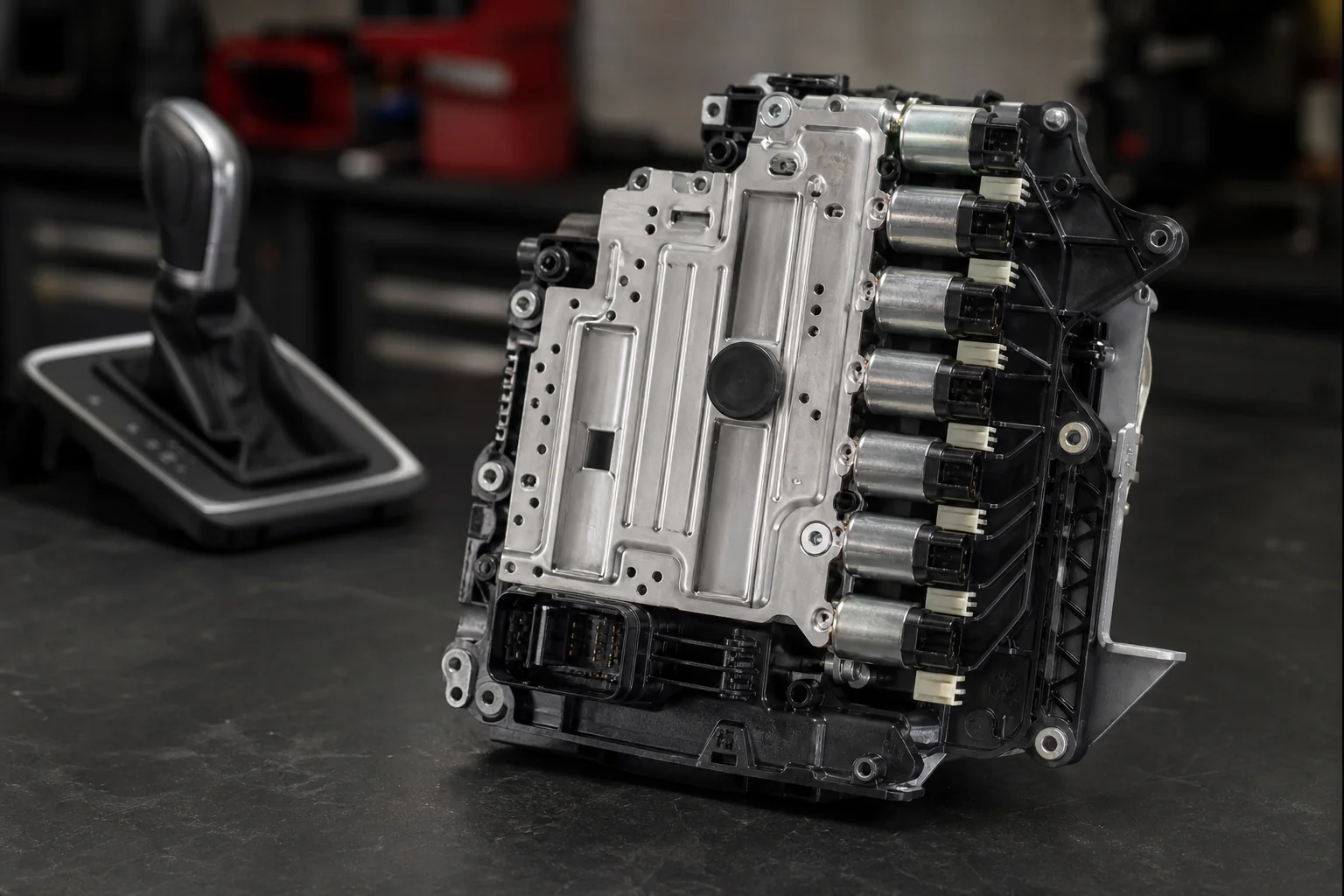
A TCU tune recalibrates the gearbox's own software: shift points, shift speed, clutch clamping pressure, per-gear torque limits, kickdown behaviour, torque-converter lock-up, launch control and manual-mode obedience. On a remapped car it is not a luxury — the gearbox must agree with the engine or it will clamp the torque your ECU map created. At FLR, DSG / TCU tuning starts from £150, and the Stage 1 + DSG bundle is £275. Diagnostics first, custom file, factory backup, fully reversible — and yes, it must be declared to your insurer.
The Short Answer
What is TCU tuning? Your automatic or dual-clutch gearbox has its own computer — the transmission control unit — running its own calibration, entirely separate from the engine ECU. It decides which gear you are in, when to change, how quickly, how firmly the clutches clamp and, crucially, how much engine torque it will tolerate before intervening. A TCU tune rewrites those tables the same way an ECU remap rewrites engine maps: read the original file, modify the calibration, flash it back, verify with live data.
The result on the road: faster and better-timed shifts, a gearbox that holds gears when you are driving rather than lunging for seventh at 1,400rpm, full torque allowed through in every gear, and manual mode that actually does what your fingers ask. If you have read our DSG remap explained guide, this article is the layer underneath — the actual software levers being pulled.
Who This Guide Is For
DSG, S tronic, PDK and torque-converter auto owners who want to know what they are paying for; remapped-car owners wondering why the gearbox feels like the weak link; and the technically curious who have heard "clamp pressure" thrown around in forums without explanation. If you just want the worth-it verdict, is a DSG remap worth it answers that — this page explains the machinery behind the verdict.
Shift Maps — When the Gearbox Changes Gear
The heart of any TCU calibration is a set of shift maps: tables that decide, for a given pedal position and road speed, which gear the box should be in. Factory shift maps chase emissions-cycle economy and refinement, which is why a stock DSG upshifts almost obsessively early and can feel hesitant when you ask for sudden acceleration on an M66 slip road — it has to work out how many gears to drop before anything happens.
Tuning the shift maps means reshaping those decisions: holding gears longer under acceleration, raising upshift points in the sportier drive modes, downshifting earlier and more decisively when you brake into a corner, and stopping the box from short-shifting into the turbo's dead zone. Done well, the gearbox starts feeling telepathic. Done crudely, it hangs onto gears everywhere and drones — which is why calibration taste matters as much as technical access.
Line Pressure and Clutch Clamping — Holding the Torque
Inside a DSG, two wet clutch packs are clamped by hydraulic pressure under TCU control. Conventional autos clamp internal clutch packs the same way. The pressure applied is calculated from the torque the TCU believes is passing through — clamp too little and the clutch micro-slips and wears; clamp far too much all the time and you get harshness and unnecessary pump load.
Here is the tuning-critical part: the TCU's pressure tables are scaled to factory engine torque. Remap the engine without touching the gearbox and one of two things happens. Either the TCU under-clamps for the real torque — slow invisible wear on the packs — or, more commonly on modern platforms, it recognises the excess and clamps down on the request instead, limiting torque to protect itself. Your Stage 1 file makes the torque; the gearbox refuses to pass it on. A TCU tune raises clamping pressure and recalibrates the torque model so the clutches hold the new output with proper margin. The friction-and-clamping physics is the same story we tell in clutch health and remapping — just managed by software instead of your left foot.
Per-Gear Torque Limiters — The Hidden Ceiling
Factory TCU files contain torque limits for each individual gear. First and second are usually capped hard — to protect driveshafts from wheelspin shock and keep launches civilised — and even higher gears carry ceilings below what a tuned engine can deliver. This is the single most common reason a remapped DSG car underperforms expectations: the ECU is willing, the gearbox says no.
A proper TCU calibration raises those per-gear limits to match the engine file — deliberately, not blindly. Sensible margins stay in place in the lower gears where shock loads live, and the limits open up where the drivetrain can safely use them. This is why we say the engine and gearbox files are two halves of one calibration, and why the Stage 1 + DSG bundle at £275 exists as a single package rather than an upsell.
Kickdown Logic — Taming the Panic Downshift
Kickdown is the auto-box behaviour where flooring the pedal triggers a multi-gear downshift. Factory kickdown calibration tends to be all-or-nothing: nothing happens through most of the pedal travel, then past the detent the box drops three gears and sends the engine to the redline for an overtake that needed one gear and some mid-range. TCU tuning reshapes the pedal thresholds and gear-selection logic so part-throttle requests get proportionate responses — one decisive downshift into the meat of the torque curve rather than a panicked lunge. On a remapped engine with a fattened mid-range, this is transformative: the box learns to use the torque the ECU tune created instead of chasing peak rpm it no longer needs.
Lock-Up Strategy — Torque-Converter Autos
Conventional automatics (ZF8, Mercedes 9G-Tronic, Aisin units and the rest) use a torque converter — a fluid coupling — to take up drive. Fluid couplings slip by design, wasting energy as heat, so they contain a lock-up clutch that mechanically bridges the converter once slip is no longer needed. When it locks, and how firmly, is pure TCU calibration.
Factory strategies leave the converter unlocked or partially slipping through more of the driving envelope than enthusiasts expect — it smooths NVH and flatters emissions tests. Tuning brings lock-up in earlier and holds it under load, so the engine's torque reaches the wheels directly instead of stirring transmission fluid. The car feels more connected, responds instantly to throttle in-gear, and runs cooler on sustained pulls. On a remapped ZF8 this is a night-and-day calibration item, and it is a headline part of what our gearbox tuning service addresses on torque-converter platforms.
Launch Control and Manual Mode That Obeys
Launch control coordinates both computers: the ECU holds a target rpm against the brake, the TCU pre-loads the clutch, and on release the clamp is fed in at a calibrated rate for maximum drive without destructive shock. TCU tuning can enable launch control where the factory disabled it, raise or adjust launch rpm to suit the engine tune, and refine the clutch-feed for consistency. Two honest notes we give every customer: repeated launches are the hardest thing you can do to any transmission — the calibration manages the stress, it does not delete it — and launch numbers are for private settings, not the A56. We calibrate take-off behaviour for everyday civility first, party tricks second.
Then there is manual mode. Stock manual/paddle modes are famously half-hearted: the box still upshifts for you at the redline, overrides your choice when it disapproves, and times out back to drive on many platforms. TCU calibration can make manual mode genuinely manual — holding your chosen gear to the limiter, obeying paddle requests immediately, and staying in manual until you decide otherwise. Safety-critical protections (over-rev on downshift, minimum-speed logic) stay active; the nannying goes. For enthusiast drivers, this alone justifies the tune.
Why ECU and TCU Must Agree — The Bundle Logic
By now the pattern is obvious, but it is worth stating as a rule: the ECU decides how much torque to make; the TCU decides how much to transmit. Tune only the engine and the gearbox clamps, limits or slips. Tune only the gearbox and shifts sharpen but there is no extra torque to exploit. Tune both, coherently, from one workshop with one data picture — and the whole drivetrain works as a single calibrated system. The torque model in the TCU has to reference the same numbers the ECU file actually delivers, which is much easier when both files are written by the same people on the same day. That is the entire logic behind pricing the DSG tune from £150 and the Stage 1 + DSG bundle at £275: not two products stapled together, one calibration in two boxes.
Platform Coverage — DSG, ZF8 and Beyond
TCU tuning support varies by gearbox family rather than car badge:
- VW Group DSG / S tronic — DQ200, DQ250, DQ381, DQ500 and DL382/DL501 families; the most mature TCU tuning scene, covering everything from a Polo GTI to an S3 or a Transporter
- ZF 8HP — the eight-speed auto in BMWs, and widely used across JLR and others; superb hardware that responds brilliantly to shift, lock-up and torque-limit calibration
- Mercedes 7G/9G-Tronic — solid gains in shift behaviour and torque allowance on AMG-adjacent and diesel models alike
- Ford Powershift / Getrag units, Hyundai/Kia DCTs and others — coverage grows constantly; some units read easily, some need bench work, a few remain locked
Support changes month to month as tools develop, so the honest answer is always vehicle-specific — send your VRN and we confirm what is possible on your exact gearbox before you commit a penny. The wider auto-tuning picture, including CVTs and older units, lives in our automatic gearbox tuning guide.
When NOT to Tune a TCU
Software cannot fix hardware. We decline TCU work when the gearbox shows mechatronic faults, stored slip or overheat codes, juddering, flaring shifts or overdue oil services. DSG oil and filter changes on schedule are non-negotiable on tuned cars — clamping pressure is only as good as the fluid delivering it. If a gearbox is faulting, the money goes to diagnostics from £40 and repair first; the calibration will still be here afterwards. And as with every FLR job: the factory TCU file is read and archived before anything is written, the tune is reversible, and it must be declared to your insurer like any modification.
Next Steps
If your DSG or auto feels like it is fighting your right foot — or you have remapped the engine and suspect the gearbox is clamping the result — the fix is a matched calibration for both computers. DSG / TCU tuning from £150, Stage 1 + DSG bundle £275, diagnostics included on standard bookings. Questions about your specific gearbox are answered honestly in our FAQ or over the phone.
Send your VRN for a fixed quote or call 01706 404 357. Workshop in Haslingden, mobile across Lancashire and the North West — road-tested on the hills we know, from Grane Road to the Rossendale climbs.
TCU Tuning — Common Questions
Shift maps (when and how fast gears change), clutch clamping pressure, per-gear torque limits, kickdown logic, torque-converter lock-up strategy, launch control and manual-mode behaviour. It is a full recalibration of the gearbox's own software, separate from the engine ECU.
On DSG and many modern autos, strongly recommended. The TCU's torque limits and clamping pressures are scaled to factory engine output — without recalibration the gearbox either clamps your new torque or lets the clutches micro-slip. The Stage 1 + DSG bundle at £275 solves both sides together.
The hydraulic pressure squeezing the wet clutch packs that carry engine torque. The TCU calculates it from expected torque — too little and clutches slip and wear, correctly raised for a tuned engine and they hold the new output with proper margin.
Caps in the TCU file on how much torque each gear will transmit — typically strictest in first and second to protect driveshafts. They are the most common reason a remapped DSG car underperforms: the engine makes the torque, the gearbox refuses it until the limits are recalibrated.
Conventional autos like the ZF8 use a fluid coupling with an internal lock-up clutch. Tuning brings lock-up in earlier and holds it under load, so torque drives the wheels instead of heating transmission fluid — the car feels dramatically more connected in-gear.
Yes, on a healthy, properly serviced gearbox with a sensibly written file — protections stay active and clamping margins are engineered, not maxed. We verify gearbox health with diagnostics before flashing and decline units showing faults or overdue oil services.
DSG / TCU tuning starts from £150, and the Stage 1 engine + DSG gearbox bundle is £275 — diagnostics, custom files, factory backups and verification included on standard bookings. Send your VRN for a fixed quote for your exact gearbox.
Reversible, yes — we archive your factory TCU file for life and can restore stock at any time. And yes, a TCU tune is a modification that must be declared to your UK insurer, exactly like an engine remap.