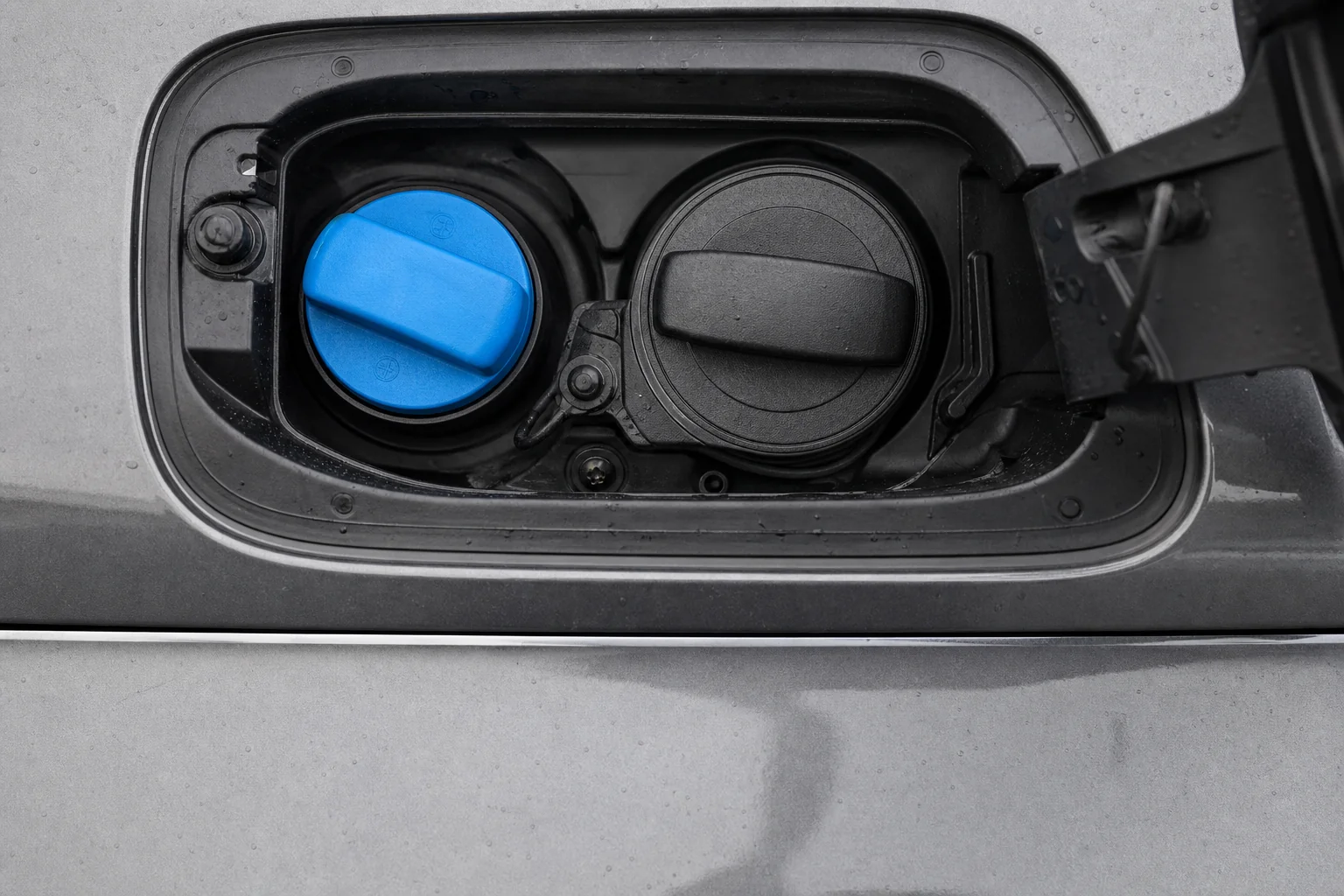
AdBlue is a urea solution injected into the exhaust so the SCR catalyst can convert NOx into nitrogen and water. When the system faults — NOx sensors, dosing valve, pump or crystallised fluid — the car starts a legally mandated countdown and will refuse to restart at zero. Deleting the system is illegal for UK road use. The fix is proper diagnosis, not removal: FLR diagnostics from £40 identifies the failed component before the countdown becomes a recovery truck.
The Short Answer
If your car has an AdBlue warning, treat it like a parking meter, not a suggestion. The system is legally required to enforce itself: ignore the countdown and the engine genuinely will not restart once it hits zero. The good news is that most AdBlue and SCR faults come down to a handful of known components — NOx sensors top the list — and all of them are diagnosable and repairable.
What is not an option is deleting the system. AdBlue/SCR removal is illegal on any vehicle used on UK roads, and FLR does not offer it. We diagnose from £40, tell you which part has actually failed, and fix that — no guesswork, no illegal shortcuts.
Who Has AdBlue — and Who Reads This Guide
Selective Catalytic Reduction arrived in volume with Euro 6 diesels — roughly 2015 onwards, earlier on some large SUVs and commercial vehicles. If your diesel has a blue filler cap next to the fuel filler, under the bonnet or in the boot floor, you have SCR. The owners who end up needing this guide are typically:
- Euro 6 diesel drivers — VW, Audi, BMW, Mercedes, Peugeot/Citroën, Jaguar Land Rover and most modern diesel platforms
- Van and fleet operators — Sprinters, Transits and Crafters working the M65/M66 corridor burn through AdBlue fastest and cannot afford no-restart downtime
- Motorway commuters — higher mileage means more dosing and earlier sensor wear
- Anyone staring at a countdown message — "AdBlue fault: no restart in X miles" or code P20EE on a scan
How SCR Actually Works — the Chemistry in Plain English
Diesel engines are efficient partly because they burn hot and lean — and that same combustion produces NOx, the pollutant behind most urban air-quality rules. EGR reduces some of it at the source; SCR cleans up what is left in the exhaust.
AdBlue itself is nothing exotic: a precisely mixed solution of 32.5% urea in deionised water. The system works like this:
- A pump draws AdBlue from its tank and a dosing valve sprays a fine mist into the hot exhaust ahead of the SCR catalyst
- Exhaust heat converts the urea into ammonia
- Inside the SCR catalyst, ammonia reacts with NOx and converts it into nitrogen and water vapour — the same harmless gases that make up most of the air you breathe
- NOx sensors before and after the catalyst measure how well the conversion is working, and the ECU adjusts dosing constantly
Consumption is modest — typically a litre every 350–600 miles depending on the vehicle and how it is driven. A tank usually lasts several thousand miles between top-ups.
The Countdown and No-Restart Logic — Why the Car Threatens You
The no-restart behaviour is not the manufacturer being dramatic. Emissions type-approval law requires an "inducement system": if the SCR system cannot do its job — empty tank, failed sensor, dosing fault — the vehicle must first warn the driver, then progressively restrict, and finally prevent the engine restarting after a set distance.
Two things matter in practice. The countdown is measured in miles, not time — a 650-mile warning on a Rossendale school-run car buys weeks; on a motorway van, days. And the car will not cut out while driving — it refuses the next restart after zero. That is your window to get it diagnosed; do not spend it hoping the light clears itself.
What Actually Fails on AdBlue Systems
After enough of these through the workshop, a clear pattern emerges:
- NOx sensors — the number one failure by a distance. They live in brutal heat, run internal heaters, and their wiring degrades. A failed NOx sensor triggers warnings even when the SCR system itself is fine. Code P20EE (SCR NOx catalyst efficiency below threshold) is frequently a sensor lying, not a catalyst dying — which is why we test before replacing a four-figure catalyst.
- Dosing valve / injector — sits in the exhaust stream and clogs with urea crystals, spraying poorly or not at all
- AdBlue pump and tank heater — pump failures and heater faults are common, and on some platforms the pump is part of a pricey tank module
- Crystallisation — AdBlue dries into white crystal deposits that block lines, valves and injectors, especially on cars that do short trips or have had a leak
- Level and quality sensors — a sensor misreading a full tank as empty produces a countdown with nothing actually wrong with the fluid
- Software faults — some platforms have known control-unit bugs fixed by manufacturer updates rather than parts
The moral: an "AdBlue fault" message tells you the system is unhappy, not which of half a dozen components is responsible. Live-data diagnostics — commanded dosing tests, NOx sensor plausibility checks, pump pressure readings — is how you avoid replacing parts at random. That is exactly what our AdBlue solutions service and fault-finding work is built around.
Winter Behaviour — Why AdBlue Hates a Lancashire January
AdBlue freezes at around -11°C, and it regularly gets close to that on the tops around Haslingden and Rossendale. Manufacturers plan for this — the tank has a heater, and the system is designed to start the engine before the fluid has thawed — but winter still exposes weak points:
- Tank heater failures often only reveal themselves in a cold snap, when the system cannot thaw and dose, and a fault registers
- Repeated freeze-thaw cycles accelerate crystallisation in lines and around the injector
- Topping up with fluid stored badly — AdBlue degrades in heat and sunlight — introduces contamination the quality sensor may flag
If an AdBlue warning appears in freezing weather, it may clear once things thaw properly. If it persists past a good warm run, book a scan.
Refilling AdBlue — Getting the Simple Bit Right
Most AdBlue "faults" we are called about are just low fluid, so it is worth doing the basics well:
- Buy AdBlue meeting ISO 22241 — supermarket and motor-factor own brands meeting the standard are fine; the brand name matters less than the spec
- Never dilute it, and never put AdBlue anywhere except the blue-capped filler — AdBlue in the fuel tank is an engine-out level mistake, so stop immediately and do not start the car if it happens
- Add a decent quantity — some cars will not clear a low-level warning until several litres go in
- Wipe up spills promptly; dried AdBlue leaves crystals and corrodes some metals
- After a refill, some vehicles need ignition-on for a minute or a short drive before the warning resets
AdBlue Deletes and UK Law
Search any AdBlue fault and you will find emulators and "delete" services promising to make the problem disappear. The legal position is not ambiguous: disabling or bypassing the SCR system on a vehicle used on UK roads is illegal. It breaches the Road Vehicles (Construction and Use) Regulations, and for commercial vehicles DVSA actively checks for emulators at roadside inspections — with substantial fines and prohibition notices for operators caught running them.
Beyond the law itself: an emulator fixes nothing. The failed sensor or pump is still failed; the car now simply lies about it while pumping untreated NOx out of the exhaust. It risks MOT failure, voids insurance as an undeclared illegal modification, and torpedoes resale the moment a dealer scan finds it. As with EGR and DPF systems, our position is fix-not-delete — bypasses belong solely on dedicated off-road and motorsport vehicles, and FLR does not fit them to road cars.
AdBlue and Remapping — What Changes, What Does Not
A legitimate remap leaves the SCR system completely alone. When we write a Stage 1 file (from £150) or an economy calibration for an AdBlue-equipped diesel, the NOx control strategy, dosing logic and inducement system all stay factory-active. Every FLR job runs the same way: diagnostics first, a custom file for your exact engine, a factory backup archived for life, and full reversibility.
And the order of operations rule applies here as everywhere: we do not remap a car with an active SCR fault or a countdown running. Power on top of an unhealthy emissions system helps nobody — the fault gets fixed first. Remaps must also be declared to your insurer; our insurance guide covers how that conversation goes.
When NOT to Panic — or Spend
- Low-fluid warning with no fault code — top up with ISO 22241 fluid and drive; this is maintenance, not a repair
- A warning in a hard freeze — give the system a proper warm run before assuming a component has died
- Quotes for a new SCR catalyst off one fault code — P20EE is frequently a NOx sensor; insist on live-data testing before four-figure parts
- Emulator offers — illegal, detectable and a false economy; walk away
Next Steps
If a countdown is running, book in promptly — the miles disappear faster than you expect. Diagnostics from £40 at our Haslingden workshop, with mobile visits across Lancashire and the North West via the A56 and M66 corridor. Once the system is healthy, we are happy to talk tuning: Stage 1 from £150 with diagnostics included, or the remap-and-service bundle from £275.
Send us the fault message and your VRN, call 01706 404 357, or browse the Knowledge Centre for more plain-English emissions guides — including DPF regeneration, the other half of the modern diesel story.
AdBlue & SCR — Common Questions
AdBlue is a solution of 32.5% urea in deionised water, injected into the exhaust ahead of the SCR catalyst. Heat converts it to ammonia, which reacts with NOx inside the catalyst and turns it into harmless nitrogen and water vapour.
Yes. The inducement system is a legal requirement: once the countdown reaches zero the engine will not restart until the fault is fixed or the tank refilled. The car will not cut out while driving — it refuses the next restart, so use the countdown window to act.
P20EE means "SCR NOx catalyst efficiency below threshold". It sounds like a dead catalyst, but in practice it is frequently caused by a failing NOx sensor giving false readings. Live-data testing should always come before replacing the catalyst itself.
NOx sensors are the biggest offender, followed by dosing valves clogged with urea crystals, pump and tank-heater failures, crystallisation in lines, and level or quality sensor faults. Diagnosis identifies which component before any parts are bought.
No. Bypassing or disabling SCR on a road-going vehicle is illegal, DVSA checks commercial vehicles for emulators at the roadside, and it risks MOT failure, fines and voided insurance. FLR does not fit AdBlue deletes — the honest fix is repairing the failed component.
It freezes at around -11°C. The tank has a heater and the system is designed to cope, but cold snaps expose failed heaters and accelerate crystallisation. A warning that appears in freezing weather and persists after a good warm run needs a scan.
Yes, as long as it meets ISO 22241 — the spec matters, not the brand. Never dilute it, store it away from heat and sunlight, and never put it in the fuel filler. If AdBlue goes into the fuel tank, do not start the engine — call for help immediately.
A legitimate remap leaves SCR fully active — dosing, NOx monitoring and inducement all stay factory. FLR will not remap a car with an active AdBlue fault; the system gets fixed first, then we tune the healthy engine. All remaps must be declared to your insurer.