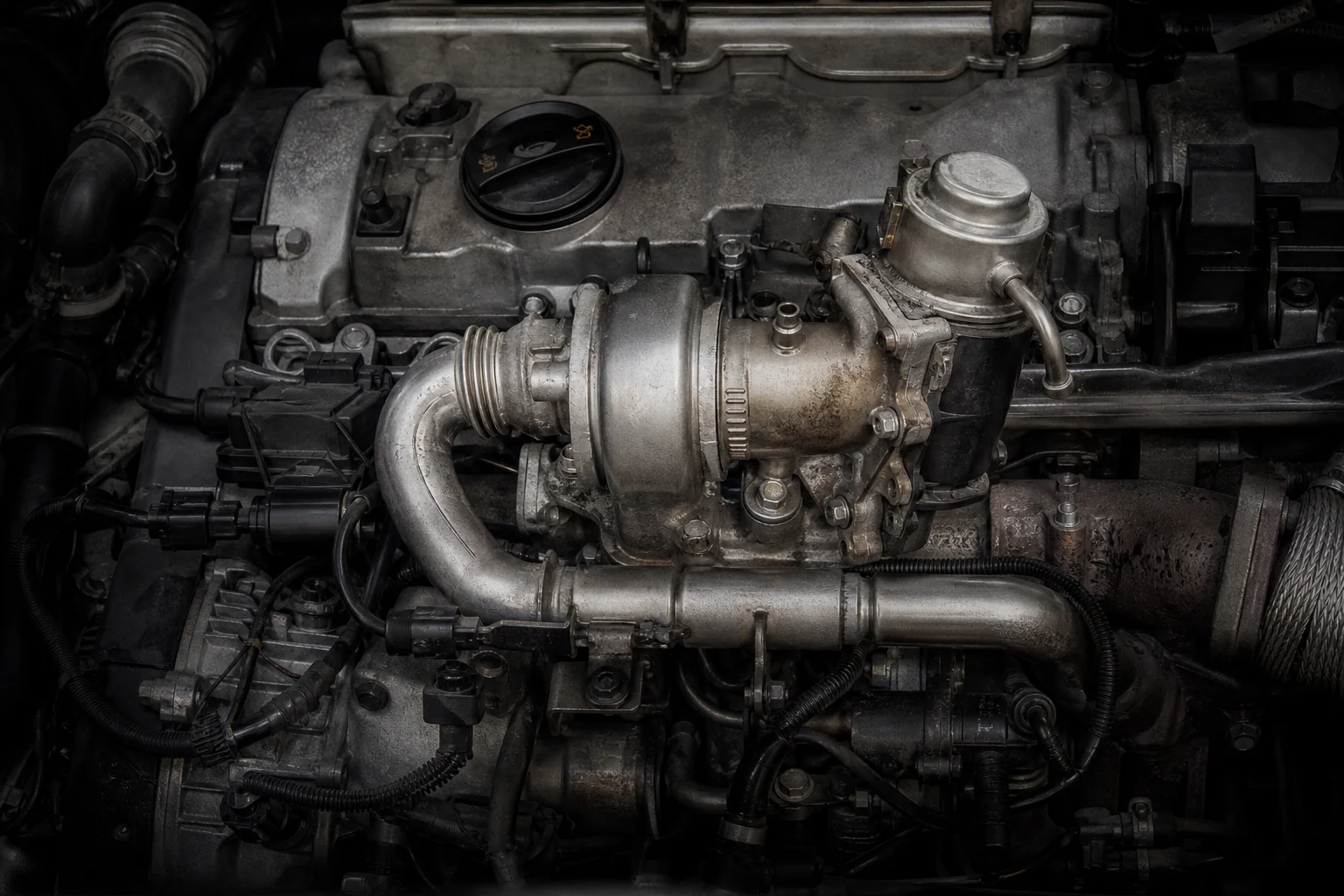
The EGR valve recirculates a measured amount of exhaust gas back into the intake to cut NOx emissions — and slowly carbons itself up doing it. Sticking valves cause rough idle, flat spots, limp mode and codes like P0401/P0402. Cleaning or replacement fixes it properly. Removing or mapping out the EGR is illegal for UK road use — FLR does not do deletes. We diagnose first from £40, fix the actual fault, and only then talk tuning.
The Short Answer
Your EGR valve is an emissions device doing a dirty job in a dirty place, and on most engines it will need attention at some point in the car's life. When it sticks, the fix is cleaning or replacement — not removal. An EGR delete is illegal for any car used on UK roads, and a remap does not fix a faulty valve either. The honest order is always the same: diagnose, repair, then tune if you want to.
At Finish Line Remaps in Haslingden we see EGR faults weekly — commuter diesels off the M65, school-run SUVs from Rossendale, vans working the A56 all day. Most are fixable in an afternoon. Start with diagnostics from £40 and you will know exactly what you are dealing with before spending on parts.
Who This Guide Applies To
EGR problems are heavily weighted toward certain cars and certain driving patterns:
- Diesel owners — almost every diesel since the early 2000s runs EGR, and diesels produce the sooty exhaust that gums valves up fastest
- Short-trip drivers — cold engines and low loads mean more EGR flow and less heat to burn deposits off
- Turbo petrol owners — many modern petrols (including GDI engines) use EGR too, though faults are less common
- High-mileage cars — carbon accumulates over years; 80,000+ miles without EGR attention is common territory for a sticking valve
- Anyone with P0401, P0402 or P0403 codes — the classic EGR flow and circuit faults
If your diesel rarely gets a proper motorway run, our guide to short-trip diesel ownership pairs well with this one — the same driving pattern that clogs EGR valves also kills DPFs.
What the EGR Valve Actually Does
EGR stands for Exhaust Gas Recirculation. The valve sits between the exhaust manifold and the intake, and under certain conditions — typically light load and cruising — it opens to let a measured amount of exhaust gas flow back into the engine.
Why feed an engine its own exhaust? NOx. Oxides of nitrogen form when combustion temperatures get very high, and NOx is the pollutant most associated with urban air quality problems. Recirculated exhaust gas is mostly inert — already burned — so it dilutes the fresh intake charge, lowers peak combustion temperature, and cuts NOx at the source.
The ECU controls the valve constantly, cross-checking against the MAF sensor and expected airflow. When the valve cannot move as commanded — stuck open, stuck shut, or lazy — the numbers stop adding up, a fault code sets, and the engine management light comes on.
Why EGR Valves Stick — the Carbon Problem
Here is the design irony: the EGR valve handles sooty exhaust gas, and diesel exhaust also carries oily vapour from the crankcase breather system. Mix hot soot with oil mist in a cool intake tract and you get a black, tar-like sludge that builds up in layers — on the valve seat, the pintle, the EGR cooler and the intake manifold itself.
Eventually the valve physically cannot seal or cannot open. Short-trip driving accelerates the process dramatically because the system never gets hot enough for long enough to keep deposits moving. We have opened intake manifolds around Lancashire with passages narrowed to half their original diameter — more carbon than manifold.
Direct injection makes it worse on the intake side, because no fuel washes over the valves to clean them — a subject of its own in our guide to carbon build-up in direct injection engines.
Symptoms of a Faulty EGR Valve
EGR faults present differently depending on whether the valve is stuck open or stuck shut:
- Rough or lumpy idle — a valve stuck open leaks exhaust into the intake at idle, where the engine wants clean air
- Flat spots and hesitation — unmetered exhaust gas dilutes the charge under acceleration, so the car stumbles when you ask for power
- Limp mode — the ECU restricts power to protect itself when EGR flow readings go out of range; see limp mode explained
- Engine management light — typically P0401 (insufficient EGR flow), P0402 (excessive flow) or P0403 (circuit fault)
- Increased smoke and worse MPG — combustion is compromised whichever way the valve fails
- More frequent DPF regenerations — extra soot from poor combustion loads the particulate filter faster
None of these symptoms are exclusive to EGR — a lazy MAF sensor, split boost hose or failing injector can mimic several of them. That is exactly why we scan and check live data before condemning any part. Guesswork parts-swapping is the most expensive way to fix a car.
Cleaning vs Replacement — What It Really Costs
Once diagnostics confirm the EGR valve is the problem, you have three honest options:
- Chemical or manual cleaning — effective when deposits are moderate and the valve motor and position sensor still work. Typically the cheapest fix, often £80–£200 at an independent depending on access.
- Valve replacement — necessary when the actuator motor or sensor has failed, or carbon has physically worn the mechanism. Parts range from roughly £100 on common diesels to £400+ on awkward engines, plus labour. Some EGR valves are buried; labour is the real variable.
- EGR cooler replacement — coolers can crack or clog. This is the bigger job and where quotes climb, particularly on V6 diesels where the cooler lives in the engine valley.
Two workshop truths. First, cleaning a valve that has electrically failed is wasted money — testing comes before spanners. Second, a new valve bolted to a heavily coked manifold will clog again quickly; a proper job addresses the cause, not just the component. Our EGR solutions service covers testing, cleaning and replacement — diagnostics first on every job.
EGR Deletes and UK Law — the Part Nobody Should Sugar-Coat
You will find plenty of people online offering to blank, delete or "map out" an EGR valve. Here is the position, plainly: removing or defeating the EGR system on a vehicle used on UK roads is illegal. Under the Road Vehicles (Construction and Use) Regulations it is an offence to use a vehicle modified so it no longer meets the emissions standards it was approved to — whether the valve is physically blanked or disabled in software.
The practical consequences stack up quickly:
- MOT risk — visible tampering or emissions failures can fail the test, and testers are increasingly wise to blanking plates and suspicious fault-code histories
- Insurance risk — an undeclared illegal modification gives an insurer clear grounds to void a policy, and remaps of any kind must be declared regardless; see our remap and MOT guide
- Fines — using a non-compliant vehicle on the road can attract significant penalties
- Resale problems — a deleted car is a liability the next owner inherits, and dealer scan tools spot software tampering
FLR does not offer EGR deletes for road cars, full stop. The genuine off-road and motorsport market — dedicated track and competition vehicles that never touch a public road — is the only place such modifications belong. Anyone framing a delete as a cheap "fix" for your daily driver is selling you a legal problem.
EGR and Remapping — What a Map Can and Cannot Do
A question we get most weeks: "can you just remap the EGR fault away?" No — anyone who says yes is describing an illegal delete with softer words. A legitimate remap works with the factory emissions systems fully active; it changes fuelling, boost and torque delivery within safe limits, not NOx control.
What is true is that a well-calibrated engine runs cleaner, and less soot slows the rate at which the EGR system re-coats itself. But the order matters: a remap on top of a sticking valve just makes a compromised engine work harder. Every FLR job — from Stage 1 from £150 upward — starts with diagnostics, uses a custom file written for your exact engine, keeps a factory backup for life, and remains fully reversible.
Common EGR Misconceptions
- "EGR robs loads of power." A healthy system mostly operates at light load and cruise — not under hard acceleration. Power you have "lost" is usually a fault, not the system working.
- "Blanking it improves MPG." Marginal at best, illegal regardless, and many ECUs compensate or trip limp mode anyway.
- "Cleaning never lasts." A clean valve on a healthy engine lasts for years. Cleaning fails when the underlying cause — short trips, breather problems, worn injectors — is ignored.
- "It's an EGR fault because the code says EGR." Codes report symptoms, not causes: insufficient flow can be a clogged passage, a vacuum leak or a sensor issue. Read our guide to fault codes before remapping.
When NOT to Touch the EGR Valve
Honest advice includes knowing when to leave things alone:
- No symptoms, no codes — preventative EGR replacement on a healthy car is rarely worth it
- Undiagnosed rough running — do not buy an EGR valve on a forum hunch; test first
- Multiple stored codes — fix in a logical order guided by live data, not by whichever part is cheapest online
- Right before an MOT with an active light — clearing codes to sneak through fixes nothing and the light returns
Next Steps
If your car has any of the symptoms above, book diagnostics from £40 at our Haslingden workshop or ask about mobile visits across Lancashire and the North West. We will scan the car, test EGR operation on live data, and give you a straight answer: clean it, replace it, or look elsewhere. Once the car is healthy, Stage 1 starts from £150 with diagnostics included — or pair it with a service in our £275 remap-and-service bundle.
Get in touch, call 01706 404 357, or browse the Knowledge Centre for more on emissions systems, tuning and the law.
EGR Valves — Common Questions
It recirculates a controlled amount of exhaust gas back into the engine's intake at light load. The inert exhaust gas lowers peak combustion temperature, which cuts NOx emissions — the pollutant most linked to urban air quality problems.
Rough idle, hesitation and flat spots under acceleration, limp mode, an engine management light with codes like P0401 or P0402, increased smoke and worse fuel economy. Symptoms differ depending on whether the valve is stuck open or stuck shut.
Often, yes — if the deposits are moderate and the valve motor and position sensor still work. Cleaning is usually the cheaper fix. If the actuator has electrically failed or the mechanism is worn, replacement is the right call. Diagnostics tells you which before you spend.
No. Removing or defeating the EGR system — physically or in software — on a vehicle used on UK roads is illegal, risks MOT failure and can void your insurance. Deletes belong only on dedicated off-road and motorsport vehicles. FLR does not offer EGR deletes for road cars.
No. A legitimate remap works with the emissions systems active — it cannot repair a valve that is mechanically stuck or electrically dead. Fix the fault first, then tune the healthy engine. Anything sold as "mapping out" an EGR is an illegal delete by another name.
P0401 is "EGR insufficient flow detected" — the ECU commanded the valve open but did not see the expected change in airflow. Causes include a stuck or carboned valve, blocked EGR passages, a faulty position sensor or vacuum control issues. Live-data testing narrows it down.
Cleaning typically runs £80–£200 depending on access. Replacement valves range from around £100 on common diesels to £400+ on awkward engines, plus labour. EGR cooler jobs cost more. FLR diagnostics from £40 confirms the fault before any parts are ordered.
Give the car regular sustained runs at operating temperature, keep servicing up to date with the correct oil, and fix breather or injector issues promptly. Short cold trips are the biggest accelerator of carbon build-up in the EGR circuit and intake.