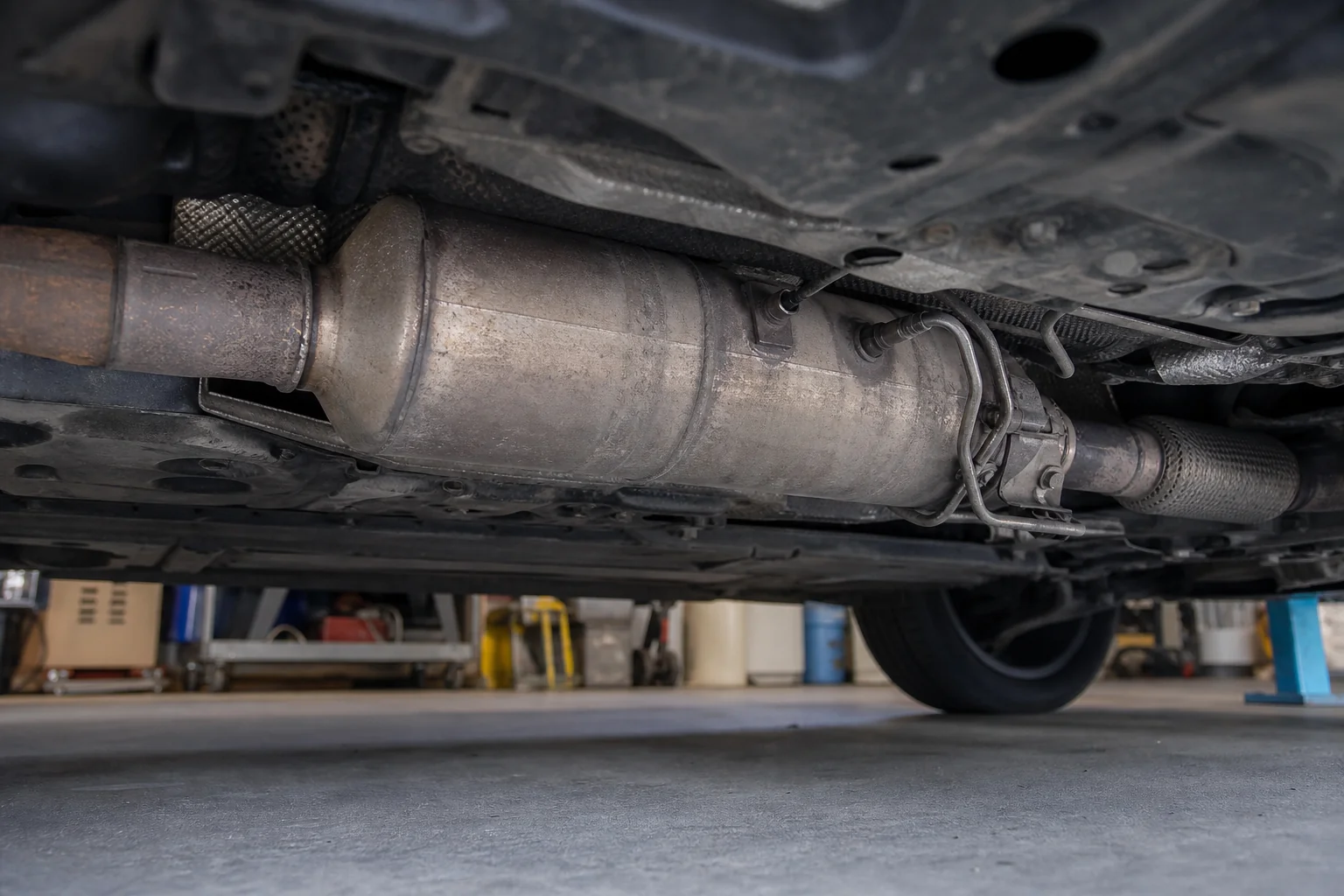
DPF regeneration burns trapped soot into a small amount of ash at very high exhaust temperatures. Passive regen happens free on motorway runs; active regen is the ECU injecting extra fuel to force the burn; forced regen is the workshop tool of last resort. Signs of an active regen: raised idle, cooling fans running, a hot smell and a brief MPG dip — do not switch off mid-regen. Repeatedly interrupted regens cause blockages and oil dilution. DPF removal is illegal for UK road use. FLR diagnoses DPF problems properly from £40.
The Short Answer
A DPF does not "fill up and die" by design — it continuously cleans itself through regeneration, and a filter that regenerates properly can outlast the rest of the car. Almost every blocked DPF we see at our Haslingden workshop got that way for one of two reasons: a driving pattern that never let regens complete, or an underlying fault — EGR, injectors, sensors, thermostat — that made the engine produce more soot than the filter could burn. Both are fixable. Neither is fixed by removal, which is illegal for UK road use.
If your DPF light is already on, our DPF and remapping facts guide covers the fault side. This page is about the process itself — because once you understand what a regen is, keeping the filter healthy becomes obvious.
Who Needs to Understand This
- Every diesel owner from roughly 2009 onwards — Euro 5 made DPFs effectively universal on diesels
- Short-trip drivers — school runs, town commutes, quick shop hops; the highest-risk usage pattern by far
- New-to-diesel drivers — the raised idle and fan noise of a regen sends a lot of people to Google in a mild panic
- Owners of petrols with GPFs — newer petrol particulate filters follow the same logic, though they regenerate more easily
- Anyone quoted for a new DPF — understanding regeneration helps you judge whether the quote makes sense
What Regeneration Actually Is
The DPF is a ceramic honeycomb that physically traps soot particles from the exhaust. Trapped soot has to go somewhere, so the system burns it off: at around 550–600°C, soot oxidises into CO₂ and a tiny residue of incombustible ash. That burn-off is regeneration.
The ECU tracks how full the filter is using a differential pressure sensor — measuring the pressure drop across the filter — combined with a soot model based on your driving. When the calculated soot load crosses a threshold, the car arranges a burn. There are three ways that happens.
Passive, Active and Forced Regeneration
- Passive regeneration — free and invisible. Sustained motorway driving gets the exhaust hot enough that soot burns off gradually as you drive. A weekly 30–40 minute run at motorway speeds — the M65 or M66 does the job nicely — keeps many DPFs healthy with no intervention at all.
- Active regeneration — the ECU takes matters into its own hands. When soot load builds and passive conditions have not occurred, it injects extra fuel late in the combustion cycle to raise exhaust temperature artificially and force the burn. This typically happens every 200–400 miles, takes 10–25 minutes of driving, and mostly goes unnoticed — which is exactly the problem, because switching off halfway through abandons the burn.
- Forced regeneration — a workshop procedure via diagnostic equipment, used when soot load has climbed too high for the car to attempt its own regen safely. The car is regenerated stationary under supervision, with temperatures and pressures monitored live. Above a certain soot threshold even a forced regen is off the table, and cleaning or replacement becomes the conversation.
How to Tell an Active Regen Is Running
The car does not announce it, but the clues are consistent:
- Raised idle — often 100–200rpm above normal when you stop
- Cooling fans running after you park, sometimes for several minutes
- A hot, slightly acrid smell from the exhaust area — alarming the first time, normal during a burn
- A temporary MPG dip — extra fuel is being spent on heat
- Stop-start deactivating and sometimes a change in engine note
- On some cars, a subtle increase in oil level over time — see oil dilution below
The single most useful habit a diesel owner can learn: if you notice these signs, keep driving for another ten minutes or so. Let the burn finish. Parking up mid-regen once is harmless; making a habit of it is how filters block.
What Repeatedly Interrupted Regens Do
Each abandoned regen leaves the filter partially loaded. The ECU tries again sooner, burning more fuel, and if attempts keep failing the soot load climbs into warning-light territory. From there the sequence is familiar: DPF light, then restricted performance, then limp mode, and eventually a filter too full for the car to regenerate itself.
There is a second, sneakier cost: oil dilution. Active regens work by injecting extra diesel, and some of it washes past the rings into the sump. On cars doing frequent failed regens the oil level actually rises — diluted oil protects worse and, in extreme cases on some engines, a rising sump level is genuinely dangerous. If your oil level is going up rather than down, that is a diagnostic red flag, not a bonus. It also means mapped or hard-worked engines on short-trip duty need oil changes more often, not less — covered in our servicing after a remap guide.
The Sensors That Make It All Work
Regeneration is only as good as the data feeding it. The differential pressure sensor is the key witness — and a common liar. A faulty or blocked-pipe pressure sensor can report a clogged filter that is actually fine, or mask one that is genuinely full. Exhaust temperature sensors bracket the DPF to manage the burn safely; when they drift, regens are aborted or never triggered. A lazy thermostat that keeps the engine cool has the same effect from the other direction.
This is why "my DPF is blocked" always deserves live-data diagnosis before parts. We regularly see cars quoted four figures for a new filter when the actual fault was a £60 sensor or a split pressure pipe. Diagnostics from £40 settles it with evidence.
Driving Habits That Keep a DPF Alive
- One proper run a week — 30–40 minutes at sustained speed; the M65, M66 or a good A56 run all work
- Do not switch off during a regen — learn the signs above and give the car ten more minutes when you spot them
- Use the right oil — DPF cars need low-SAPS oil (typically ACEA C-grade); the wrong oil produces ash that never burns off
- Fix warning lights promptly — EGR and injector faults multiply soot production; see our EGR guide
- Match the car to the job — if your driving is genuinely all short trips, a modern diesel may simply be the wrong tool; our short-trip diesel guide is the honest read
When a Workshop Forced Regen Is the Right Call
If the DPF light is on and soot load has climbed beyond what the car will handle itself, a supervised forced regeneration is often the fix — provided the underlying cause is addressed at the same time. Our process at FLR is the same every time: scan the car, read soot and ash levels, check pressure and temperature sensors on live data, identify why the filter loaded up, then regenerate where it is safe to do so. A forced regen on top of an unfixed fault just books the same appointment again in a month.
What we do not do is remove the filter. DPF removal is illegal for UK road use — it is an automatic MOT failure (the filter's presence is checked, and smoke testing catches gutted filters), an offence under the Road Vehicles (Construction and Use) Regulations, and an insurance-voiding modification. Every legitimate option — regen, clean, sensor repair, replacement — comes first, and off-road-only solutions belong strictly on vehicles that never touch a public road. Full detail on our DPF solutions page.
When NOT to Act
- Fans running after a drive with no warning lights — that is a regen finishing, not a fault
- A one-off MPG dip — normal during an active regen cycle
- Additive miracle cures for a lit DPF warning — a bottle in the tank does not clear a heavily loaded filter or fix the sensor fault that caused it
- Replacing the DPF off a single pressure reading — verify the sensor and pipes first; filters get condemned on faulty evidence constantly
Next Steps
Want to see the regen cycle visually? The interactive DPF explainer in our Knowledge Centre walks through soot loading and burn-off stage by stage. If your DPF light is on now, book diagnostics from £40 — workshop in Haslingden or mobile across Lancashire. And if the car is healthy and you want it driving at its best, every FLR remap keeps the DPF and full emissions suite active: Stage 1 from £150 with diagnostics included, custom file, factory backup and full reversibility as standard.
Get in touch or call 01706 404 357 — we would genuinely rather teach you to keep your filter healthy than sell you a new one.
DPF Regeneration — Common Questions
An active regeneration typically takes 10–25 minutes of driving. Passive regeneration is gradual and continuous during sustained motorway driving. A workshop forced regen usually takes 20–40 minutes under diagnostic supervision.
Raised idle, cooling fans running after you park, a hot acrid smell, a temporary MPG dip and stop-start deactivating are the classic signs. If you notice them, keep driving for another ten minutes to let the burn complete.
Once is harmless — the ECU simply tries again later. Repeatedly interrupting regens lets soot accumulate, triggers warning lights and eventually blocks the filter. It also increases oil dilution, because regen fuel washes into the sump each aborted cycle.
Typically every 200–400 miles for active regens, though it varies with driving style, fuel quality and engine health. Very frequent regens — every 60–100 miles — usually point to an underlying fault or a short-trip pattern worth investigating.
Fuel dilution from repeated or failed active regens — extra injected diesel washes past the rings into the sump. A rising oil level needs investigating promptly: diluted oil protects poorly, and the failed regens behind it have a cause worth finding.
Often, yes — if the light has just come on, a sustained 30–40 minute drive at motorway speeds can let an active regen complete. If the light stays on, flashes, or the car is in limp mode, soot load is likely too high and it needs diagnostic attention.
No. Removing a DPF from a road-going vehicle is illegal, an automatic MOT failure and grounds for voided insurance. Every legitimate fix — regeneration, cleaning, sensor repair or replacement — should come first. FLR does not remove DPFs from road cars.
A properly written remap keeps the DPF and regeneration strategy fully active, and an efficient calibration can even reduce soot production. FLR never remaps a car with an active DPF fault — diagnosis and repair come first, then tuning. See our DPF and remapping guide.