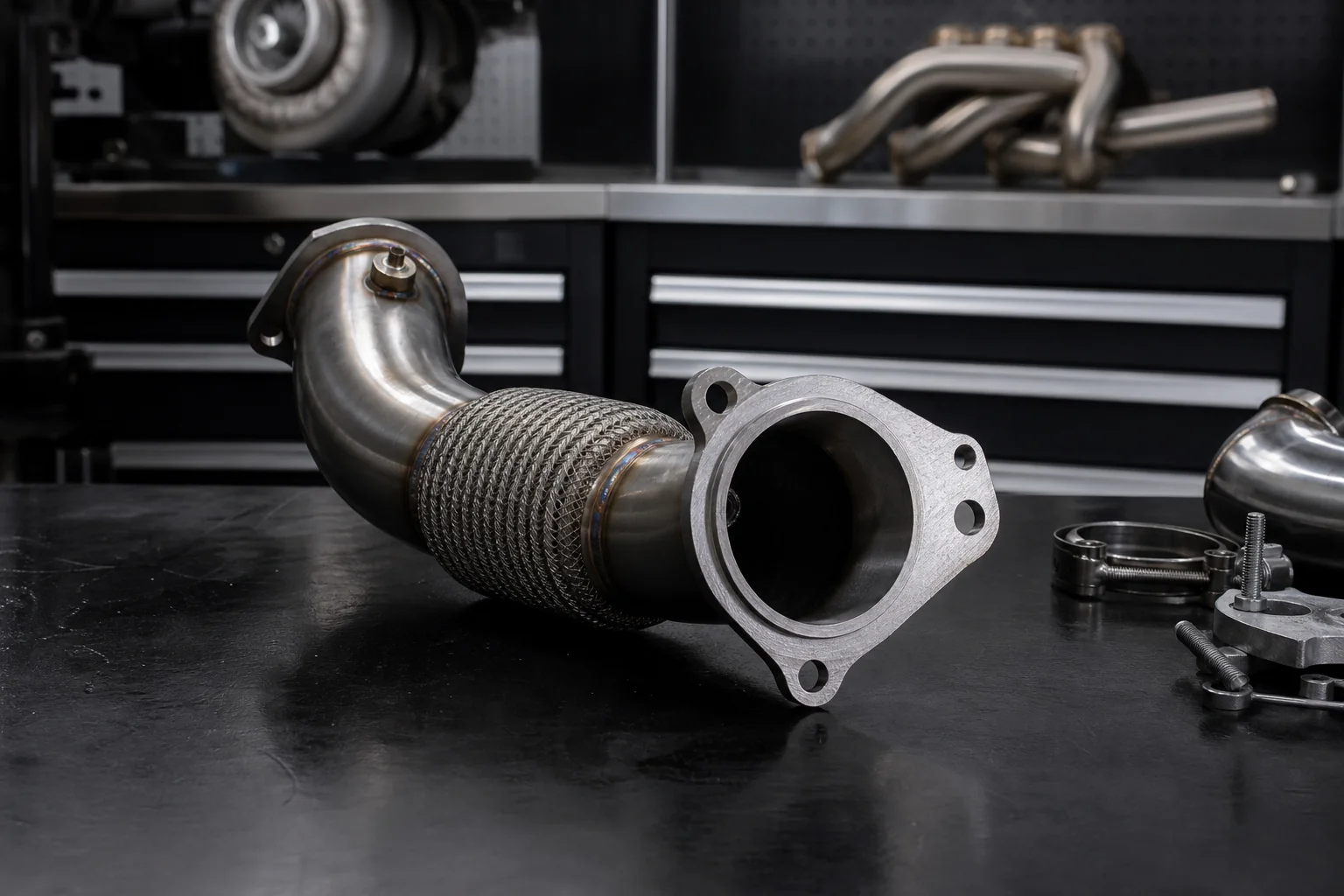
Removing a catalytic converter from a road car is illegal in the UK — it is an emissions offence, an MOT failure on both the visual check and the gas test, and an insurance-voiding modification. Decat pipes flow better, which is precisely why they belong on dedicated track and motorsport vehicles only. For road-going Stage 2 builds, a quality sports cat delivers most of the flow benefit while keeping the car legal. FLR builds road cars legal and track cars honest — and we will tell you which side of the line your plan sits on before you spend.
The Short Answer
Is a decat legal in the UK? Not for road use — full stop. A car first used with a catalytic converter must keep one that works. Removing it breaches the Road Vehicles (Construction and Use) Regulations, fails the MOT, and hands your insurer a reason to walk away from a claim. None of that is scare-mongering; it is just how the rules read.
Does that mean fast road cars are stuck with a restrictive factory exhaust? No. High-flow sports cats exist for exactly this reason, and for most Stage 2 road builds they are the right answer. Decats have a legitimate home too — on track and competition vehicles that never drive to the circuit on public roads. The rest of this guide unpacks each piece.
Who This Guide Is For
- Stage 2 planners — anyone speccing a downpipe or exhaust to pair with a bigger map
- Buyers of modified cars — a previous owner's decat becomes your legal problem the day you buy it
- Owners with a P0420 code — "catalyst efficiency below threshold" prompts a lot of people to consider removal instead of repair
- Track-day and motorsport builders — the one audience for whom a decat is a legitimate conversation
What a Catalytic Converter Actually Does
The cat is a honeycomb coated with precious metals — platinum, palladium, rhodium — sitting in the exhaust stream. As hot gases pass through, the coating catalyses three chemical clean-ups at once: carbon monoxide becomes CO₂, unburned hydrocarbons become CO₂ and water, and NOx is reduced back to nitrogen. A healthy modern cat converts well over 90% of these pollutants once warm.
The ECU watches it constantly using oxygen sensors before and after the cat. When the downstream sensor sees the cat no longer storing and converting properly, you get the famous P0420 code. And because the cat needs heat to work, most real-world emissions happen in the first minutes of a cold start — one reason manufacturers mount cats ever closer to the turbo.
Sports Cat vs Decat — the Flow Reality
The honest engineering picture, without the marketing:
- Factory cats are built to a cost with dense cells (typically 400–600 cells per square inch). On a tuned turbo car they are a genuine restriction, particularly in the downpipe position.
- Decat pipes remove the restriction entirely — maximum flow, fastest spool, loudest exhaust. That is the whole appeal, and on a track car it is a fair engineering choice.
- Sports cats use high-flow cores (100–200 CPI) with better substrates. A quality 200-cell sports cat recovers most of the flow gain of a decat — on a typical Stage 2 road build the difference between a good sports cat and a full decat is small, and far smaller than forum lore suggests.
Two honesty notes. Cheap eBay "sports cats" with flimsy cores collapse, rattle and fail emissions — buy a reputable brand or do not bother. And no exhaust part adds power by itself on a stock map; hardware and calibration work together, which is why exhaust changes belong inside a proper Stage 2 conversation with matching custom software.
UK Law — Where the Line Actually Sits
The legal framework is worth spelling out precisely, because half-truths circulate constantly:
- Removal is a road offence. Using a vehicle on the road without the emissions equipment it was type-approved with breaches the Construction and Use Regulations. This applies regardless of whether the car "drives fine".
- MOT — visual check. Testers check for the presence of a catalytic converter on cars that require one. A missing cat is a fail before the gas probe comes out; obvious decat pipes are not subtle on a ramp.
- MOT — emissions test. Petrol cars face a metered gas test. Without a cat, CO and hydrocarbon readings on a warm modern engine will generally not pass. "It passed last year" usually means it was not looked at properly — not that it is legal.
- Insurance. An undeclared illegal modification gives an insurer grounds to void the policy — and unlike a declared remap, a decat is not something a mainstream insurer will simply accept on a road car. Remember any modification, including a remap, must be declared; see our insurance guide.
- Sports cats occupy a pragmatic space. An aftermarket high-flow cat is not type-approved equipment, but a quality unit keeps the car passing the MOT emissions test and maintains functioning emissions control — which is why it is the accepted route for fast road builds. Cheap units that cannot pass the gas test give you decat problems with extra steps.
More on how testers view modified cars in our remapping and MOT guide.
Insurance, Resale and the Long Tail of a Decat
The costs of a decat do not stop at the MOT station. An insurer that discovers an undeclared decat after a claim can void cover entirely — leaving you personally liable after a serious accident, which is a life-changing amount of risk to trade for a louder exhaust. Resale suffers too: a decatted car is a car the next owner has to put right before it is legal, and dealers and savvy buyers price accordingly. And with cat theft having made converters expensive and traceable, a missing cat raises questions you do not want a prospective buyer asking.
Where Decats Genuinely Belong
None of the above means decat pipes are evil. They are off-road and motorsport parts, and in that context they make sense: a dedicated track car, a competition build running to motorsport regulations, a drag or show vehicle transported on a trailer. No MOT emissions requirement applies to a vehicle that is never used on the public road, and maximum flow with no compromise is a legitimate goal there.
The line we hold at FLR is simple: we frame decat work strictly as off-road-only, we say so before any money changes hands, and we will not nod along to "it's for the track" on somebody's daily commuter. Our decat service page carries the same framing. If that costs us the occasional job, fine — it is the same fix-not-delete honesty we apply to DPF and EGR systems.
Honest Advice for Stage 2 Exhaust Choices
For a road car heading to Stage 2, our standing advice from the workshop floor:
- Spend on a quality 200-cell sports cat downpipe from a reputable manufacturer — it unlocks the flow the map needs while keeping the car legal and MOT-passable
- Budget for calibration, not just metal — the custom file is what turns hardware into usable, safe power; every FLR map is written for your exact spec, with a factory backup kept for life and full reversibility
- Declare the build to your insurer — remap and hardware both
- Ignore peak-number chasing — we do not promise specific BHP figures, because the honest gains depend on your engine, fuel and hardware; anyone quoting exact numbers before seeing the car is guessing
- Diagnostics before tuning — from £40, every time; a Stage 2 build on a tired engine is money in the wrong order. Our diagnostics service and turbo health guide cover what we check.
When NOT to Touch the Exhaust
- P0420 with no other work planned — diagnose first; failing oxygen sensors and exhaust leaks mimic a dying cat, and a £60 sensor beats an £800 cat every time
- A daily driver you cannot afford to have off the road — exhaust work that risks MOT trouble on your only car is the wrong project
- Chasing sound alone — a cat-back system changes the note without touching emissions hardware and stays comfortably legal
- Buying used and "sorting it later" — a decatted car is illegal the day you drive it home; price the correction into the deal or walk away
Next Steps
If you are planning a build, send us your VRN and goals — we will spec the exhaust and software honestly, whether that is a road-legal sports-cat Stage 2 or a genuine track project. If a P0420 or emissions worry brought you here, book diagnostics from £40 before condemning any parts. Stage 1 remains the no-hardware option from £150 with diagnostics included, and the Knowledge Centre covers the wider legal picture on emissions systems and tuning.
Workshop in Haslingden, mobile across Lancashire and the North West — call 01706 404 357.
Cats & Decats — Common Questions
Not for road use. Removing the catalytic converter from a car that was fitted with one breaches the Construction and Use Regulations, fails the MOT and can void your insurance. Decat pipes are legitimate only on dedicated off-road, track and motorsport vehicles.
Yes, on two fronts: testers visually check that a required catalytic converter is present, and petrol cars must pass a metered emissions test that a decatted modern engine will generally not pass. Claims of decats "sailing through" usually mean the car was not checked properly.
A sports cat replaces the dense factory core with a high-flow 100–200 cell catalyst that still converts emissions; a decat removes the catalyst entirely. On a typical Stage 2 road build, a quality sports cat recovers most of the flow benefit while keeping the car legal.
A quality sports cat maintains functioning emissions control and lets the car pass the MOT gas test, which is why it is the accepted route for fast road builds. Cheap units with flimsy cores can fail emissions and collapse — buy reputable or not at all.
On a stock map, very little — hardware and calibration work together. Reduced exhaust restriction mainly benefits tuned turbo cars running matching custom software. That is why exhaust changes belong inside a proper Stage 2 build, not as a standalone bolt-on.
P0420 is "catalyst system efficiency below threshold" — the downstream oxygen sensor sees the cat underperforming. Causes include a genuinely worn cat, but also failing sensors, exhaust leaks and misfires. Diagnose before replacing anything expensive.
Yes — exhaust hardware and remaps are both material modifications that must be declared. An undeclared decat is worse still: it is an illegal modification, giving the insurer clear grounds to void the policy entirely after a claim.
Only in a strictly off-road, track or motorsport context, stated plainly up front. For road cars we build legal: quality sports cats, matching custom-written calibration, diagnostics first from £40, factory backup kept for life and everything reversible.