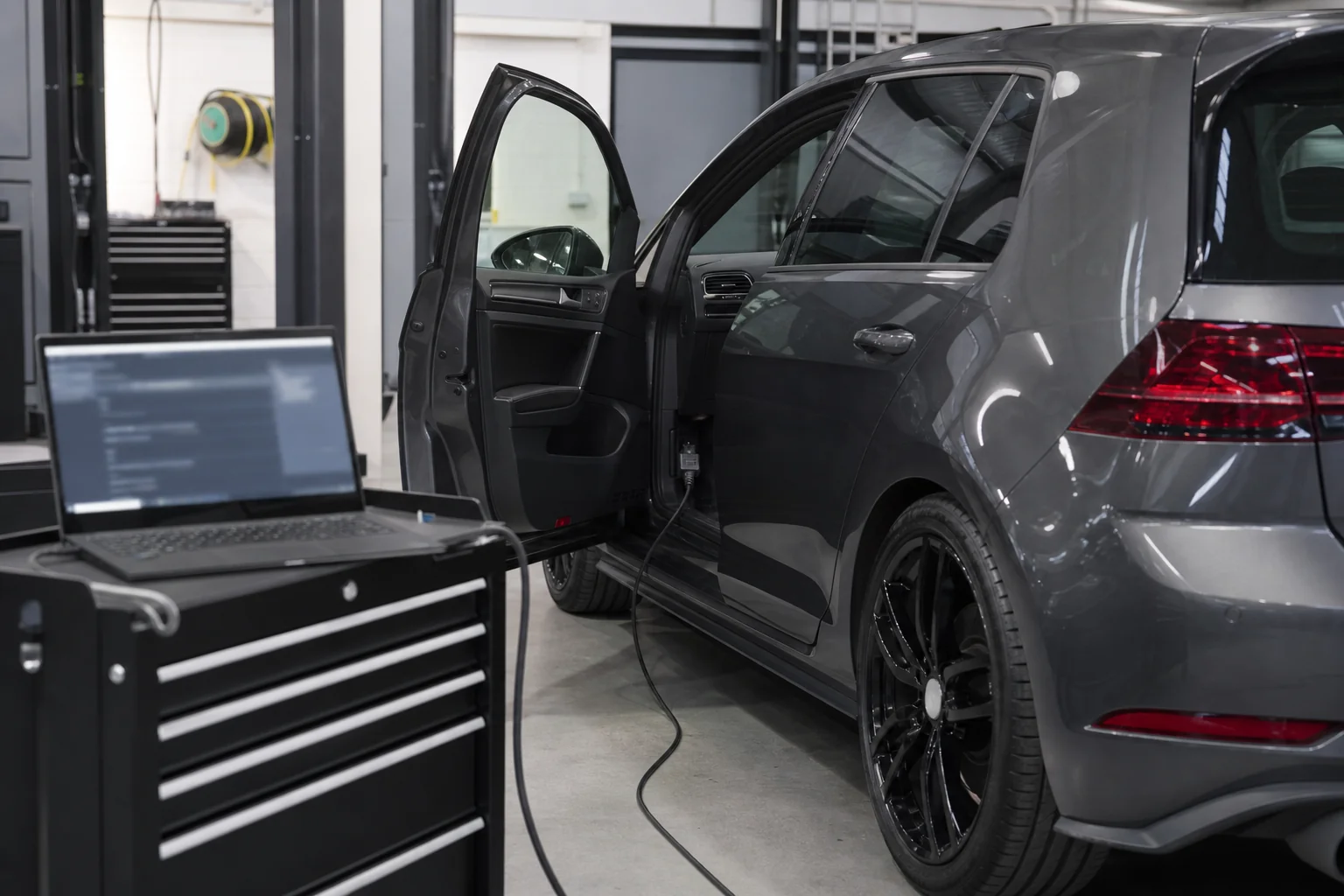
Why check the turbo before a Stage 1 remap? Because Stage 1 raises boost and load, and a tired turbo fails faster under both. Before any flash we check shaft play, boost leaks, actuator and wastegate operation, oil supply and live boost tracking. Warning signs you can spot yourself: whining or siren noises, blue smoke, rising oil use, lazy spool. If the turbo is not fit, we refuse to flash — diagnostics from £40 finds out either way. Stage 1 from £150 when the car is healthy.
The Short Answer
A Stage 1 remap raises boost targets and holds the engine at higher load more of the time. A healthy turbo takes that comfortably — factory components are engineered with margin, and a sensible calibration stays well inside it. A worn turbo does not get that margin. More boost through a bearing with play in it, or a compressor already breathing its own oil, accelerates the ending that was already written.
So the check is not box-ticking. It is the single biggest thing separating a professional remap from an expensive gamble — and it is why every FLR job starts with diagnostics before anyone talks about power. If you are weighing up whether Stage 1 makes sense for your car at all, start with is a Stage 1 remap worth it? — this guide covers the health gate the car must pass first.
Why Stage 1 Raises the Stakes for Your Turbo
A Stage 1 calibration typically raises boost pressure within safe hardware limits, extends how long peak boost is held, and increases fuelling to match. For the turbo, that means:
- Higher shaft speeds, more often — the compressor works harder across more of your driving
- More heat — sustained load raises exhaust gas temperatures at the turbine
- More frequent full-load events — because the car is now genuinely enjoyable to overtake in
None of this troubles a healthy unit — Stage 1 stays inside factory component tolerances by design. But it narrows the margin a worn turbo was quietly living on. The remap does not cause the failure; it brings the appointment forward. Which is why we would rather find the wear on the ramp than have you find it on the M65.
What We Physically Check Before Flashing
Before any Stage 1 at FLR — workshop or mobile — the turbo assessment covers:
- Shaft play — with intake pipework off, we check the compressor wheel for radial and axial movement. A little radial float on journal bearings is normal; a wheel that rocks or touches the housing is a refusal.
- Boost leaks — inspecting (and where needed pressure-testing) hoses, clamps, intercooler joints and the intake tract. A leak makes the turbo overwork to hit target — remapping on top compounds it.
- Actuator and wastegate operation — electronic actuators and VNT mechanisms checked for smooth, full travel; a sticking vane ring or lazy wastegate is exactly what causes overboost and limp mode after tuning.
- Oil supply and feed pipes — evidence of restricted or coked oil feed lines, oil condition and service history. Oil starvation is the number one turbo killer, tuned or stock.
- Oil residue mapping — some oil misting in the intake is normal on high-mileage engines; pooled oil before the compressor or soaked intercooler pipework tells a different story.
- Smoke colour — blue smoke points at oil (often turbo seals), black at over-fuelling, white at coolant. Each has a different diagnosis path before any tuning talk.
- Live-data boost tracking — a logged road test comparing actual boost against ECU target through the rev range. Slow spool, undershoot, overshoot or oscillation all show up here before they show up as a breakdown.
- Fault memory — stored and pending codes for underboost, overboost, air mass plausibility — the paper trail of a turbo that has been struggling quietly.
The whole assessment folds into the diagnostics that come with every remap booking — or you can book standalone diagnostics from £40 if you just want a verdict on the turbo before deciding anything.
Warning Signs You Can Spot Yourself
You do not need our tools to catch the early hints. Before booking any remap, pay attention to:
- Whining or siren noises — a rising whistle or "police siren" under boost that was not there last year usually means bearing wear or a cracked housing
- Blue smoke — especially on startup or when lifting off after a long pull; classic worn-seal behaviour
- Rising oil consumption — topping up between services when you never used to; the missing oil is going somewhere, and the turbo is a prime suspect
- Lazy spool — boost arriving noticeably later than it used to, or the car feeling flat until higher revs
- Flutter or surge noises — repeated chuffing on throttle lift can indicate leak or actuator issues
- Intermittent power loss or limp mode — the ECU pulling power to protect itself; read limp mode explained before you go anywhere near a tuning laptop
One or two of these do not automatically mean a dead turbo — a £40 diagnostic separates "needs a hose clamp" from "needs a turbo" cheaply. But be honest with yourself and your tuner about them. A remap booked to fix a car that "feels down on power" often reveals a fault, not a calibration problem — our guide on signs you need a remap covers how to tell the difference.
What Is Normal vs What Is Not
| Observation | Usually fine | Needs investigating |
|---|---|---|
| Shaft movement | Slight radial float, no contact | Rocking wheel, axial play, wheel touching housing |
| Intake oil | Light misting on high-mileage engines | Pooled oil, soaked intercooler hoses |
| Noise | Consistent, familiar turbo whistle | New whining, siren or grinding notes |
| Boost behaviour | Smooth build, tracks target | Undershoot, overshoot, oscillation, late spool |
| Exhaust smoke | Brief vapour on cold start | Blue on lift-off, persistent black under load, white plumes |
When We Refuse to Flash
This is the part some customers do not expect: sometimes the answer on the day is no. We will not flash a Stage 1 onto a car with:
- Measurable shaft play beyond normal float, or wheel-to-housing contact
- Unresolved boost leaks or actuator faults
- Active underboost/overboost fault codes or limp-mode history that has not been diagnosed
- Blue smoke or oil consumption pointing at failing seals
- Evidence of oil starvation — restricted feed pipes, sludge, missed services
It is not gatekeeping for the sake of it. A remap on that car would run fine for a fortnight, then the turbo would let go, and the remap would take the blame — bad for you, bad for us, bad for the industry's reputation. What you get instead is a written explanation of what we found and what it costs to put right. Fix it, and the Stage 1 is waiting. That diagnostics-first discipline is the same reason we wrote is ECU remapping safe? the way we did: safety is a process, not a promise.
Common Misconceptions
- "Stage 1 killed my mate's turbo." Almost always: a worn turbo met higher load and failed sooner than it otherwise would have. The check exists precisely to stop that story happening to you.
- "A healthy-sounding car doesn't need checking." Boost leaks and lazy actuators are often silent — they show in live data long before you hear anything.
- "High mileage means the turbo must be tired." Not necessarily. A well-serviced diesel at 140,000 miles with clean oil history often checks out better than a neglected 60,000-mile example. We test the turbo in front of us, not the odometer.
- "The remap can just be turned down if something's wrong." A calibration cannot compensate for mechanical wear. If the hardware is not fit, the answer is repair — never a softer map over a fault.
What It Costs
The turbo assessment is built into the diagnostics included with every remap booking — so on a healthy car, the check costs you nothing extra and Stage 1 is from £150 all-in: diagnostics, custom-written file, factory backup kept for life, live-data verification, fully reversible. If you would rather know the turbo's condition before committing to anything, standalone diagnostics start from £40 and the findings are yours either way. For context, a quality remap nationally averages £250–£500 — the difference at FLR is not corners cut, it is a workshop in Haslingden rather than a marketing budget.
Next Steps
If your turbo passes, Stage 1 on a healthy engine is one of the best-value upgrades in motoring. If you have noticed any of the warning signs above, get the diagnosis first — it is cheaper than a turbo and much cheaper than a turbo plus a recovery from Grane Road. Send your reg for a quote or call 01706 404 357; we cover Rossendale, wider Lancashire and the North West from Haslingden, mobile or in the workshop. More answers in the Knowledge Centre.
Turbo Health Before a Remap — Common Questions
Because Stage 1 raises boost and holds the engine at higher load more often. A healthy turbo handles that with margin to spare; a worn one fails faster under it. Checking shaft play, leaks, actuator operation and oil supply first is what separates a safe remap from an expensive gamble.
Shaft play at the compressor wheel, boost leaks across hoses and intercooler joints, actuator and wastegate travel, oil supply and feed-pipe condition, oil residue in the intake, exhaust smoke colour, stored fault codes and a logged road test tracking actual boost against ECU target.
New whining or siren noises under boost, blue smoke on startup or lift-off, rising oil consumption between services, lazy spool or a flat feeling until higher revs, flutter on throttle lift, and intermittent power loss or limp mode. Any of these deserve a diagnostic before tuning is discussed.
No — a properly written Stage 1 stays within factory component tolerances, and factory protections like boost limits and temperature safeguards remain active. Failures blamed on remaps almost always trace back to pre-existing wear that was never checked before flashing.
Yes, regularly. Measurable shaft play, unresolved boost leaks, active boost-related fault codes, blue smoke or oil starvation evidence all mean no flash that day. You get a written explanation of the findings and repair options instead — and the remap once the car is fit.
A small amount of radial float is normal on journal-bearing turbos. What matters is excessive movement, axial (in-out) play, or the compressor wheel contacting the housing — those indicate bearing wear that more boost will only accelerate.
It is included in the diagnostics that come with every FLR remap booking, so on a healthy car it costs nothing extra — Stage 1 is from £150 all-in. As a standalone check before you commit, diagnostics start from £40 and the findings are yours whatever you decide.
Not yet. Limp mode is the ECU protecting itself from a detected fault — often boost-related — and adding power on top makes it worse. Diagnose and fix the cause first; a remap is for healthy cars. Our limp mode guide explains the common causes and the right order to tackle them.