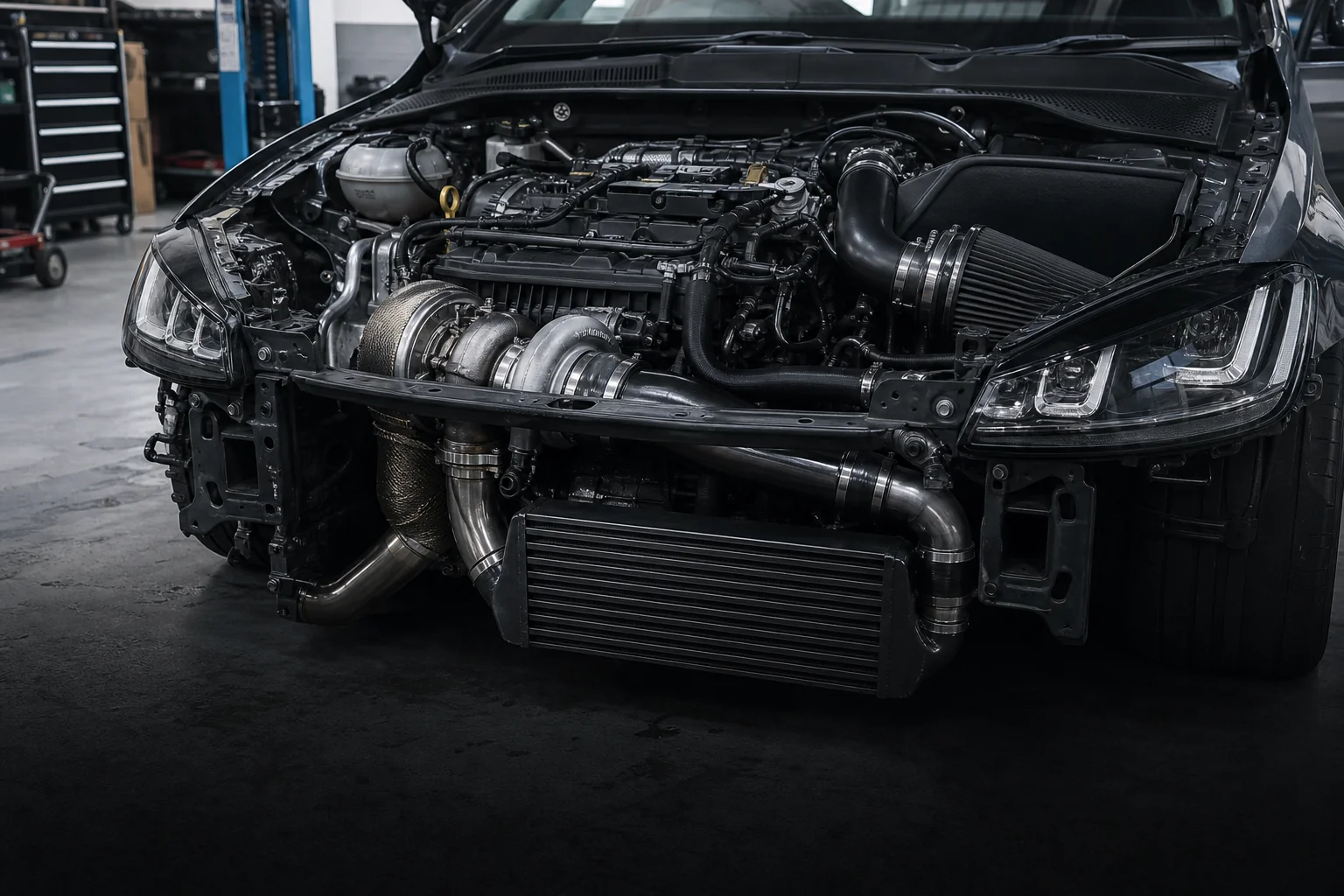
An intercooler cools the compressed air leaving your turbo before it enters the engine. Cooler air is denser (more oxygen per cylinder fill) and far less prone to knock, so the ECU can run the timing and boost the map asks for. Factory cores handle Stage 1 fine on a healthy car — an uprated intercooler becomes genuinely worthwhile at Stage 2 and above, or if you see power fade on back-to-back pulls (heat soak). We map around real logged temperatures, not marketing claims. Diagnostics first, custom file, factory backup, reversible — every job.
The Short Answer
What does an intercooler do? When your turbo compresses air, it heats it — significantly. An intercooler is a radiator for that compressed charge air, sitting between the turbo and the engine, dumping heat into the airflow passing through your front bumper. Cooler charge air is denser, so each cylinder fill contains more oxygen, and it is far less likely to trigger knock (uncontrolled combustion) in a petrol or excessive exhaust temperatures in a diesel.
In short: the turbo makes the air, the intercooler makes it usable. Every modern turbocharged car has one from the factory, sized for factory power plus a sensible margin. The tuning question is simply whether that margin covers the extra airflow your calibration asks for — and the honest answer depends on the stage, the car and how you drive it.
Who This Guide Is For
Owners weighing up Stage 2 hardware lists, anyone who has noticed their car feels slower on a third hard pull than the first, and drivers being upsold a shiny front-mount they may not need. If you are still deciding whether to tune at all, start with is a Stage 1 remap worth it — this guide picks up once boost and airflow enter your vocabulary.
Why Charge Temperature Matters — Density and Knock
Two pieces of physics drive everything in this article:
- Density. Air expands as it heats. Compressing air in a turbo can raise its temperature by well over 100°C, and hot air carries less oxygen per litre. Cool the charge back down and the same boost pressure delivers a denser, oxygen-richer cylinder fill — which means more fuel can be burned and more torque made at identical boost.
- Knock. On petrol engines, hot intake charge makes the air-fuel mixture more likely to ignite spontaneously before the spark — knock, or detonation. The ECU's knock sensors catch it and pull ignition timing to protect the engine, which costs power instantly. On diesels, hot charge air pushes exhaust gas temperatures up, forcing the ECU to reduce fuelling. Either way: heat in, power out.
This is why two identical remapped cars can perform differently on the same road — the one managing its charge temperatures keeps its calibrated timing and boost; the one running hot is quietly protecting itself. Modern ECUs are so good at this self-protection that owners often never realise heat is what is stealing their performance.
How an Intercooler Actually Works
Most cars use an air-to-air intercooler: compressed charge flows through internal tubes and fins while ambient air flows across the outside, carrying heat away. Effectiveness comes down to core size (surface area and volume), fin and tube design, and how much fresh air reaches it — which is why placement behind the bumper matters and why crawling traffic is an intercooler's worst enemy.
Some models (many BMWs, various performance engines) use air-to-water systems instead: a compact heat exchanger transfers charge heat into a dedicated coolant loop with its own radiator. These respond quickly and package neatly but can saturate under sustained load. Both types serve the same goal — deliver the coolest, densest charge the packaging allows. The turbo side of this system is covered in our how turbochargers work guide.
Heat Soak — The Power Thief on Back-to-Back Pulls
Heat soak is what happens when heat arrives faster than the intercooler can shed it. The core's metal itself warms up, and once it is saturated it stops cooling effectively — it can even start adding heat to the charge.
You have felt it even if you never named it: first overtake up the M66, car feels strong. Second, still decent. Third pull minutes later, noticeably flatter. Nothing is broken — the intake temperature sensor is reading high, and the ECU is trimming timing and boost to stay safe. Park up, let airflow do its work, and the performance comes back.
Small factory cores soak fastest, especially on hot days, in traffic, towing up long climbs like the A56 over the moors, or during repeated hard runs. A larger, denser uprated core takes far longer to saturate and recovers faster — that consistency, more than any peak number, is the real-world benefit owners notice.
Factory vs Uprated — Why Stage 2 Changes the Maths
A Stage 1 calibration from £150 works within sensible airflow limits, and on a healthy car the factory intercooler handles it — that is precisely why Stage 1 is software-only. Stage 2 is different: with a high-flow intake and exhaust hardware fitted, the calibration asks the turbo for meaningfully more airflow, which means meaningfully more compression heat, sustained for longer.
At that point the factory core shifts from "adequate with margin" to "the bottleneck". Logged intake temperatures climb during pulls, the ECU trims to protect itself, and the calibration cannot safely deliver what the hardware upstream could support. An uprated intercooler restores the margin: charge temperatures stay closer to ambient, stay there longer, and the map's advertised performance is there on the tenth pull, not just the first. This is why an intercooler sits on virtually every credible Stage 2 hardware list, alongside the choices we cover in the Stage 2 remap guide.
One caveat worth its own sentence: bigger is not automatically better. An oversized core adds charge-pipe volume (slightly lazier response) and can block airflow to the radiator and air-con condenser behind it. The right core is matched to the power target — another reason we spec hardware and calibration together rather than mapping around whatever arrived in a box.
Symptoms of a Tired or Undersized Intercooler
Signals worth investigating, on stock or tuned cars alike:
- Power fades on repeated pulls but returns after a cool-down — classic heat soak
- High intake air temperatures on live data — climbing steeply under load and slow to recover
- Noticeably stronger performance on cold mornings than warm afternoons — every car shows some of this, but a big gap points at charge cooling
- Oil residue or crusted fins — a light oil film inside pipework is normal; a soaked, road-grime-caked core has lost much of its efficiency
- Physical damage — bent fins from stone strikes, or a weeping core from corrosion, reducing effective area
- Boost leaks at the end tanks — hissing under load, overboost/underboost codes, fuel trims drifting
Several of these mimic other faults — a split boost hose or lazy sensor produces similar complaints. This is why every FLR job starts with diagnostics from £40 and live-data logging rather than guesswork, and why our signs you need a remap guide keeps hammering the same point: identify the actual cause before spending money.
Common Intercooler Misconceptions
- "An intercooler adds power on its own." On a stock map, barely — the ECU targets the same boost either way. An intercooler protects and sustains power; the calibration creates it. Hardware without software is money half-spent.
- "You need a front-mount for Stage 1." No. A healthy factory core handles Stage 1 on the vast majority of cars. Anyone insisting otherwise is selling hardware, not solving problems.
- "Bigger is always better." Oversized cores add lag-inducing volume and choke radiator airflow. Match the core to the target.
- "Intercoolers never wear out." Cores clog externally with debris, fins fold flat, end tanks crack and seams weep. They degrade quietly over a decade of British road grime.
Cost Reality
Quality uprated intercoolers for common platforms typically run from a couple of hundred pounds to £700+ for premium cores, plus fitting — bumper-off jobs on most cars. Budget the calibration alongside it: hardware plus a matching custom file is where the value lives, and it is how we quote Stage 2 packages. If your goal is a sharper daily rather than a hardware build, the Stage 1 + DSG bundle from £275 transforms how a dual-clutch car drives without touching a single pipe.
When You Do NOT Need an Intercooler Upgrade
Honesty time, because this saves customers real money:
- Standard Stage 1 on a healthy car — the factory core is fine. Spend nothing here.
- Daily driving without repeated hard pulls — heat soak barely features in commuting; one overtake at a time never saturates a healthy core
- Logged temperatures already look good — if live data shows intake temps recovering quickly and staying sensible under load, an upgrade buys you very little
- The actual fault is elsewhere — leaking hoses, tired sensors and clogged filters all masquerade as "needs a bigger intercooler"
We would rather tell you to keep your money than fit hardware that changes nothing you can feel. That is the same diagnostics-first honesty behind every service we offer — see the FAQ for how we assess what a car genuinely needs.
Next Steps
Building towards Stage 2 and want the cooling side specified properly? Send your VRN and goals — we will map out hardware, calibration and cost in one honest conversation. Already suspect heat soak or a tired core? Book diagnostics and we will log the data that answers it. And remember the basics that apply to every tuned car: declare the remap to your insurer, keep emissions hardware intact (removal is illegal for UK road use), and know your factory file is archived and restorable at any time.
Request a quote or call 01706 404 357 — workshop in Haslingden, mobile across Lancashire and the North West.
Intercoolers — Common Questions
It cools the compressed air leaving your turbo before it enters the engine. Cooler air is denser — more oxygen per cylinder fill — and far less prone to knock, so the engine can safely make the power the calibration asks for.
Very little on a stock map, because the ECU still targets factory boost. An intercooler protects and sustains power rather than creating it — the gains come when a matching calibration uses the extra thermal headroom.
No. A healthy factory intercooler handles Stage 1 on the vast majority of cars — that is why Stage 1 is software-only from £150 at FLR. Uprated cooling becomes genuinely worthwhile at Stage 2 and above.
When heat arrives faster than the intercooler can shed it, the core itself saturates and stops cooling effectively. Power fades on back-to-back pulls and returns after a cool-down. Larger, denser cores resist it far longer and recover faster.
Live data tells the truth: intake air temperatures climbing steeply under load and recovering slowly point at charge cooling. We log exactly this during diagnostics before recommending any hardware — some "intercooler problems" turn out to be split hoses or lazy sensors.
Quality cores for common platforms typically run from a couple of hundred pounds to £700+, plus fitting — most are bumper-off jobs. Budget the matching calibration alongside; hardware without software is money half-spent.
Yes. Oversized cores add charge-pipe volume that softens response, and can block airflow to the radiator and air-con condenser behind them. The right core is matched to the power target, not chosen by bragging rights.
They degrade quietly: external fins clog with road grime and fold from stone strikes, end tanks crack, and seams can weep boost. A decade of British roads takes a real toll — worth inspecting whenever performance feels inconsistent.