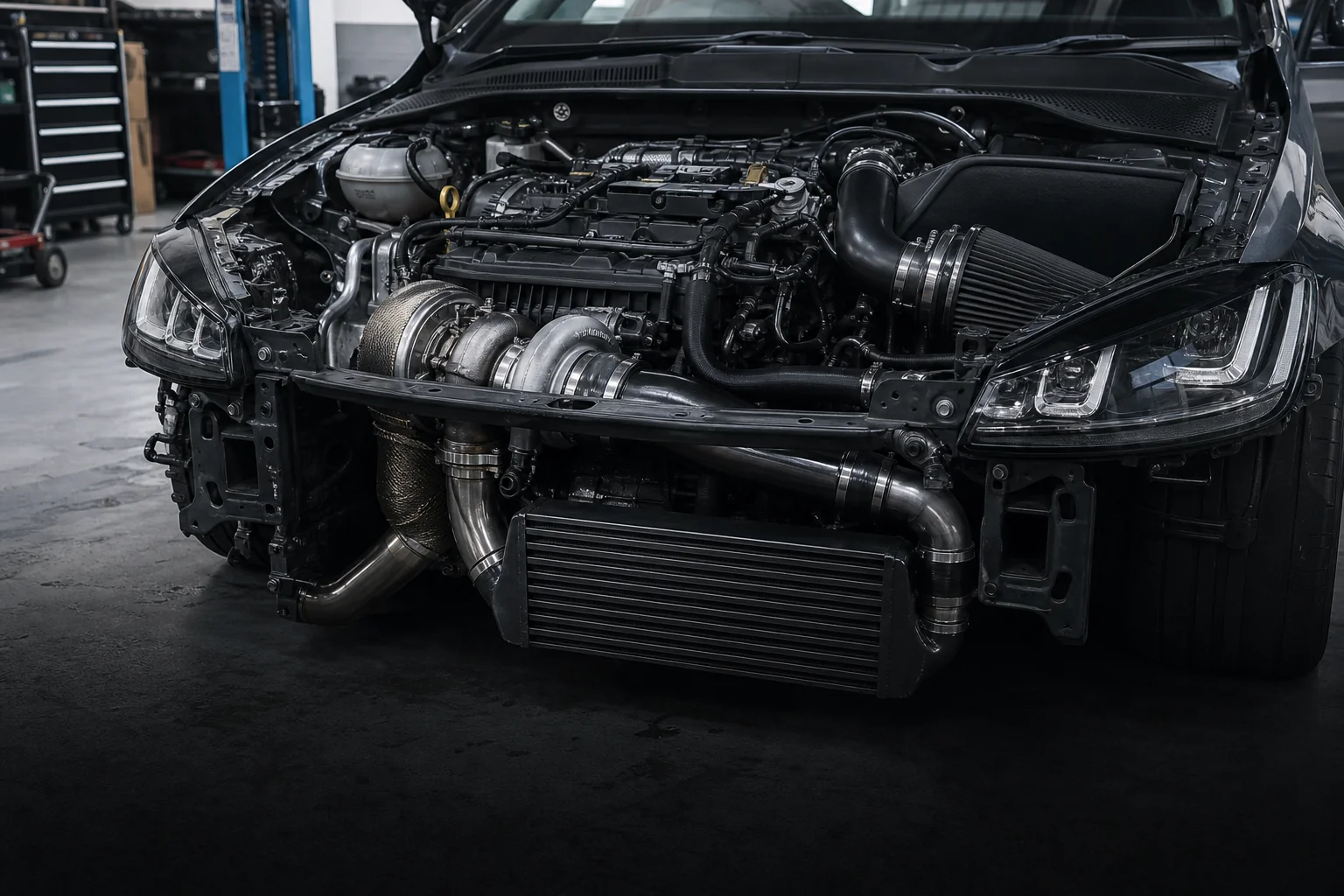
A turbocharger uses waste exhaust energy to spin a turbine, which drives a compressor that forces more air into the engine. More air means more fuel can be burned, which means more torque. Factory maps deliberately run turbos well below their limits — which is exactly the headroom a Stage 1 remap from £150 claims back through software alone. Warm-up, cool-down and clean oil keep any turbo happy. Diagnostics first, custom file, factory backup, fully reversible — every job at FLR.
The Short Answer
How does a turbocharger work? Hot exhaust gas leaving your engine spins a turbine wheel at anywhere up to 200,000+ rpm. That turbine sits on a shared shaft with a compressor wheel on the intake side, which squeezes fresh air and forces it into the cylinders at above-atmospheric pressure — what tuners call boost. More air in the cylinder lets the ECU inject more fuel safely, and burning more fuel per stroke produces more torque.
It is free energy in the loosest sense — energy that would otherwise disappear out of the tailpipe as heat and noise gets recycled into airflow. That is why nearly every modern petrol and diesel engine, from a 1.0 EcoBoost to a 3.0 BMW straight-six, is turbocharged: manufacturers get big-engine torque from small-engine fuel economy and emissions figures.
And it is why turbo engines remap so well. The turbo, the fuelling system and the internals are almost always capable of more than the factory calibration asks of them. Software decides how hard the turbo works — which puts a custom-written Stage 1 remap in charge of the whole equation.
Who This Guide Is For
This is for the owner sat in traffic on the A56 wondering what actually happens when the boost gauge sweeps round. If you are considering a remap and want to understand the hardware your money is working with, or you have heard terms like VNT, wastegate and turbo lag thrown around forums and want them decoded honestly, keep reading. No physics degree required — just the same plain-English explanation we give customers across Haslingden and Rossendale every week.
Turbine and Compressor — The Two Halves
Every turbocharger is two fans joined by a shaft, living in two separate housings:
- The turbine (hot side) — bolted to the exhaust manifold. Exhaust gas expands through it and spins it. It runs glowing hot — several hundred degrees on a hard motorway pull.
- The compressor (cold side) — connected to your intake. As the shaft spins, the compressor wheel draws in filtered air and compresses it before sending it towards the engine, usually via an intercooler.
- The centre housing (CHRA) — the bearing cartridge between the two, fed with engine oil (and often coolant) to keep the shaft alive at enormous speeds.
Compressing air heats it up, which is why the charge passes through an intercooler before entering the engine — cooler air is denser and safer. We cover that whole story in our intercoolers explained guide.
Journal vs Ball Bearing Turbos
The shaft between the two wheels has to survive six-figure rpm, so the bearing design matters:
- Journal bearings — the shaft floats on a thin film of pressurised engine oil. Cheap, durable and fitted to the vast majority of factory turbos. The trade-off is slightly more drag, so the turbo takes fractionally longer to spool.
- Ball bearings — a caged ball-bearing cartridge supports the shaft. Less friction means quicker spool and better response, which is why ball-bearing units appear on performance applications and upgraded turbos. They cost more and are fussier about oil quality.
For a road car on a Stage 1 or Stage 2 calibration, the factory journal-bearing turbo is almost always fine. Bearing upgrades only enter the conversation when you step into hybrid turbo territory — see our hybrid turbos explained guide for when that makes sense.
Wastegates, Actuators and VNT Vanes — How Boost Is Controlled
Left alone, a turbo would keep accelerating until something let go. Boost has to be controlled, and there are two main mechanisms:
- Wastegate — a valve that bleeds exhaust gas around the turbine once target boost is reached. It is opened by an actuator: a simple pneumatic diaphragm on older cars, an electronic actuator on most modern ones. The ECU commands the actuator, the actuator positions the gate, boost holds at target.
- VNT / VGT (variable nozzle or variable geometry turbo) — instead of bypassing gas, a ring of movable vanes around the turbine changes the angle and speed at which exhaust hits the wheel. Vanes closed at low rpm act like putting your thumb over a hosepipe — the gas accelerates and spools the turbo early. Vanes open at high rpm to let the full flow through without over-speeding. Almost every modern turbo diesel uses VNT, and increasingly petrols do too.
Here is the key point for tuning: boost targets are software. The wastegate duty cycle and vane position maps live in the ECU. A remap does not force the turbo beyond what the hardware can do — it asks for a higher, still-safe boost target and manages the path to it more intelligently. Sticky VNT vanes (usually carbon build-up on diesels) are one of the most common faults we find during pre-remap diagnostics, which is one more reason every FLR job starts with a diagnostic health check from £40.
Turbo Lag vs Spool — What You Actually Feel
Turbo lag is the pause between pressing the pedal and the turbo delivering boost. It exists because the turbine has inertia — exhaust flow has to physically accelerate the wheels before pressure builds. Spool is the process of that acceleration; lag is the time it takes.
What you feel on Grane Road when you squeeze the throttle in fourth at 1,500rpm and nothing much happens for a second — that is lag. Modern engines mask it well with VNT vanes, small twin-scroll turbines and clever mapping, but it never disappears entirely. It is physics, not a fault.
Software makes a genuine difference here. Factory torque-request maps are often lazy at low rpm for refinement and emissions reasons. A custom calibration can sharpen throttle mapping, raise low-rpm boost targets and fill in the mid-range, so the turbo feels awake far earlier. Many customers describe a remapped car as having "less lag" — technically the turbo spools similarly, but the calibration stops wasting the boost it builds. If your car feels flat below 2,000rpm, our signs you need a remap guide helps separate mapping from mechanical causes.
Why Factory Maps Leave Headroom — And Why Remaps Work So Well
Manufacturers calibrate one engine for the whole world: poor-quality fuel in some markets, extreme climates, drivers who never service anything, fleet warranty exposure, tax brackets and insurance groups. The same physical engine is frequently sold at two or three different power outputs purely through software.
That means the turbo, injectors, pistons and rods in your car are usually validated well beyond the output on your V5. A remap written for UK fuel, UK climate and a verified-healthy individual car can claim a healthy slice of that margin back — typically 15–30% more power and even more torque on turbocharged engines, though exact figures vary by engine code and we quote from your VRN rather than promising numbers.
Compare that with a naturally aspirated engine, where airflow is fixed by atmospheric pressure and cam design. Software can only sharpen throttle response and ignition — modest gains. On a turbo engine, software commands the airflow itself. That is the entire reason the value equation in our is Stage 1 worth it guide stacks up so heavily in favour of turbocharged cars.
Signs Your Turbo Is Struggling
Before any remap, we want the turbo healthy. Watch for:
- Whining or siren noises under boost — possible bearing wear or a cracked housing
- Blue smoke on start-up or overrun — oil passing worn seals into the intake or exhaust
- Loss of power or limp mode — over/underboost codes, often sticky VNT vanes or a lazy actuator
- Excessive shaft play — detectable with the intake pipe off; a small amount of side play is normal, in-and-out play is not
- Oil in the intercooler pipework — a light film is normal; pooling suggests seal trouble
Any of these means diagnose before you even think about tuning. Flashing extra boost onto a tired turbo just accelerates the failure. This is exactly why we check live boost data against target on every job — and why we cover the topic in depth in turbo health before a remap.
Common Turbo Myths
- "A remap over-boosts the turbo until it dies." A properly written map targets boost well within the compressor's efficient range and keeps all factory protections active. Failures come from generic files, hidden faults and skipped diagnostics — not from custom calibration on a healthy engine.
- "Turbos on remapped cars always fail early." Turbo life is dominated by oil quality, heat management and driving habits. A well-serviced remapped car routinely outlasts a neglected stock one.
- "More boost is always more power." Past the compressor's efficiency island, extra boost mostly adds heat, not power. Good calibration is about the whole picture — boost, fuelling, timing, temperatures — not one number.
- "Diesels don't have turbo lag." They do — VNT vanes just hide it well at low rpm. That is part of why turbo diesels feel so muscular after tuning.
Care Habits That Keep Turbos Alive
Stock or remapped, the same rules apply. The bearing cartridge lives or dies on oil:
- Warm up before working it hard. Cold oil is thick and flows poorly. Keep revs and load modest for the first few miles — especially on frosty Rossendale mornings.
- Cool down after hard running. After a sustained motorway blast up the M65 or M66, a minute or two of gentle driving before switching off lets the turbo shed heat while oil is still circulating. Killing the engine immediately can cook the oil in the bearing housing.
- Never stretch oil intervals. Quality oil to the correct spec, changed on time or early. It is the cheapest turbo insurance there is.
- Fix boost leaks and vacuum faults promptly. A split hose makes the ECU chase targets it cannot reach, working everything harder.
- Take short-trip diesels for a proper run. Regular sustained driving keeps VNT mechanisms and the DPF clean.
When NOT to Tune a Turbocharged Car
We turn work away every week, and turbo condition is a frequent reason. Do not book a remap if the car has active boost-related fault codes, visible smoke, turbo whine, a slipping clutch or overdue major servicing. Fix first, tune second. Equally, if your turbo is on borrowed time at high mileage with patchy history, spend the money on a diagnostic assessment before committing — a remap is reversible; a failed turbo sending debris through the engine is not. Our FAQ covers how we assess borderline cars.
Next Steps
If your turbocharged car is healthy and you want to feel what the hardware can really do, Stage 1 from £150 is the starting point — diagnostics included, custom-written file, factory backup archived for life, fully reversible. Hardware-supported builds step up to Stage 2, and every calibration we write is bespoke via custom tuning. Remember a remap must be declared to your insurer, and we never remove emissions hardware for road use — it is illegal in the UK.
Send your VRN for a fixed quote or call 01706 404 357. Workshop in Haslingden, mobile across Lancashire and the North West.
How Turbochargers Work — Common Questions
Exhaust gas spins a turbine wheel, which drives a compressor wheel on the same shaft. The compressor forces extra air into the engine, letting it burn more fuel and make more torque. It recycles energy that would otherwise be wasted out of the tailpipe.
The delay between pressing the throttle and boost arriving, caused by the time it takes exhaust flow to accelerate the turbine. Modern VNT turbos and good calibration minimise it, but it never fully disappears — it is physics, not a fault.
A turbo with movable vanes around the turbine. Closed vanes accelerate exhaust gas for early spool at low rpm; open vanes allow full flow at high rpm. Most modern turbo diesels use VNT, and sticky vanes from carbon build-up are a common fault we catch during pre-remap diagnostics.
It bleeds exhaust gas around the turbine once target boost is reached, stopping the turbo from over-speeding. The ECU controls it via an actuator — which means boost targets are ultimately software, and that is what a remap adjusts.
Because software commands the airflow. Factory maps run turbos conservatively for worldwide fuel, climates and warranty margins. A custom calibration for a healthy UK car claims that headroom back — typically 15–30% more power on turbocharged engines, varying by engine code.
Not meaningfully on a healthy engine with a properly written map — boost stays within the compressor's efficient range and factory protections remain active. Oil quality, heat management and driving habits matter far more to turbo life than a sensible Stage 1 calibration.
Yes. Drive gently for the first few miles while oil warms, and after hard running allow a minute or two of easy driving before switching off so the turbo sheds heat with oil still circulating. Both habits cost nothing and add years to a turbo.
No boost-related fault codes, no whining under load, no blue smoke, boost tracking target on live data. We verify all of this during the diagnostic check included with every FLR remap — and we decline to flash cars that fail it.