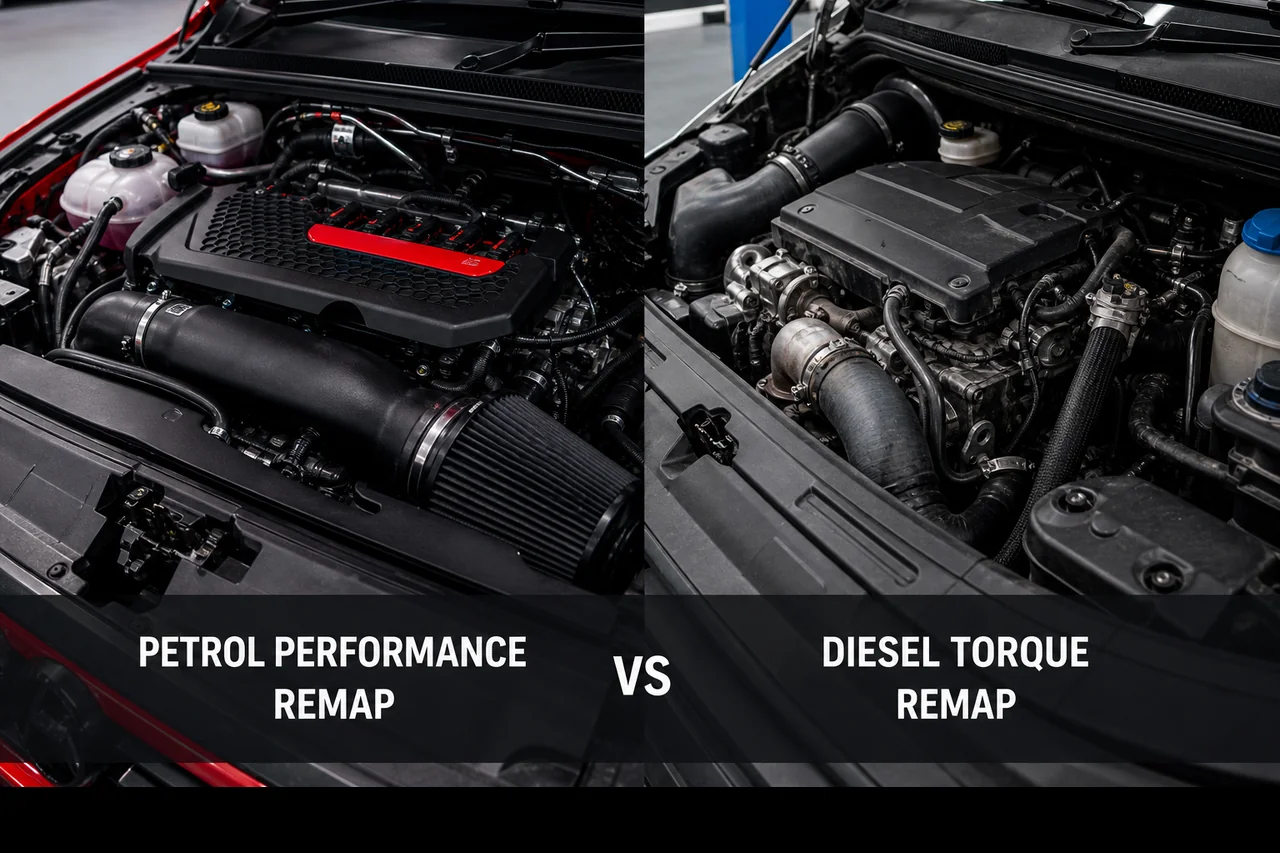
Diesel remaps typically deliver larger torque gains at lower RPM — ideal for towing, motorway lugging and commercial use — but add DPF and emissions considerations. Petrol remaps improve mid-range punch, throttle response and turbo spool on EA888, EcoBoost and similar platforms — often feeling sharper per percentage on a hot hatch. Both start from £150 Stage 1 or £150 economy at FLR. Diagnostics £40 first. Pick Stage 1 for performance feel, economy remap for mileage focus — see our economy remap fuel savings guide. Towing diesels? Read remap for towing next.
The Short Answer
Which remaps better — petrol or diesel? Neither fuel type wins universally. Diesel remapping moves massive torque into the RPM range you actually use for towing and commuting. Petrol remapping makes turbo engines feel eager and reduces lag on platforms where factory calibration is conservative.
Are the processes the same? Same workshop workflow — diagnostics, backup, custom write — but different ECU strategies inside the file. Diesels juggle rail pressure, smoke maps, DPF regeneration and torque monitoring. Petrols manage knock control, lambda targets, boost and ignition timing with finer granularity at higher RPM.
At Finish Line Remaps in Haslingden, we cover both daily. Stage 1 £150, economy £150, DSG £150, ECU + DSG bundle £275, diagnostics £40. We write for your engine variant — not a one-size petrol or diesel download. New to Stage 1? Read our Stage 1 remap guide first.
How ECU Calibration Differs by Fuel Type
Modern turbocharged petrol and diesel ECUs share hardware concepts — boost control, torque limiters, driver wish maps — but the combustion physics diverge. Your tuner's job is respecting those differences while extracting usable gains.
Diesel ECU priorities
Common-rail diesels control injection timing, quantity and sometimes multiple events per cycle. The ECU models soot production for DPF loading, manages EGR rates for NOx vs particulate trade-offs, and monitors rail pressure with tight fault thresholds. Remapping adjusts fuelling and boost within smoke and torque limiter tables — illegal deletes aside, road maps keep all monitoring active.
Petrol ECU priorities
Direct and port-injected turbo petrols lean heavily on knock sensing — the ECU retards timing instantly when detonation is detected. Boost, wastegate duty, ignition timing and lambda targets interact across load and RPM. Remapping widens safe timing margins, improves spool and sharpens throttle maps while staying inside knock strategy — especially critical on high-compression downsized engines.
Generic files ignoring these structures cause limp mode on both fuel types — just for different reasons. Rail pressure faults on diesels; knock retard on petrols.
Side-by-Side Comparison
Marketing loves identical "+35%" stickers on every listing. Real-world remapping outcomes differ by platform — but these patterns hold across most cars we see in Lancashire.
| Factor | Diesel Remap | Petrol Remap |
|---|---|---|
| Typical gain feel | Large low-RPM torque — stronger from 1,500–2,500rpm | Sharper mid-range and response — rewards 2,500–4,500rpm use |
| Best use case | Towing, vans, motorway miles, high annual diesel mileage | Hot hatches, SUVs, spirited daily driving, shorter trips |
| Economy potential | Strong with economy remap — lugging at lower RPM | Moderate — downsized petrols already optimised; gains vary by driving style |
| Emissions extras | DPF, EGR, AdBlue monitoring — diagnostics essential | Simpler — no DPF; cats and lambda still matter for MOT |
| Towing | Default choice — see towing guide | Capable on large turbo petrol SUVs — higher revs under full load |
| FLR pricing | Stage 1 / economy from £150 | Stage 1 / economy from £150 |
| Risk if unhealthy | DPF overload, rail faults, turbo soot issues | Knock-related timing pull, coil and plug stress at high load |
| FLR verdict | Choose diesel for tow/load/mileage priority | Choose petrol for response and performance feel priority |
Diesel Remapping — Torque, Economy and DPF Reality
Diesel owners usually feel remapping most in the first half of the rev counter. A 2.0 TDI that previously needed a downshift on the A682 now holds gear with less fuss. A Transit with a full load clears motorway inclines without the old rail-pressure hesitation from a cheap tuning box.
Two FLR paths for diesels:
- Stage 1 performance — from £150; stronger overtakes, towing headroom, sharper response
- Economy remap — from £150; smoother lugging, fewer unnecessary downshifts, better real-world MPG on mixed routes
Diesel caveat: emissions hardware. DPF-equipped cars need clean bills of health before tuning. We diagnostics first — soot load, sensor plausibility, regen history. Remapping a diesel with an active DPF fault is false economy. Short-trip drivers face DPF challenges regardless of tune; driving pattern matters.
Commercial and fleet diesels — Sprinter, Crafter, Vivaro — benefit from diagnostics-first fleet calibration documented on our economy and Stage 1 pages. Reliability beats peak numbers when the van cannot afford limp mode mid-job.
Petrol Remapping — Response, Spool and Knock Discipline
Turbo petrol remapping is often about feel as much as numbers. Factory maps on mainstream hot hatches deliberately soften tip-in for warranty and emissions averaging. Stage 1 restores intentional response — still road-legal, still knock-aware.
Platforms we map regularly:
- VAG EA888 / EA211 — GTI, R, TTS, many Skoda and Audi variants; DSG pairing common
- Ford EcoBoost — Focus ST, Fiesta ST, Puma ST; watch intercooler heat on track-style use
- BMW B48 / B58 — wide torque plates respond well to coherent timing and boost adjustment
- Mercedes M264 / AMG four-cylinder — sophisticated torque monitoring requires custom writes
- Hyundai/Kia turbo — i30N, Kona N; strong gains with sensible knock margins
Natural aspiration petrol remapping exists but gains are smaller — turbocharged engines offer the meaningful calibration headroom most owners seek. We quote honestly when a platform is not worth the investment.
Petrol MOT considerations: no DPF, but cats, lambda and smoke still apply on applicable tests. Crude maps causing misfire or rich running fail emissions — proper custom calibration does not.
Stage 1 vs Economy — By Fuel Type
Both fuel types offer both calibration styles at FLR — same price, different objective.
Stage 1 — performance focus
Choose Stage 1 when you want the car to feel noticeably stronger — overtakes, hill holding, motorway pace, fun factor on petrol performance cars. Diesel Stage 1 adds torque you feel every day; petrol Stage 1 sharpens response and widens usable rev band.
Economy — mileage focus
Choose economy when fuel cost dominates — high-mileage diesel commuters, delivery routes, long caravan tours at moderate pace. Economy remapping removes flat spots that force unnecessary revving and downshifts — the savings come from driving in higher gears with adequate torque, not from magic lean tables. Read realistic expectations in our economy remap fuel savings article.
Can economy feel slow?
Properly written economy maps should not feel sluggish — they feel smoother. If a "economy" file from elsewhere made your car undriveable, it was poorly written. FLR economy calibrations remain responsive for daily use.
Percentage Gains — Why Diesel Numbers Look Bigger
Advertised "+35% torque" appears on both fuel types, but diesel torque baselines are already high — so the absolute Newton-metre jump feels massive. Petrol percentage torque gains may look similar on paper but arrive higher in the rev range where you need to downshift or hold gear differently.
Power (bhp) gains often look closer between fuels — torque delivery shape matters more for daily driving. A diesel remap customer describes "effortless"; a petrol customer describes "immediate." Same workshop, different physics.
We quote range expectations per platform when you enquire — not universal marketing percentages copied from file reseller websites.
Driving Style — Who Should Choose Which
Fuel type advice only makes sense alongside how you actually drive. These patterns help customers in Rossendale and Greater Manchester choose the right calibration — not just the right fuel badge on the boot.
Choose diesel remapping if you…
- Cover 15,000+ miles annually on mixed A-road and motorway routes
- Tow caravans, trailers or horseboxes regularly — see our towing guide
- Drive a commercial van or dual-purpose pickup for work during the week
- Prefer holding high gears at low RPM rather than revving hard
- Can maintain occasional longer runs to keep DPF health in check
Choose petrol remapping if you…
- Drive a hot hatch or sports SUV for enjoyment, not maximum motorway miles
- Mostly do shorter trips where diesel DPF regen cycles struggle anyway
- Want sharper throttle and faster turbo response on B-roads
- Own a large turbo petrol SUV that tows occasionally but not at maximum capacity weekly
- Plan future hardware — intercooler, intake, downpipe — where petrol Stage 2 headroom rewards proper ECU work
When either fuel is fine
Standard family SUVs used for school runs and annual holidays benefit from both — the decision becomes Stage 1 vs economy more than petrol vs diesel. Send your VRN; we identify engine code and advise honestly if gains will be modest on a naturally aspirated petrol or a heavily restricted fleet diesel.
Common Mistakes When Comparing Fuel Types
Forum debates repeat the same errors. Avoid these when deciding whether to remap — and which fuel type to buy next time.
- Chasing peak bhp for towing — diesel torque at low RPM matters; petrol peak power at 5,500rpm does not help on a 7% gradient in top gear
- Assuming petrol remaps cannot improve economy — smaller gains than diesel often, but removing flat spots still helps turbo petrols driven smoothly
- Ignoring DPF because "diesel remaps always cause DPF problems" — poorly written maps and ignored faults cause problems; custom road calibrations on healthy cars do not inherently destroy filters
- Buying a tuning box by fuel type — boxes trick sensors on both fuels; neither gets the precision of custom ECU calibration. See our remap vs tuning box guide
- Expecting remap to fix the wrong car — remapping a underpowered petrol at maximum tow weight is a compromise; sometimes the honest answer is a more suitable tow vehicle
Hardware and Mileage Limits — Both Fuels
Remapping assumes healthy hardware. Fuel type changes what fails first under added load.
- Diesel: Worn injectors, tired turbo VNT mechanisms, DPF issues, dual-mass flywheel chatter — diagnostics exposes these before flash
- Petrol: Weak coils, aged spark plugs, boost leaks, intercooler heat soak on repeated pulls — especially on tuned hot hatches driven hard
- Both: Clutch slip on manuals, DSG clutch packs on high-torque diesels, cooling system marginal on sustained load
We decline or defer tuning when health checks fail. Adding power to a failing diesel DPF or a misfiring petrol coil wastes your money and ours.
Insurance, MOT and Daily Practicality
Insurers treat petrol and diesel remaps identically — declare either. MOT treats both as emissions-compliant road vehicles when hardware is intact and maps are road-focused. Diesels add DPF presence checks; petrols skip DPF but not cat or lambda integrity.
Urban ULEZ and clean-air zones increasingly favour newer petrols over older diesels — remapping does not change emissions class. Factor local driving charges into ownership economics alongside fuel savings from economy tuning.
If you split time between Manchester clean-air concerns and rural Lancashire mileage, fuel-type economics can outweigh remap choice — we still map both, but honest advice sometimes means economy calibration on the car you already own rather than chasing the opposite fuel type on paper.
FLR's Verdict — Petrol vs Diesel Remapping
Petrol vs diesel remapping comes down to use case, not forum loyalty. Diesel wins towing, load and high-mileage torque. Petrol wins response, revs and performance-car feel. Both remap properly from £150 at FLR with diagnostics £40, DSG £150, bundle £275.
Still deciding Stage 1 vs economy? Read economy remap fuel savings. Towing? Remap for towing. Ready to book? Request a quote with your VRN or call 01706 404 357 — we will advise for the engine you have, not the one you wish you bought.
Petrol vs Diesel Remapping — Common Questions
Neither is universally better. Diesel remaps deliver larger low-RPM torque — ideal for towing and high mileage. Petrol remaps improve response and mid-range punch on turbo engines. Choose based on your driving, not generic percentages.
Diesel torque gains often feel larger in daily driving because they arrive at lower RPM. Petrol gains can be equally satisfying but typically need higher revs to extract fully. Absolute bhp increases are often comparable; delivery shape differs.
Petrol avoids DPF complexity, but both need proper calibration and healthy hardware. Diesels require emissions diagnostics first; petrols need knock control respected. Neither fuel type is "safer" with a bad generic file.
Yes — economy remapping from £150 suits both. Diesels often see the largest mileage improvements on long routes. Petrol economy gains depend more on driving style. See our economy remap guide.
Diesel, in most cases — remapped low-RPM torque suits caravans and trailers better. Turbo petrols can tow well too; read our remap for towing guide for load-specific advice.
At FLR, Stage 1 and economy remaps both start from £150 regardless of fuel type. DSG/TCU tuning is from £150 standalone or from from-£275 bundled. Diagnostics £40.
No — fix DPF or related faults first via diagnostics. Remapping an unhealthy diesel accelerates filter and turbo damage. We identify issues before any performance work.
Modern turbo petrols — VAG EA888, Ford EcoBoost, BMW B48, Mercedes turbo fours, Hyundai/Kia N cars — offer the best headroom. Naturally aspirated petrol gains are modest; we advise honestly when remapping is not worthwhile.