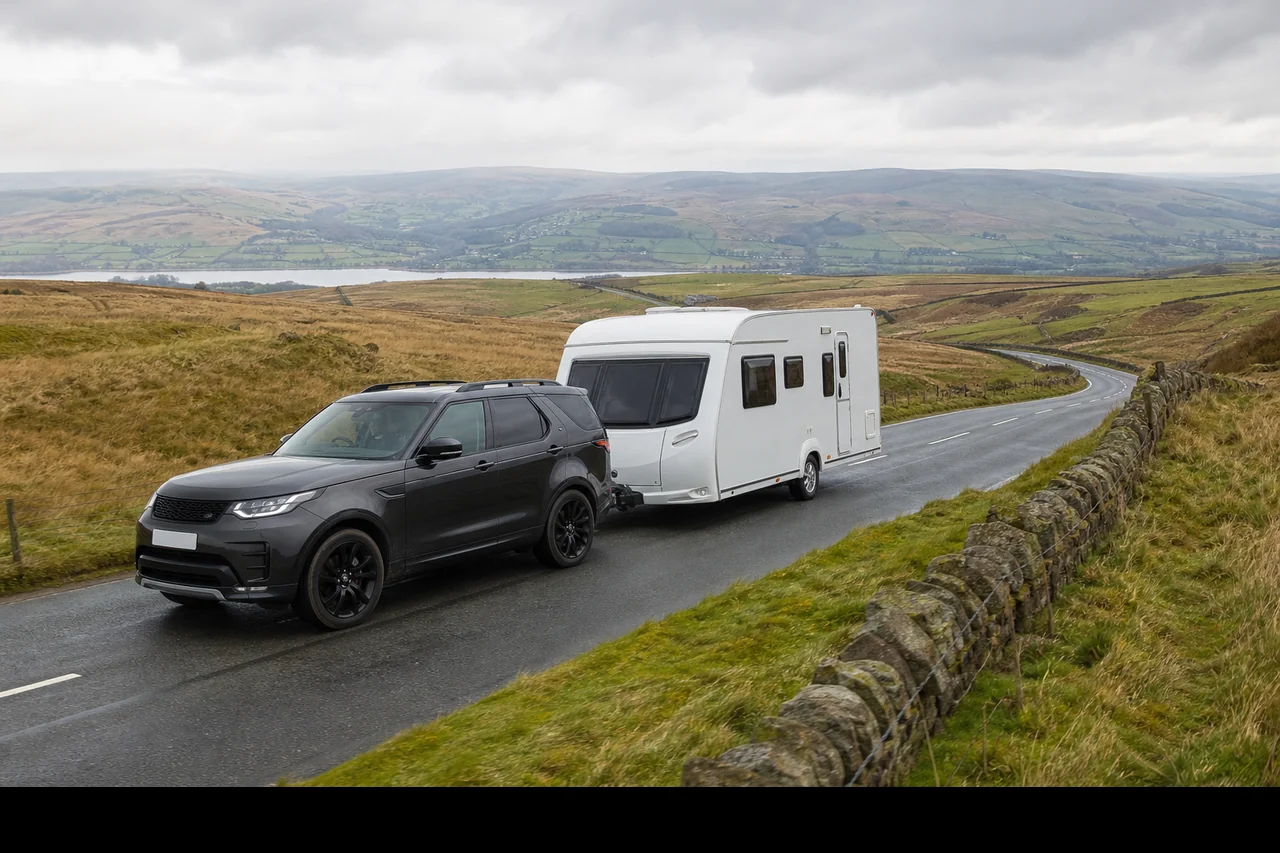
Towing needs torque where you actually use it — 1,500–2,500rpm on diesels, mid-range on turbo petrols — not a peak power figure at 4,500rpm. A custom Stage 1 or economy remap from £150 improves low-down pull, reduces gear hunting and makes overtakes safer with a loaded trailer. Match gearbox calibration with a DSG/TCU remap (£150 standalone, £275 ECU + DSG bundle). Diagnostics £40 first — we will not add load to a tired turbo or slipping clutch. Diesels dominate towing; read our petrol vs diesel remap guide if you are choosing a tow car.
The Short Answer
Is remapping worth it for towing? For most owners pulling near their legal tow limit regularly, yes — when the car is mechanically healthy. Factory maps often prioritise emissions and smoothness over sustained load torque. A custom road calibration unlocks the mid-range your caravan actually demands on the A56, M66 and Pennine routes toward the Lakes.
What does a tow-focused remap change? Fuelling, boost targets and torque limiters adjusted for earlier, smoother torque delivery — without deleting emissions hardware or writing smoke maps. Throttle response improves so you need less pedal travel to hold speed uphill. On automatics, pairing engine and gearbox maps prevents hesitation when the ECU requests power the DSG was not expecting.
At Finish Line Remaps in Haslingden, we write every file for the specific car, load use and hardware in front of us. Stage 1 from £150, economy tuning from £150, diagnostics £40, ECU + DSG bundle £275. Mobile service across Lancashire and the North West for caravan season prep. Read Stage 1 remap explained for typical towing gains on stock hardware.
Why Factory Maps Fall Short When Towing
Manufacturers calibrate for average mixed driving — cold start emissions, urban cycles, NCAP-relevant smoothness and warranty-friendly conservatism. Towing at 85% of legal capacity through Rossendale is not their design centre.
Typical frustrations we hear from tow car owners:
- Gear hunting — automatic boxes shift up to save fuel, then immediately downshift on inclines, surging and slowing repeatedly
- Flat spots below 2,000rpm — you floor it, wait, then torque arrives late when the gap has closed or the hill steepened
- Manual diesels needing third gear where second feels wrong — factory torque limiters protect the clutch but leave you underpowered with 1,800kg on the hitch
- Heat creep on long climbs — not fixed by remap alone, but smoother torque reduces constant high-RPM screaming that builds heat
- Overtake anxiety — dual-carriageway passes with a loaded twin-axle need instant mid-range, not peak power you never reach in the wrong gear
A tuning box tricking rail pressure can add crude mid-range surge — but it fights factory safety strategies and causes limp mode under sustained towing load. A custom remap integrates the change properly. See our remap vs tuning box comparison if you are weighing options.
Torque Where You Need It — Not Peak BHP
Brochures quote horsepower; tow bars feel Newton-metres. A 150bhp diesel with 380Nm from 1,750rpm often tows better than a 200bhp petrol peaky at 5,500rpm — especially on hills where you cannot hold high revs in top gear.
Custom remapping reshapes the torque curve:
- Earlier boost build for earlier torque arrival
- Reduced flat spots in the 1,500–2,500rpm band critical for loaded diesels
- Torque limiters raised coherently with fuelling and smoke maps — not crude spikes
- Throttle maps adjusted for smoother pedal response when manoeuvring on campsites
We calibrate for real roads, not dyno screenshots. A caravan owner in Haslingden cares about holding 60mph on a 6% gradient in gear — not a number at redline.
Diesel vs Petrol for Towing
Diesels remain the default tow car choice — thermal efficiency, low-RPM torque and longer gearing suit braked trailers. Modern turbo petrols — VW TSi, Ford EcoBoost, BMW B48 — close the gap with wider torque plates but still prefer higher RPM under heavy load.
Remapping both fuel types helps towing, differently:
- Diesel Stage 1 — biggest real-world towing gains; improve 1,750–3,000rpm delivery; monitor DPF health on long loaded runs
- Petrol Stage 1 — widens mid-range, reduces turbo lag; still revs higher than diesel when fully loaded — choose gearing carefully
- Economy remap — useful for lighter trailers and high annual mileage; smoother low-RPM torque saves fuel on long caravan tours
Full platform comparison in our petrol vs diesel remapping guide. If buying specifically to tow, diesel usually wins; if you already own a capable petrol SUV, remapping still meaningfully improves loaded performance.
Gearbox Tuning — Engine Power Needs Box Support
Increasing engine torque without updating automatic shift logic causes the classic tow-car complaint: "It hunts constantly uphill." DSG, torque-converter auto and modern single-clutch automated manuals all use torque models to decide shift points.
A TCU/DSG remap from £150 — or £275 bundled with Stage 1 — adjusts:
- Shift points under partial and full load — holding gears longer when towing
- Clutch pressure targets on DSG to handle increased torque without slip
- Downshift response for overtakes with trailer attached
- Manual mode behaviour where applicable
Manual gearbox owners benefit from engine-side torque improvements alone — but clutch health matters more when you remap. We inspect for slip during diagnostics and advise if the friction plate is marginal for your tow weight.
Stage 1 vs Economy Remap for Towing
Not every tow car needs maximum Stage 1 aggression. Choose based on how and what you tow.
Stage 1 performance remap — from £150
Best when you regularly tow at or near legal capacity, need confident overtakes and drive Pennine routes where power reserves matter. Improves throttle response and mid-range torque with road-legal emissions hardware intact. Our Stage 1 service page covers platforms and typical gains.
Economy remap — from £150
Best when you tow moderate loads less aggressively — weekend caravan trips, lighter camping trailers — and prioritise fuel cost on long tours. Economy calibration smooths delivery and encourages lugging in higher gears legally and safely — often the surprise favourite among tow car owners who expected "economy" to mean slow. Details on our economy remapping page.
Which to pick?
Tell us your typical loaded weight, routes and annual miles when you quote. We write custom files — not a one-size menu. Some owners choose Stage 1 for summer towing season and accept slightly higher fuel use; others economy-tune a high-mileage diesel tow car and report better hill holding anyway because flat spots were removed.
Mechanical Health — Remap Is Not a Towing Upgrade Package
Remapping improves calibration; it does not replace maintenance. Before adding load via software, confirm hardware is fit.
- Cooling system — tired water pumps, partial radiator blockages and low coolant show up on long climbs with a caravan behind you
- Turbo condition — worn bearings or leaking seals fail faster under sustained boost
- Brakes and tyres — tow car tyres rated correctly; trailer brakes serviced; no remap compensates for weak stopping
- Transmission service — DSG fluid and filter intervals matter more on remapped tow cars
- Suspension and hitch — nose weight correct; stabiliser adjusted; shocks capable of loaded rear sag
- DPF on diesels — long loaded runs help regeneration; short hops to local sites do not — see our DPF guides if EML appears
We turn work away when diagnostics show problems — because the right answer is fix first, tune second. That protects your holiday and our reputation.
Legal Weight, Licence Limits and Insurance
Remapping does not change your legal tow limit — that comes from manufacturer homologation, licence category and actual vehicle spec (tow bar rating, tyre load index, gross train weight). Know your 85% guideline for stability, your B+E entitlement if required, and your trailer's plated weight.
Declare remapping to your insurer — towing already affects premiums; undeclared modifications void cover when you need it most. A responsible road calibration on a correctly loaded rig is standard practice for thousands of UK caravanners; hiding the tune is not.
Platform Notes — Common Lancashire Tow Cars
Every engine variant behaves differently under load. These are patterns we see regularly at FLR — not universal promises, but realistic expectations when customers ask whether remapping helps their tow rig.
VAG 2.0 TDI — Golf, Passat, Octavia, Superb
Ubiquitous tow car choice. Factory maps soften mid-range for emissions averaging; Stage 1 restores usable torque from 1,700rpm that transforms A-road hill holding with a twin-axle behind you. DSG models benefit strongly from paired TCU work — the box otherwise upshifts aggressively into sixth before the incline starts. Check DPF health if your caravan season mixes short local hops with one long run to Scotland.
Ford 2.0 EcoBlue — Kuga, Mondeo, Ranger
Strong tow credentials with sensible gearing. Remapping smooths transient flat spots that cause surging when the turbo transitions. Ranger owners towing near maximum braked capacity should prioritise cooling and brake maintenance alongside calibration — the map helps hold speed; it does not upgrade mechanical limits.
Land Rover / Discovery Sport and Evoque diesels
Popular for caravan stability and weight. Heavier vehicles mask some factory laziness until fully loaded — then mid-range response matters for safe overtakes. Custom writes respect terrain response and gearbox logic; generic files cause inconsistent behaviour on inclines.
BMW xDrive diesel estates and SUVs
Excellent tow weight ratings on paper. ZF autos respond well to paired engine and gearbox calibration — without it, increased engine torque exposes slow downshift decisions on the M6 with a loaded trailer. Mileage and turbo health checks essential on higher-mileage examples.
Older HDi and 1.6/2.2 diesel tow cars
Still common in the club scene. Gains remain meaningful when injectors and turbo are healthy. High-mileage units need honest diagnostics — we sometimes recommend mechanical refresh before flash rather than chasing numbers on tired hardware.
What Changes After Remapping — Owner Reports
Numbers vary, but the stories repeat. Customers towing from Haslingden toward the Yorkshire Dales or North Wales coast report the same themes after a proper tow-friendly calibration:
- Approaching Pennine inclines in sixth gear where they previously planned a fifth-gear run-up
- Reduced stress on dual-carriageway overtakes — torque arrives when requested, not after a downshift and turbo spool delay
- Smoother campsite manoeuvres from sharper low-speed throttle control — less kangarooing when positioning on grass
- Fewer passengers commenting on "that hill" they dread each summer — the car simply holds pace
- On economy maps, measurable fuel improvement on long touring routes when flat spots no longer force unnecessary revving
We do not guarantee specific MPG or bhp figures in writing — your load, weather and right foot matter. We do guarantee custom calibration written for your car, with factory file backed up and reversible on request.
Real-World Towing on Lancashire Roads
Local geography shapes what "good towing tune" means. Steady M65 miles allow top-gear torque holding; A682 and Snake Pass routes demand mid-range punch and cooling headroom. Wind across open moorland adds virtual weight — predictable power beats peak spikes that break traction on wet cambers.
After a proper tow-focused remap, owners typically report:
- Fewer downshifts on familiar hills — holding sixth where they previously dropped to fifth
- Smoother motorway merges with loaded trailer — less panic full-throttle
- Reduced need to build speed before inclines — torque arrives when requested, not two seconds later
- Better fuel economy on some routes — holding higher gear at lower RPM with adequate torque
Results vary by platform, mileage and load. We quote honestly from experience with VAG, BMW, Ford, PSA and Mercedes tow cars common in our area — not generic internet percentages.
FLR's Verdict — Remap for Towing
Remap for towing caravans and trailers — yes, when the car is healthy and the file is written properly. The win is usable torque, smoother delivery and gearbox alignment — not a dyno trophy. Stage 1 £150, economy £150, DSG £150, bundle £275, diagnostics £40.
Commercial fleet or van towing? See fleet tuning. Choosing between fuel types? Read petrol vs diesel remap. Ready to book? Request a quote with your VRN, tow weight and typical routes — or call 01706 404 357.
Remap for Towing — Common Questions
Yes — on a mechanically sound car, a custom Stage 1 or economy remap improves low-down and mid-range torque, reduces gear hunting and makes hill climbing and overtakes safer with a loaded caravan. Diagnostics first to confirm the car can handle increased load.
Stage 1 from £150 suits regular heavy towing near capacity and demanding routes. Economy from £150 suits moderate loads and owners prioritising fuel on long tours — it still removes flat spots that hurt towing. We advise based on your typical loaded weight and mileage.
Recommended on DSG and auto tow cars when engine torque increases. Without TCU alignment, the gearbox may hunt or slip under load. DSG remap from £150 standalone or from from-£275 bundled with Stage 1 at FLR.
Diesel generally tows better due to low-RPM torque — remapping amplifies that advantage. Turbo petrols benefit too but often need higher revs when fully loaded. See our petrol vs diesel remap guide for detail.
No. Legal tow capacity comes from manufacturer homologation and your licence category. Remapping improves how effectively you use available power within those limits — it does not change plated weights or hitch ratings.
Any increased load stresses turbo, clutch and cooling systems. Custom maps respect factory limiters coherently; crude tuning or ignoring pre-existing faults causes problems. Diagnostics from £40 identifies weak components before we flash — we decline unhealthy cars.
Yes. Remapping is a performance modification regardless of tow use. Declare it to your insurer — especially when towing valuable loads. Non-disclosure can void cover in a claim.
Yes. We map Transit, Sprinter, Vivaro and other commercial platforms for sustained load towing via our fleet tuning service — diagnostics-first, DPF strategies intact for road compliance.