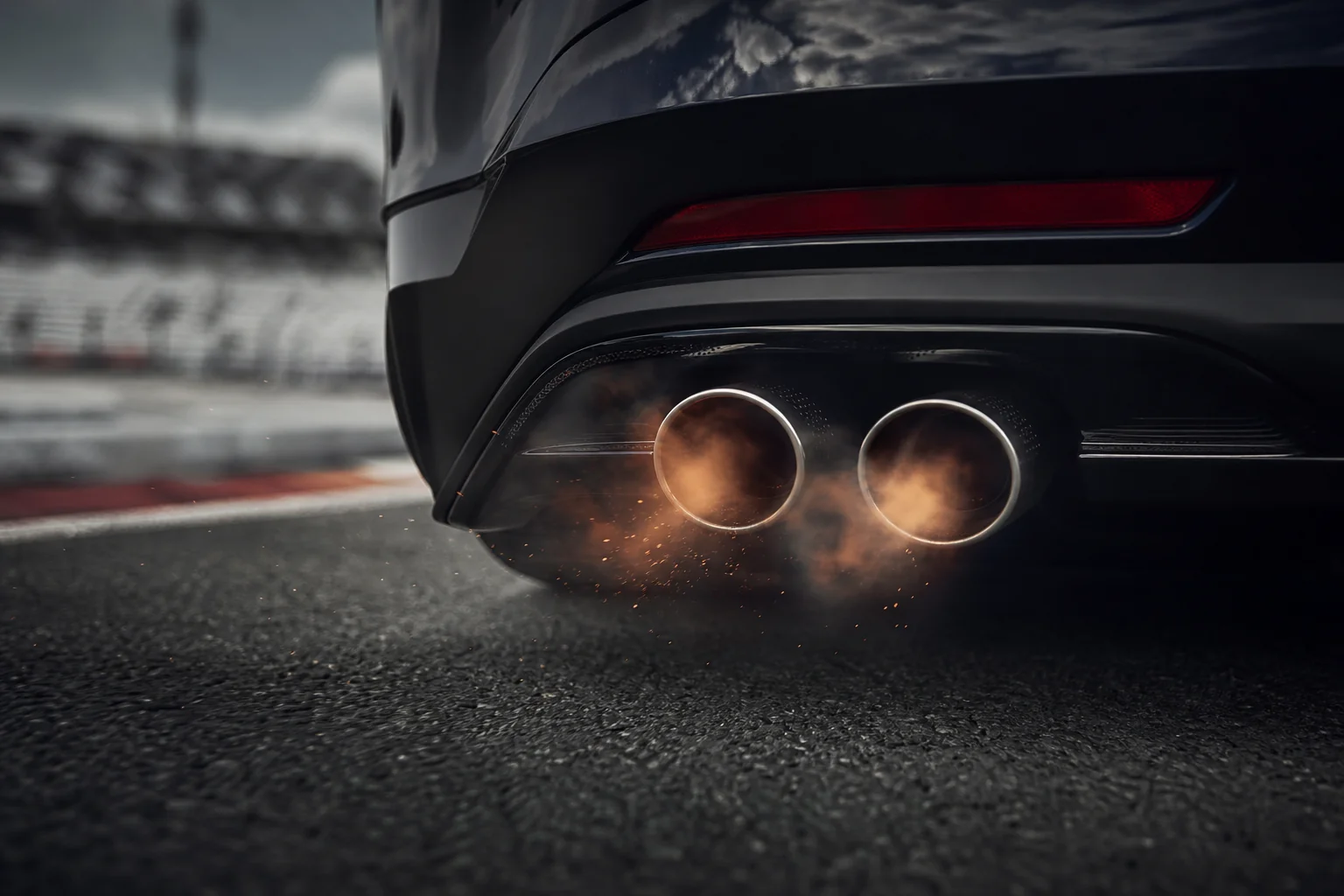
Pops and bangs are deliberate: the map keeps fuel flowing on overrun and retards ignition so it burns late — in the exhaust instead of the cylinder. The result is crackle on lift-off. Trade-offs are real: higher exhaust temperatures, extra stress on the catalytic converter and exhaust components, and noise that can attract MOT and roadside attention if excessive. Results vary heavily by platform — turbo petrols crackle best, and we tell you honestly what your car can and cannot do before booking. Aggressive setups are for off-road use. It is a character choice, not a performance one — and we calibrate it conservatively for exactly that reason.
The Short Answer
Pops and bangs is an overrun fuelling strategy written into the ECU calibration. It adds no meaningful power — it adds character, and it does so by burning fuel in places the factory deliberately avoided burning it. Done conservatively on a suitable car, it is a manageable trade-off many owners happily accept. Done aggressively on the wrong car, it is a shortened catalytic converter's life with a soundtrack.
At Finish Line Remaps we offer it as an option — usually alongside a Stage 1 remap from £150 — but we explain the trade-offs first, every time. Some customers hear them and go ahead delighted. Some choose a milder setting. Some skip it. All three are good outcomes, because all three are informed. This guide is that conversation in written form, for anyone from Haslingden to the far end of the M65 wondering whether crackle is for them.
How Overrun Fuelling Creates the Crackle
Understand one factory behaviour first: when you lift off the throttle at revs, a standard car cuts fuel completely — it is coasting on momentum, burning nothing. That silence on overrun is a fuel-saving, emissions-friendly choice.
A pops and bangs map changes that choice. On overrun, the ECU keeps injecting a controlled amount of fuel and retards the ignition timing — firing the spark much later than normal. Late combustion means the mixture is still burning as the exhaust valve opens, so part of the burn happens in the manifold and exhaust system rather than the cylinder. That out-of-place combustion is the crackle. Larger unburnt pockets igniting further down the system are the louder bangs, and on turbo cars the exhaust-side energy also keeps the turbine spinning — the anti-lag family of behaviours shares this same mechanism.
The calibration levers are how much fuel, how much retard, and over what rev and temperature window it is active. That is why "pops and bangs" ranges from a subtle warm-engine burble to full theatrical gunfire — it is a dial, not a switch, and where we set that dial is the whole craft of doing it responsibly through our pops and bangs service.
Why Some Cars Crackle and Some Won't
Platform matters enormously, and this is where honest expectation-setting saves disappointment:
- Turbo petrols — the sweet spot. Exhaust energy, suitable fuelling control and receptive ECUs make TSI, EcoBoost and similar engines the classic crackle platforms
- Naturally aspirated petrols — possible on some, milder in result; less exhaust energy to play with
- Diesels — generally no. Diesel combustion does not produce the same overrun crackle, and the DPF sits in the way of everything; anyone promising petrol-style pops on a standard diesel deserves your scepticism
- Exhaust hardware — a standard exhaust with all its silencers muffles much of the effect; sports exhausts amplify it. The same map sounds completely different through different pipework
- ECU generation — some ECUs allow fine overrun control, others are locked down tight; what is achievable is engine-code specific
This is why we quote from your VRN and tell you what your specific car can actually do before you book — not after. If the honest answer is "your platform will barely crackle," you will hear it from us first.
The Wear Trade-Offs Nobody Mentions
Fuel burning in the exhaust means heat in the exhaust — that is the physics, and no tuner can waive it. The components paying the bill:
- Catalytic converter — the big one. Cats are designed for a temperature window, and combustion happening just upstream pushes spikes beyond it. Aggressive maps measurably shorten cat life; the ceramic core can degrade or break up. This stress lands hardest on cars that keep the factory cat close to the turbo
- Exhaust valves and manifold — burning mixture past an open exhaust valve adds thermal cycling to the valve, seat and manifold
- Turbocharger — extra exhaust-gas temperature on overrun is extra heat through the turbine at exactly the moment the factory calibration expected cooling
- Flexible joints and silencers — pressure pulses from proper bangs stress flexi sections and baffles over time
How much any of this matters is dose-dependent. A mild, warm-engine-only burble map adds modest stress. A maximum-attack bang map used everywhere, every day, is a consumable exhaust system. We calibrate conservatively by default and tell you where your setup sits on that spectrum — the same honesty-first framing as everything else we flash, and it is worth reading is ECU remapping safe? for how we think about calibration risk generally.
Legality and Noise — The Honest Bit
Nothing about pops and bangs is automatically illegal, but noise law is where it collides with reality. UK vehicles must not be modified to be louder than their type approval allowed. The MOT includes an exhaust noise assessment — largely at the tester's judgement — and a car that sounds like gunfire on lift-off invites scrutiny it would not otherwise get. Roadside, police can issue notices for excessively noisy vehicles, and several UK areas now trial noise cameras. A crackle map on a standard exhaust usually stays within reason; a loud map through a decatted straight-through system is asking for attention — and a decat brings its own emissions illegality for road use, which is a line FLR does not cross. Emissions systems stay fitted and functional on everything we map; see remapping and MOT — the facts for the wider picture.
Then there is the neighbour reality, which no statute covers: cold-start crackle at 6am on a terraced street in Rossendale makes you the most talked-about person on the road for the wrong reasons. We can scope maps to activate only at temperature or above certain revs — worth discussing at booking if you like your neighbours.
For the aggressive end of the spectrum — loud bang maps, anti-lag behaviours — the honest framing is off-road use: track days, show cars, private land. We will say so plainly when a request lands there, the same way our service pages mark off-road-only work.
Common Misconceptions
- "Pops and bangs adds power." No. Overrun happens off-throttle — nothing about crackle accelerates the car. Power comes from the remap underneath, not the noise on top
- "It's just how tuned cars sound." No — it is a deliberate calibration choice. Plenty of seriously fast cars are mapped with zero crackle, silent on lift-off by design
- "Factory cars have it, so it must be harmless." Some performance models do ship with mild overrun burble — calibrated by the manufacturer within the emissions and durability budget of that specific car, usually far milder than aftermarket maps. The existence of a factory version does not make every aftermarket version equivalent
- "You can put it on any car." Platform-dependent, as above — diesels especially disappoint anyone sold that promise
What It Costs and How We Do It
Pops and bangs is typically added as an option alongside a remap rather than flashed alone — the sensible time to calibrate overrun behaviour is when the whole file is being custom-written anyway. Stage 1 starts from £150 with diagnostics included; DSG and gearbox tuning from £150; the engine-plus-gearbox bundle is from £275. Send your VRN through the contact page for a fixed quote including the crackle option for your exact car.
The process is the same diagnostics-first routine as every FLR job: health check before flashing, custom file for your engine code, factory backup archived permanently, live-data verification after. That backup matters here more than most jobs — if you tire of the noise in a year, or a buyer wants it gone, the map is fully reversible. The mechanics of going back are covered in can a remap be reversed? — and if resale is on your mind, our remaps and resale value guide is worth ten minutes before you decide.
When NOT to Add Pops & Bangs
- Your car is a diesel — the honest answer is it will not deliver what the videos promised
- The cat is original and elderly — adding thermal stress to a tired catalytic converter accelerates an expensive failure
- The car has unresolved faults — same rule as every remap: diagnostics first, fix first, then discuss options
- You need the car quiet — early shifts, residential parking, noise-sensitive areas: consider a temperature- or rev-gated mild setup, or skip it
- You are selling soon — crackle narrows your buyer pool; most everyday buyers hear "abuse" where enthusiasts hear "character"
- You expected performance — if the goal is speed, put the budget into the tune and hardware, not the soundtrack
Next Steps
If you have read the trade-offs and still want the crackle — good, that is exactly the informed choice we ask for. Send your VRN via the contact page or call 01706 404 357 and we will confirm what your platform can do, quote it fixed, and calibrate it sensibly — subtle burble to full character, matched to how and where you drive. Browse the pops and bangs service page for specifics, see custom tuning if you want the whole calibration tailored, and the FAQ answers the insurance and legality questions in more depth. Workshop in Haslingden — where the A56 hills give a crackle map its best audition — and mobile across Lancashire and the North West.
Pops & Bangs — Common Questions
The map keeps injecting fuel on overrun — where a standard car cuts it completely — and retards ignition so combustion finishes late, partly in the exhaust. That out-of-place burn is the crackle; larger unburnt pockets igniting downstream are the bangs.
A mild crackle map is not automatically illegal, but vehicles must not be modified to exceed their approved noise levels — excessive noise risks MOT scrutiny, roadside notices and noise-camera enforcement. Aggressive setups are honestly framed as off-road use. Emissions systems must stay fitted and working regardless; FLR does not remove them.
The engine itself tolerates a conservative map well — the stress lands on the exhaust side: catalytic converter, exhaust valves, manifold and turbo see higher temperatures. Mild maps add modest wear; aggressive maps used constantly measurably shorten catalytic converter life. It is dose-dependent, which is why calibration matters.
No. The crackle happens on overrun, off-throttle, and contributes nothing to acceleration. Any performance gain comes from the remap it is usually paired with — pops and bangs is a character option layered on top, not a performance feature.
Realistically no — diesel combustion does not produce petrol-style overrun crackle, and the DPF sits in the exhaust path. Be sceptical of anyone promising it on a standard diesel. Turbo petrols are the platforms that deliver the sound people actually want.
Yes. We archive your factory ECU file before flashing anything, so the car can be returned to stock — or re-flashed with the same remap minus the crackle — at any point. Useful if your circumstances, neighbours or buyers change.
It is typically added as an option alongside a remap — Stage 1 starts from £150 with diagnostics included, DSG tuning from £150, and the engine-plus-gearbox bundle is from £275. Send your VRN for a confirmed quote including the crackle option for your exact platform.
Yes — it is part of an ECU modification, and remaps are material modifications UK insurers expect you to declare. Undeclared tuning can invalidate a policy even on unrelated claims. Declare the remap and its options together.