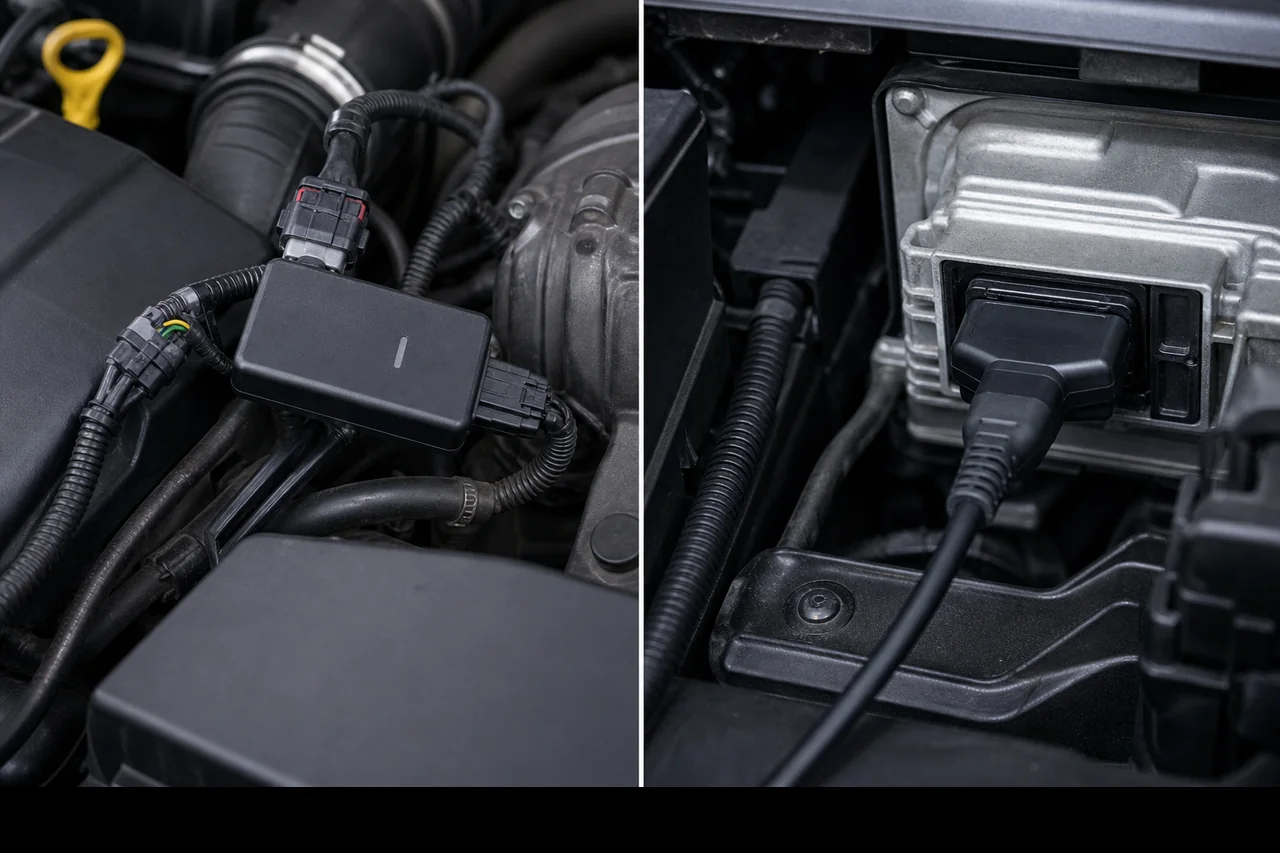
A tuning box intercepts sensor signals and fools the ECU into adding fuel or boost. An ECU remap changes the calibration itself — fuelling, boost targets and torque limits rewritten properly for your engine. Tuning boxes are cheaper upfront and removable, but they are less precise, can feel crude and still count as a modification for insurance. A custom-written remap from £150 is the cleaner long-term solution for most drivers in Lancashire who want predictable, reversible gains.
The Short Answer
ECU remap vs tuning box — which is better? For most road cars, a properly written ECU remap wins on precision, drivability and long-term value. A tuning box can make sense as a temporary trial or on a lease car you cannot modify permanently — but it is not the same quality of calibration.
Think of it this way: a remap speaks the ECU's language because it changes the language itself. A tuning box shouts louder at the ECU until it gets what it wants. Sometimes that works. Often it creates hesitation, limp mode, smoke or fault codes — especially on modern common-rail diesels and turbo petrols with tight emissions strategies.
At Finish Line Remaps in Haslingden, we write custom ECU calibrations — we do not sell tuning boxes. That does not mean boxes are useless for everyone; it means we see the aftermath when cheap boxes meet Lancashire hills and worn injectors. This guide is the honest comparison we give customers before they book a Stage 1 remap from £150 — see our Stage 1 remap explained guide for what that includes.
How Each Option Actually Works
Understanding the mechanics matters because forum arguments about "which is faster" often skip how the power is delivered — and that is what you feel every day on the M66 or climbing out of Rossendale.
What a tuning box does
A tuning box — also called a piggyback, plug-in module or remap chip — sits between your engine sensors and the ECU. It intercepts signals (commonly rail pressure, boost, air mass or pedal position) and sends modified values to trick the factory ECU into adding fuel, holding boost longer or advancing timing.
The factory calibration file inside the ECU stays unchanged. The box is essentially lying to the car about what the sensors read. Some boxes are generic; others claim vehicle-specific maps. Either way, the ECU's safety strategies, torque monitoring and emissions logic were never designed around those falsified inputs.
What an ECU remap does
An ECU remap reads your factory software, adjusts the calibration tables directly — fuelling, boost targets, torque limiters, smoke maps, throttle response — and writes the modified file back to the engine control unit. The ECU now operates on new parameters that were written to work together, not conflicting signals from an external device.
At FLR, every remap starts with diagnostics, a full backup of your original file and custom-written calibration for your exact engine variant, mileage and hardware. No generic downloads. Read our custom vs generic remap guide to see why that distinction matters as much as remap vs box.
DSG and gearbox tuning — a quick note
Tuning boxes typically target engine sensors only. They do not improve shift speed or clutch pressure in a DSG gearbox. A separate TCU remap — £150 at FLR, or £275 bundled with Stage 1 — aligns the gearbox with increased engine torque. Boxes leave that gap wide open, which is why remapped engines on stock DSG logic sometimes feel fast in a straight line but hesitant or slippy under load.
Side-by-Side Comparison
Marketing pages love vague claims. Here is a straight comparison across the factors that actually matter when you are deciding how to spend your money.
| Factor | ECU Remap | Tuning Box |
|---|---|---|
| How it works | Rewrites ECU calibration — fuelling, boost, torque limits adjusted together | Intercepts sensor signals and tricks the factory ECU into adding performance |
| Precision | High when custom-written — calibrated for your engine variant, mileage and mods | Low to moderate — generic or semi-specific; ECU fights back with safety corrections |
| Reversibility | Full restore to factory file if original backup saved (standard at FLR) | Remove the box in minutes — ECU returns to stock behaviour immediately |
| Insurance | Must declare — performance modification | Must declare — still a performance enhancement device, removable or not |
| Cost long-term | £150 Stage 1 once; no subscription; includes diagnostics on standard jobs | £150–£400 upfront; may need replacement if faulty; often sold with "map updates" upsells |
| FLR verdict | Recommended for daily drivers, vans and performance builds when diagnostics pass | Acceptable short-term trial; not our first recommendation for long-term ownership |
Both options are modifications in the eyes of insurers and manufacturers. Do not buy a tuning box thinking it is invisible because it unplugs — see our Knowledge Centre entry on remapping vs tuning boxes for the full FAQ answer.
Drivability — What You Actually Feel
Peak power figures sell boxes and remaps alike. Real-world driving is about how power arrives — and that is where the two diverge sharply. On paper, a 190bhp 2.0 TDI might show similar numbers with either approach. On the A56 into Haslingden, the difference is obvious within a mile.
Tuning box marketing loves quoting identical percentage gains to remaps. What they rarely show is part-throttle behaviour, cold-start manners or how the car behaves when you floor it uphill with a full load. Those are the moments that matter on Lancashire roads — not a peak figure on a rolling road in ideal conditions.
Well-written remaps improve part-throttle response, reduce turbo lag and smooth torque delivery through the rev range. Because every table was adjusted together, the car feels cohesive — like a better version of factory, not a bolt-on fighting the ECU.
Tuning boxes often produce noticeable mid-range surge followed by flat spots. The ECU detects something wrong — because something is wrong from its perspective — and pulls power back to protect the engine. Customers come to us after removing a box that caused:
- Intermittent limp mode under sustained load — common on Pennine inclines
- Black smoke on acceleration from crude fuelling overrides
- Rough idle or cold-start hesitation when the box interferes with rail pressure
- False fault codes logged repeatedly, leading to unnecessary dealer bills
- DSG hesitation because engine torque spikes faster than gearbox logic expects
Not every box causes all of these. Some premium units are better than eBay specials. But the fundamental limitation remains: you are asking factory software to react to fake sensor data rather than operating on coherent new calibration.
Myth vs Fact — Tuning Boxes & Remaps
The tuning box industry has excellent marketing. Here is what we hear repeated in Haslingden and what is actually true.
Cost, Reliability and Long-Term Ownership
Upfront price is only part of the equation. Long-term ownership costs include fault codes, failed components, insurance and resale.
Upfront cost comparison
Quality tuning boxes typically cost £150–£400 depending on vehicle and brand. A custom Stage 1 ECU remap at FLR starts from £150 — with diagnostics included on standard bookings. DSG/TCU tuning is £150 standalone or £275 as an ECU + DSG bundle. Standalone diagnostics without remapping is £40 if you want a health check first.
On paper, a £180 box and a £150 remap look similar. The remap includes professional calibration written for your car, backup of your factory file and verification — not a device that may fail, need firmware updates or get lost when you sell the vehicle.
Mechanical stress and component life
Any performance increase asks more of turbo, clutch, injectors and gearbox. That is true for boxes and remaps. The difference is control: a custom map respects factory limiters and adjusts them coherently. A box can spike rail pressure or boost in ways the ECU was never meant to sustain, causing premature wear on high-mileage cars.
We diagnostics first precisely because adding power to a weak turbo or tired injectors is a bad idea regardless of method. We turn work away when the car is not healthy enough — that protects you more than choosing box over remap.
Warranty and resale
Both are modifications that can affect powertrain warranty claims. A box removes cleanly for inspection; a remap restores cleanly if your tuner saved the original file. Neither is a free pass on warranty scrutiny — read our warranty guide for the full UK picture.
At resale, buyers increasingly ask whether a car has been tuned. A documented FLR remap with restore capability is easier to explain than an unknown box history or mystery fault codes in the ECU log.
When a Tuning Box Might Make Sense
We prefer remaps — but we are not going to pretend boxes never fit anyone's situation. A plug-in module might be reasonable if:
- Lease or company car policy forbids ECU writes but tolerates a removable device — check your contract, not a forum post
- You want to trial extra power before committing to a permanent calibration — accept the drivability compromises during the trial
- Your vehicle is temporarily between tuners and you need a stopgap — rare, but it happens
- Budget is genuinely limited and you accept lower precision — though a £150 Stage 1 often costs the same as a mid-range box
If any of those apply, buy from a reputable brand with vehicle-specific mapping and a returns policy — not an unbranded unit from a marketplace listing. And declare it to your insurer the same day it arrives.
For everyone else — especially owners keeping the car long-term across Lancashire — a custom remap is the better tool for the job.
Petrol, Diesel and Vans — Platform Differences
Not all engines respond to boxes and remaps the same way. Modern common-rail diesels with tight smoke maps and complex DPF strategies are particularly unforgiving of crude sensor trickery — rail pressure spikes from cheap boxes cause fault codes that linger even after removal.
Turbo petrols — especially VAG EA888 and BMW B48 platforms — have sophisticated knock control and torque monitoring. A custom remap works within those strategies. A box fighting them creates inconsistent boost and occasional limp mode when the ECU decides something does not add up.
Commercial vans — Transit, Sprinter, Vivaro — are heavily marketed with plug-in tuning boxes because fleet owners want quick installs between jobs. But a van that limps on the M65 with a full load costs more than the hour saved on installation. Diagnostics-first remapping on a healthy van delivers predictable towing torque without the rail-pressure roulette of budget boxes.
FLR's Verdict — Remap vs Tuning Box
ECU remap vs tuning box — which is better? For the vast majority of drivers we speak to in Haslingden, Rossendale and Greater Manchester, a custom-written ECU remap is the cleaner, more precise and better-value long-term choice. Tuning boxes trade convenience for calibration quality — and on modern turbocharged engines, that trade often shows up as fault codes, smoke or limp mode when you need the power most.
We write every map for the specific car in front of us — not a generic file, not a sensor trick. Stage 1 from £150, DSG from £150, ECU + DSG bundle £275, diagnostics £40. Straight pricing, honest advice, reversible backups on every job.
Still comparing options for your reg? Request a quote, call 01706 404 357, or read the full answer in our remapping vs tuning box FAQ.
ECU Remap vs Tuning Box — Common Questions
For most road cars, yes. A custom remap rewrites the ECU calibration directly — fuelling, boost and torque limits work together. A tuning box tricks sensor signals, which is less precise and can cause hesitation, fault codes or limp mode on modern engines.
Sometimes the upfront cost is similar — FLR Stage 1 remaps start from £150. Boxes can be cheaper at the budget end, but lower precision and potential reliability issues often cost more long-term. Compare like-for-like quality, not just the lowest listing price.
Yes. A tuning box is a performance enhancement device regardless of whether it is removable. Non-disclosure can void your policy. Declare it the same way you would an ECU remap.
Yes — at FLR we save your original factory file before writing anything. We can restore stock calibration on request. Removal of a box is faster, but remaps are fully reversible when your tuner keeps the backup — which we do on every job.
A box changes engine output but not gearbox shift logic. Increased torque can expose lazy DSG behaviour or cause hesitation. A TCU remap (from £150 at FLR, or from from-£275 bundled with Stage 1) aligns the gearbox with the engine — something a tuning box cannot do.
Cheap or poorly matched boxes can cause excessive rail pressure, boost spikes or crude fuelling that stresses turbos and injectors — especially on high-mileage cars. Any power increase adds load; uncontrolled increases add risk. Diagnostics before tuning matters for both methods.
For long-term fleet or commercial use, a diagnostics-first custom remap is more predictable and better integrated with factory safety strategies. Boxes are marketed for easy van installs but can cause rail-pressure faults and limp mode under towing load.
Yes. We remove the box, scan for fault codes it may have caused, confirm mechanical health and write a custom calibration for your car. Contact us with your VRN and we will advise on the right approach.