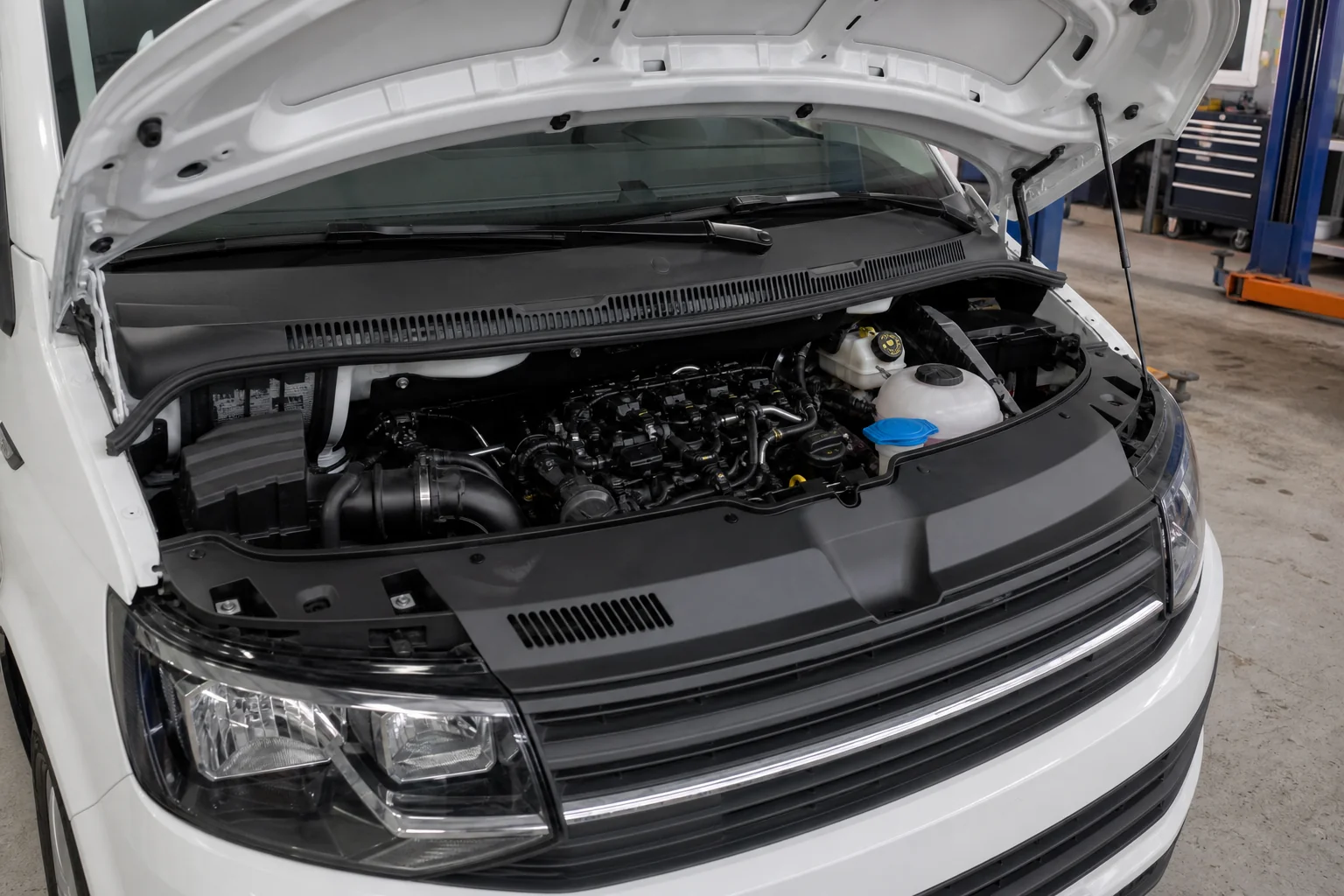
Does fleet remapping pay for itself? On high-mileage diesel vans, usually yes. An economy calibration realistically improves MPG by 5–12% — driver behaviour decides where in that range you land. Remaps from £150 per vehicle including diagnostics, with 1–2 hours downtime each and mobile visits to your yard. Speed limiters stay compliant, factory files are backed up for life, and everything is reversible. Declare the modification to your fleet insurer.
The Short Answer
For a diesel van doing serious annual mileage, an economy remap is one of the rare fleet spends that can pay for itself within months and keep paying every month after. The calibration reshapes torque delivery so the engine works less hard at working speeds — fewer downshifts under load, more relaxed motorway cruising, less time deep in the throttle.
The honest caveats: gains depend on the vehicle, the routes and — more than anything — the drivers. A calibration cannot out-tune a driver who sits at 80 with a roof rack. That is why we quote 5–12% as the realistic MPG range, not the fantasy 20% you will see in some fleet marketing.
For the technical detail on how economy calibrations work, our economy remap fuel savings guide covers it engine-by-engine. This page is about the business decision.
Who This Applies To
- Trades and couriers — Transits, Sprinters, Crafters, Vivaros and Berlingos doing 15,000–40,000 miles a year
- Multi-van SMEs — three to twenty vehicles where a percentage fuel saving becomes a visible line on the P&L
- Loaded and towing operations — builders, landscapers, plant hire — where vans work at or near payload daily
- Single owner-drivers — one van is still a fleet of one; the maths works the same way
It applies least to petrol city vans on short hops and to vehicles nearing end-of-lease where you will not hold the vehicle long enough to bank the savings.
The Business Case in Numbers
Work it through for your own fleet with three figures: annual mileage per van, current MPG, and your pence-per-litre. As a worked shape (not a promise): a diesel van covering 25,000 miles a year at 33 MPG uses roughly 3,440 litres. A conservative 6% improvement saves around 195 litres per van per year — at typical UK diesel prices, comfortably north of £250 per vehicle, every year, against a one-off remap from £150. At 10% and higher mileages, the payback lands in the first few months.
| Factor | What to plug in | Notes |
|---|---|---|
| MPG improvement | 5–12% realistic | Depends on routes, load and drivers |
| Cost per vehicle | From £150 | Diagnostics included; multi-vehicle rates on request |
| Downtime per vehicle | 1–2 hours | Mobile visits — vans tuned at your yard |
| Ongoing cost | None | Software change, no servicing implications |
Two things sharpen the case further. First, the drivability gain is free: the same calibration that saves fuel makes a loaded van far less painful up the climbs out of Haslingden or on M66 slip roads, which drivers notice immediately. Second, the change is software only — no hardware to maintain, and the factory file is archived for life so any van can go back to stock before lease return or sale.
The Driver Behaviour Caveat
We will be blunt because it saves awkward conversations later: the driver is the biggest variable in your fuel figures, before and after a remap. A calibration gives the engine more torque at lower revs so it can be driven more efficiently. Whether it is driven that way is a management question, not a tuning one.
- Best case — steady drivers on mixed routes bank the upper end of the range because the van holds higher gears under load
- Worst case — a driver who treats the new mid-range as a performance upgrade will cancel the savings, and no honest tuner will pretend otherwise
- Practical fix — pair the remap with telemetry or simple MPG tracking per van; the data usually settles the argument inside a month
If your vans are also used for towing, the same calibration logic pays off twice — see our remapping for towing guide for how torque delivery changes loaded driving.
Downtime and How Bookings Work
Each vehicle takes roughly 1–2 hours: diagnostic health check, factory ECU file read and archived, custom-written calibration flashed, then live-data verification. For fleets we schedule around your operation, not ours:
- Mobile visits — we come to your yard or depot anywhere across Lancashire and the North West; vans off the road for a couple of hours rather than a day. How that works in practice: mobile remapping guide
- Batching — two to four vehicles per visit is the sweet spot; larger fleets are done across scheduled visits so you are never short of vans
- Evenings and staged rollouts — remap two vans first, measure for a month against the untuned ones, then commit the rest. We actively encourage this pilot approach
- Workshop option — our Haslingden base is minutes off the A56/M66 corridor if drop-off suits better
Speed Limiters and Compliance
A frequent fleet manager worry, answered plainly: an economy remap does not remove your speed limiter. Where vans are limited at 62 or 70 mph — for policy or insurance reasons — the limiter stays in place; we can also set or adjust limiters as a service where your policy requires it. Equally important on the compliance front:
- Emissions systems stay intact. DPF, EGR and AdBlue removal is illegal for UK road use, and we do not do it on any vehicle — fleet or private. An economy calibration works with these systems, not around them.
- Insurance declaration. A remap is a material modification; your fleet insurer needs to know. Most commercial insurers handle economy calibrations routinely, but the declaration is not optional.
- Paper trail. Every vehicle gets a record of the work, and every factory file is archived for life — so any van can be returned to stock for lease return, warranty visits or fleet disposal.
Economy vs Performance Calibration — Pick per Van
| Calibration | Best for | What changes |
|---|---|---|
| Economy | High-mileage, route-driven vans | Torque reshaped for low-rev efficiency; 5–12% typical MPG gain |
| Blended (most popular) | Loaded vans, mixed routes, towing | Stronger mid-range with economy-minded cruising behaviour |
| Performance (Stage 1) | Lightly loaded vans, crew buses | Typical Stage 1 torque gains; economy roughly neutral driven calmly |
Mixed fleets can mix calibrations — economy files on the motorway vans, blended files on the loaded ones. Details of each option are on our van remapping and economy remapping service pages.
Risks and Honest Trade-Offs
- Unhealthy vans do not get flashed. Every vehicle gets a diagnostic check first; a van with DPF problems, boost leaks or injector faults gets a findings report instead of a remap. On a fleet, this doubles as a cheap health audit — several customers have caught developing faults this way before they became roadside recoveries.
- Warranty and lease terms. Manufacturer goodwill on powertrain claims can be affected, and some lease agreements restrict modifications — check yours; reversibility helps, but check first.
- Savings are probabilistic, not guaranteed. We quote ranges because that is what the real world delivers. Anyone guaranteeing a specific MPG figure for your fleet, sight unseen, is selling.
- Not every van is worth doing. End-of-lease vehicles, low-mileage runabouts and petrol city vans often are not. We will say so per vehicle.
When NOT to Remap the Fleet
- Vans within a few months of lease return or disposal — you will not hold them long enough to bank the savings
- Vehicles with active faults, limp mode or chronic DPF issues — fix first, tune after
- Fleets with no way to measure fuel — install basic MPG tracking first, or you will never know what you gained
- Where your lease or insurance terms flatly prohibit modification and cannot be renegotiated
Next Steps — Pilot Two Vans
The lowest-risk way in: pick two representative vans, remap them, and measure a month of fuel data against the rest of the fleet. If the numbers work — and on working diesels they usually do — roll it out. Send us your vehicle list and typical routes via the contact page or call 01706 404 357 for a per-vehicle quote. Multi-vehicle scheduling, mobile visits across Lancashire and the North West, and the fleet tuning options are all detailed on the service page — and the Knowledge Centre answers the wider questions your drivers will inevitably ask.
Van & Fleet Remapping — Common Questions
A realistic 5–12% MPG improvement on working diesel vans with an economy-focused calibration. Where you land in that range depends on routes, load and — above all — driver behaviour. We quote ranges rather than guaranteed figures, and we recommend piloting two vans and measuring before committing the fleet.
Around 1–2 hours per vehicle, covering the diagnostic health check, factory file backup, custom calibration flash and live-data verification. With mobile visits to your yard, vans are back on jobs the same morning.
Either. We run mobile visits across Lancashire and the North West and typically batch two to four vehicles per visit, or you can drop vans at our Haslingden workshop just off the A56/M66 corridor. Larger fleets are scheduled across multiple visits so you always have vans available.
No. An economy or Stage 1 calibration leaves your speed limiter in place, and we can set or adjust limiters where your fleet policy or insurance requires them. Compliance stays intact.
An economy or performance remap that keeps emissions systems active is legal. Removing or defeating DPF, EGR or AdBlue systems is illegal for UK road use and we do not offer it on any vehicle. Our calibrations work with the emissions equipment, not around it.
Yes. A remap is a material modification and must be declared to your fleet insurer. Most commercial insurers deal with economy calibrations routinely, but non-disclosure risks the policy — declare it before or immediately after the work.
Remaps start from £150 per vehicle including the diagnostic check, custom-written file and lifetime factory backup — against a national quality-remap average of £250–£500. Multi-vehicle rates are quoted per fleet; send your vehicle list for a fixed price.
Yes. Every factory ECU file is read and archived for life before we flash anything, so any van can be returned to its original calibration for lease return, warranty visits or disposal — at any point.