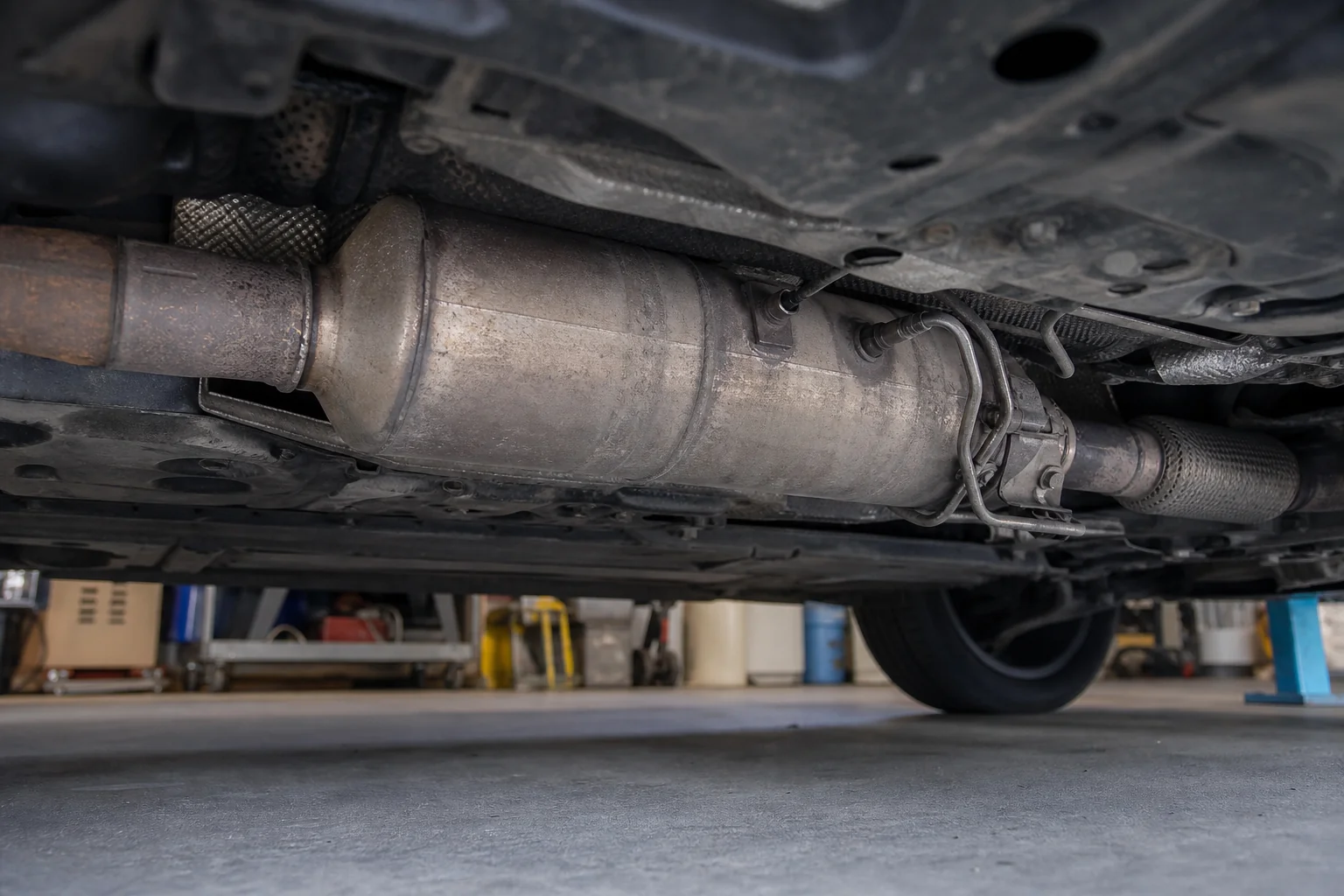
The ECU estimates DPF soot load largely from a differential pressure sensor comparing pressure before and after the filter. When the sensor drifts or its pipes crack or block, the ECU gets it wrong in either direction — false blocked-filter warnings, or a genuinely clogging DPF hiding in plain sight. Codes like P2453 point at the sensor circuit, not automatically the filter. Diagnosis beats parts-cannon guessing: a sensor is a modest fix, a DPF replacement can run four figures. Diagnostics from £40 at FLR tells you which one you actually have.
The Short Answer
Your diesel's ECU cannot see soot. It estimates how full the DPF is, and the biggest input to that estimate is a small differential pressure sensor mounted near the filter with two thin pipes running to it. When that sensor or its pipework fails, everything downstream fails with it — regeneration timing, soot-load warnings, limp mode decisions, the lot.
So before anyone tells you that you need a new DPF, the question that matters is: is the reading real? Answering that takes a scan tool, live data and about half an hour of method. It is one of the most common jobs through our DPF solutions service, and it applies to virtually every diesel with a particulate filter — which means every diesel sold in the UK since roughly 2009.
How Differential Pressure Sensing Estimates Soot
The principle is simple. Exhaust gas flows through the DPF's ceramic honeycomb, and soot trapped in the walls restricts that flow. Restriction creates a pressure difference: higher pressure before the filter, lower after. The sensor reads both sides through its two pipes and reports the difference to the ECU.
The ECU combines that pressure difference with exhaust flow rate, temperatures and a running soot model to estimate how loaded the filter is. Cross a threshold and it schedules an active regeneration — injecting extra fuel to raise exhaust temperature and burn the soot off. Cross a higher threshold and you get the warning light; higher still and it is limp mode and a forced-regen-or-workshop situation. The full cycle is covered in our DPF regeneration guide.
Notice the dependency: the entire strategy leans on one sensor telling the truth. There is no backup measurement of soot. Bad input, bad decisions.
How DPF Pressure Sensors Fail
Three failure modes cover almost everything we see:
- Drift. The sensing element ages and its readings creep away from reality — often reading slightly high at all times. The ECU thinks soot is accumulating faster than it is, regenerates constantly, and eventually throws a blocked-filter warning on a filter that is fine.
- Blocked or cracked pipes. The two rubber-and-metal pipes live in a hot, sooty environment. Soot and condensation clog them; heat cracks them. A blocked pipe flattens the reading (ECU thinks the filter is emptier than it is — dangerous, because a genuinely clogging DPF goes unnoticed). A cracked pipe leaks pressure and skews the reading unpredictably.
- Implausible output. The sensor reports a value the ECU knows cannot be right — pressure with the engine off, or a signal outside the electrical range. This is what typically sets P2453 (differential pressure sensor performance) and its neighbours P2452, P2454 and P2455.
Symptoms from the driver's seat: more frequent regenerations (fans running after switch-off, raised idle, a diesel-hot smell), falling MPG, a DPF warning that comes and goes, or a car that drops into limp mode with DPF-related codes. Sound familiar? Our guide to limp mode explains what the ECU is doing and why.
P2453 and Friends — What the Codes Actually Say
Here is the detail that saves people money: P2453 points at the sensor circuit, not the filter. It means the differential pressure signal is behaving implausibly — stuck, out of range or inconsistent with other data. That is a different statement from P2002 (filter efficiency below threshold), which says the ECU believes the filter itself is underperforming.
The two get conflated constantly. We have had customers arrive quoted for a new DPF off the back of a P2453 that turned out to be a split sensor pipe. We have also seen the reverse — a drifted sensor under-reading for months while the filter quietly loaded up, then P2002 arriving late with a filter that was genuinely, badly blocked. The code is the start of the diagnosis, never the end. Both codes feature in our rundown of the top ten fault codes we see before remapping.
False-Blocked vs Genuinely Blocked — How We Tell
This is the judgement call the warning light cannot make, and it is where live data earns its keep. Our process through fault-finding looks like this:
- Key-on, engine-off reading. With no exhaust flow there should be essentially zero pressure difference. A meaningful offset here means the sensor is lying before we go any further.
- Idle and free-rev behaviour. We watch the differential pressure respond to engine speed. A healthy system shows small, smooth, proportional changes. A blocked pipe shows a flat line; a genuinely loaded filter shows high readings that climb sharply with revs.
- Cross-check the soot model. The ECU stores calculated soot mass, ash volume and time since last regeneration. If measured pressure and the model disagree wildly, the sensor side is suspect.
- Physical inspection. Pipes off, check for soot blockage, splits and moisture. Two minutes that catches a remarkable number of these faults.
Only when the reading is trustworthy do we judge the filter itself — and often a genuinely loaded filter just needs a properly monitored regeneration and a change in driving pattern, not replacement.
Why Diagnosis Beats the Parts Cannon
The parts-cannon approach — replace the sensor, then the pipes, then force a regen, then quote a DPF — works eventually, but you pay for every miss. The failure cases stack up in one direction: a new sensor on a blocked filter does nothing; a new DPF behind a lying sensor fails again the same way; and every forced regeneration on a misdiagnosed car is heat cycling the filter for no reason.
An hour of proper diagnosis identifies the actual fault before any parts are ordered. That is the whole argument. It is also why we will not quote for DPF work over the phone from a code alone — the same code has a £40 outcome and a four-figure outcome, and guessing between them with your money is not diagnosis.
And to head off the question we get asked most: no, removing the DPF is not the shortcut. Emissions deletes are illegal for UK road use and FLR does not offer them — the honest version of that conversation is in DPF and remapping — the facts.
Cost Reality — Sensor vs Filter
The gap between the two outcomes is exactly why the diagnosis matters:
- Differential pressure sensor: commonly around £40–£120 for the part on mainstream diesels, plus modest fitting time — it is usually accessibly mounted. Pipes are cheaper still.
- DPF replacement: genuine filters routinely run £1,000–£2,500 fitted depending on the car; even quality aftermarket units are many hundreds. (Cheap unbranded filters often fail to regenerate properly — a false economy we would steer you away from.)
- Diagnosis at FLR: from £40, and you know which bill you are actually facing before spending a penny on parts.
One honest caveat: sometimes it genuinely is both. A sensor that under-read for months can let a filter load beyond the point a normal regeneration recovers. We will tell you if that is the situation — with the live data to show why.
Why This Matters Before a Remap
Every remap booking at FLR starts with diagnostics, and DPF pressure readings are on the checklist for every diesel. A remap changes fuelling and exhaust flow; mapping a car whose soot estimate is already wrong is asking for a blocked filter down the line. If the readings are suspect we fix that first — then write the custom file, with your factory backup archived so everything stays reversible. Wondering whether your diesel's flat spots and warnings are sensor, filter or something else entirely? Start with signs your car needs a remap and a scan.
When NOT to Act
- Do not replace the DPF off a single code. P2453 especially is a sensor-circuit code — verify the reading first.
- Do not keep forcing regenerations hoping the light stays off. Repeated forced regens on a misdiagnosed car add heat stress and dilute your engine oil with fuel.
- Do not clear the code and carry on. If the sensor is under-reading, the silence is the dangerous part — the filter loads up unmonitored.
- Do not buy the cheapest unbranded sensor. A sensor that reads wrong from new recreates the original problem with a receipt attached.
Next Steps
DPF light on, regens getting frequent, or a big quote you want a second opinion on? Book diagnostics from £40 — we will read the codes, watch the live pressure data and tell you plainly whether it is the sensor, the pipes, the filter or nothing at all. Answers to the most common DPF questions live on our FAQ page, or send us your VRN / call 01706 404 357. Workshop in Haslingden, mobile across Lancashire and the North West — including all the short-trip diesels of Rossendale that never get a motorway run.
DPF Pressure Sensors — Common Questions
It measures the pressure difference between the inlet and outlet of the diesel particulate filter through two small pipes. The ECU uses that difference — alongside flow and temperature data — to estimate how much soot the filter holds and to decide when to regenerate.
Unusually frequent regenerations, falling MPG, a DPF warning light that comes and goes, limp mode with DPF-related codes, or — the quiet failure — no warnings at all while the filter genuinely loads up because the sensor is under-reading.
Not necessarily. P2453 is a sensor performance code — it says the differential pressure signal is implausible, which is very often a drifted sensor or a cracked or soot-blocked pipe rather than a blocked filter. Verify the reading with live data before condemning the DPF.
Typically around £40–£120 for the part on mainstream diesels plus modest fitting time, since the sensor is usually accessibly mounted. Compare that with £1,000–£2,500 for a fitted genuine DPF — which is exactly why diagnosing before replacing matters.
Yes. A sensor that under-reads stops the ECU regenerating on time, so soot accumulates unmonitored. Left long enough the filter can load beyond what a normal regeneration recovers. That is why we check both sensor plausibility and actual filter state in the same visit.
No. DPF removal or defeat is illegal for UK road use — it is an automatic MOT failure and can carry substantial fines — and FLR does not offer it. Diagnosing and fixing the actual fault is nearly always cheaper than owners expect anyway.
Not until the fault is resolved. A remap changes fuelling and exhaust flow, and mapping a car with an unreliable soot estimate risks a blocked filter later. We diagnose first on every booking — if the DPF system checks out healthy, the remap goes ahead.