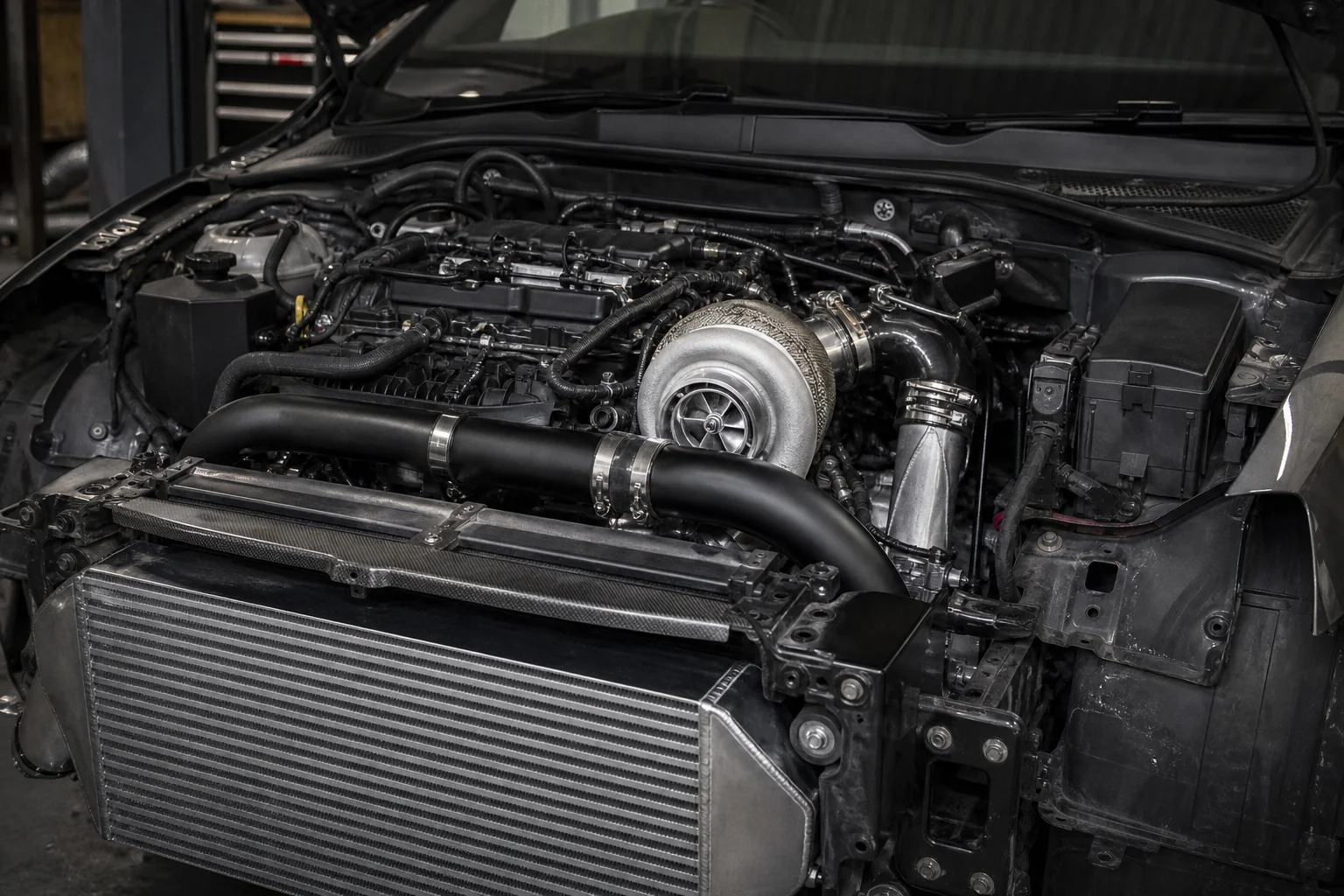
A hybrid turbo keeps your factory turbo's housings but fits larger or more efficient wheels and upgraded internals, so it bolts straight in while flowing significantly more air. It is Stage 3 territory — worthwhile only when you have genuinely outgrown Stage 2, and only with supporting fuelling, cooling and clutch work. The custom calibration is what makes or breaks the build. Every FLR project starts with diagnostics, uses a custom file, keeps a factory backup and stays reversible. No emissions hardware removal for road use — it is illegal in the UK.
The Short Answer
What is a hybrid turbo? It is your original turbocharger, professionally rebuilt with upgraded internals — typically a larger billet compressor wheel, sometimes a larger turbine wheel, machined housings to suit, uprated bearings and a rebalanced shaft assembly. From the outside it looks stock and bolts to the same manifold, pipework and oil feeds. Inside, it can flow considerably more air than the unit the factory signed off.
That "same outside, more inside" trick is the whole appeal. No custom manifolds, no downpipe fabrication headaches, no repackaging the engine bay — a hybrid slots into the space the factory left, which keeps installation sane and often keeps the car looking untouched under the bonnet.
But a hybrid turbo on its own does nothing. It is a component, not a result. The result comes from the custom calibration that tells it how hard to work — and from the supporting hardware that lets the rest of the car keep up.
Who Hybrid Turbos Are Actually For
Honest answer: a small minority of the cars we tune. A hybrid makes sense for the owner who has already maxed a healthy Stage 2 setup and still wants more — the Golf R or Focus ST owner building a fast-road weapon, the diesel owner chasing serious towing torque, the project car heading for occasional track use. If you are still on a stock map wondering where to start, this is not your first step. Start with our Stage 1 vs Stage 2 guide; for most daily drivers around Haslingden and Rossendale, Stage 1 from £150 delivers the biggest satisfaction-per-pound of any modification and needs no hardware at all.
How a Hybrid Makes More Power
A turbocharger's output is limited by how much air its compressor can move efficiently. Factory wheels are sized for the factory power target plus a modest margin — push a stock turbo far past that and it falls off its efficiency map, producing more heat than airflow while the shaft speed climbs into dangerous territory.
A hybrid resets that ceiling:
- Billet compressor wheel — larger and more aggressively machined than the cast factory item, moving more air at lower shaft speed
- Machined compressor housing — opened up to accept the bigger wheel while retaining the factory fitment points
- Turbine upgrades — a larger or higher-flow turbine wheel on bigger builds, so the exhaust side does not choke the gains
- Uprated bearings and seals — often a ball-bearing cartridge for durability and quicker spool at the higher workload (see our how turbochargers work guide for the bearing story)
- Balancing — the rebuilt assembly is precision-balanced, because tolerances at 150,000+ rpm are unforgiving
The trade-off is physics you cannot dodge: bigger wheels have more inertia, so most hybrids spool slightly later than stock. A good calibration minimises it; a lazy one turns your daily into an all-or-nothing light switch.
The Supporting Work a Hybrid Demands
This is where budgets get real. Air is only a third of combustion — the rest of the car has to match:
- Fuelling — more air needs more fuel. Depending on platform that can mean an uprated high-pressure fuel pump, injectors, or on direct-injection petrols a supplementary system on big builds. Running lean under boost is how engines die.
- Cooling — a hybrid generates more charge heat than the factory intercooler was sized for. An uprated core is close to mandatory; our intercoolers explained guide covers why charge temperature decides both power and safety.
- Clutch and drivetrain — factory clutches are matched to factory torque. Hybrid-level torque will find a marginal clutch in weeks. Read clutch health and remapping before you spend a penny on the turbo.
- Exhaust and intake flow — the usual Stage 2 hardware (high-flow downpipe with a sports cat, intake) becomes the baseline, not the upgrade. We only fit and map road-legal emissions-compliant hardware — removing DPFs or cats for road use is illegal in the UK and we do not do it.
- Health and maintenance — fresh oil and filters, healthy plugs or glow plugs, boost pipework that holds pressure. Diagnostics first, always.
Realistic Expectations — No Fairy Tales
We will not quote BHP figures here, because honest numbers depend on the engine code, the specific hybrid specification, fuel quality and the supporting hardware. What we will say:
- A well-specified hybrid build typically sits meaningfully above what the same engine achieves at Stage 2 on the stock turbo — that is the whole point
- Peak numbers arrive higher in the rev range, and low-rpm response usually softens slightly versus stock
- Real-world drivability depends almost entirely on calibration quality, not the wheel size on the invoice
- Fuel economy under gentle driving can stay reasonable; use the performance and it will not
Anyone promising an exact figure before seeing your car, your hardware list and your fuel is guessing. We confirm expectations from your VRN and specification during quoting — send us the details and we will tell you straight, including if we think the spend is not worth it for your goals.
Why the Calibration Matters More Than the Hardware
Two identical hybrid turbos on two identical engines can drive completely differently. The difference is the file. A hybrid changes the compressor map, spool characteristics and safe boost envelope of the whole system — so every boost target, torque request, fuelling table and protection threshold in the ECU needs rebuilding around the new hardware, not just turning up.
A proper hybrid calibration is developed iteratively: baseline logging, conservative first map, repeated data review of boost tracking, air-fuel ratios, exhaust temperatures and knock activity, then refinement until the car delivers its performance smoothly and safely across the whole rev range — including on real roads like the climbs out of Rossendale, not just a dyno cell. That is custom tuning in the truest sense, and it is why a generic "hybrid map" downloaded for your engine code is a gamble with a four-figure hardware bill sitting on top of it.
Manual cars also need the torque delivery shaped to what the clutch can hold. Automatics and DSGs need the gearbox software to agree with the new engine output — a DSG / TCU calibration is effectively mandatory on dual-clutch cars at this level, or the gearbox will simply clamp the torque the turbo worked so hard to make.
Hybrid vs a Bigger Aftermarket Turbo
Why not just fit a larger off-the-shelf turbo? Sometimes that is the right call — but hybrids win on packaging and practicality:
- Fitment — a hybrid reuses factory manifolds, pipework, oil and coolant lines; a larger frame turbo often needs custom fabrication
- Cost of installation — bolt-in beats fabricate-and-fit almost every time
- Spool — a well-specified hybrid usually keeps more low-end response than a big frame swap chasing the same power
- Ceiling — the big turbo wins outright maximum power; if your goals are drag-strip numbers, a hybrid may only be a stepping stone
For a fast road car that still commutes down the M66, the hybrid's balance of response and headroom is usually the smarter package.
Common Hybrid Turbo Misconceptions
- "A hybrid turbo alone adds huge power." Without calibration and supporting mods, it adds almost nothing — the ECU still targets stock boost.
- "Hybrids are unreliable." A quality hybrid from a reputable builder, mapped sensibly, is a durable component. Failures usually trace to cheap rebuilds, missing supporting mods or aggressive generic files.
- "It's just a Stage 2 with a different turbo." No — the calibration has to be rebuilt around new compressor behaviour. Treating it as a tweaked Stage 2 file is how engines get hurt.
- "Insurance won't notice." A hybrid build is a significant modification and absolutely must be declared to your insurer, like any remap.
When NOT to Go Hybrid
Skip or postpone a hybrid build if any of these apply: the car has unresolved faults or limp-mode history (diagnostics from £40 comes first); the clutch, gearbox or engine health is questionable; the budget only stretches to the turbo with nothing left for fuelling, cooling and calibration; the car is your only transport and downtime hurts; or your real-world driving would never use the extra performance. An honest Stage 2 on a healthy car beats a compromised hybrid build every single time — and costs a fraction as much.
Next Steps
If you have genuinely outgrown Stage 2 and want to plan a hybrid project properly, start a conversation. We will assess the car, spec the full package and give you a realistic picture — timeline, budget, expectations — before anything is ordered. Our FAQ covers process questions, and Stage 2 remains the honest recommendation for most fast-road builds.
Get in touch with your VRN and goals or call 01706 404 357. Every FLR build: diagnostics first, custom file, factory backup archived, reversible calibration.
Hybrid Turbos — Common Questions
A factory turbocharger rebuilt with upgraded internals — typically a larger billet compressor wheel, machined housings, uprated bearings and a rebalanced shaft — so it flows significantly more air while bolting into the original location with factory pipework.
Only if you have genuinely maxed out Stage 2 and have budget for the supporting fuelling, cooling, clutch and calibration work. For most daily drivers, Stage 1 or Stage 2 delivers far better value. We tell customers honestly when a hybrid is the wrong spend.
No. Without a custom calibration the ECU still targets factory boost, so the bigger hardware sits idle. The calibration is what converts the turbo's extra flow into safe, usable performance — it matters more than the hardware itself.
Typically uprated fuelling (pump and/or injectors depending on platform), an uprated intercooler, Stage 2-level intake and road-legal exhaust hardware, a clutch that can hold the torque, and a full custom calibration. On DSG cars, gearbox software must be calibrated to match.
Usually slightly — larger wheels carry more inertia, so full boost arrives a little later than stock. Good hybrid specification and careful calibration keep the difference small; many builds use ball-bearing cartridges partly to claw back response.
It depends on the engine code, the hybrid specification, fuel and supporting hardware — which is why we never promise figures before assessing the car. Expect a meaningful step over Stage 2 on the same engine when the whole package is specified properly.
The software side is — we archive your factory file before any flash and can restore stock calibration at any time. The hardware can be returned to stock too, though that is a physical job. The build must be declared to your insurer either way.
Yes, when emissions systems stay intact and functioning. Removing DPFs, cats or other emissions hardware for road use is illegal in the UK and FLR does not offer it. We build fast road cars the legal way.