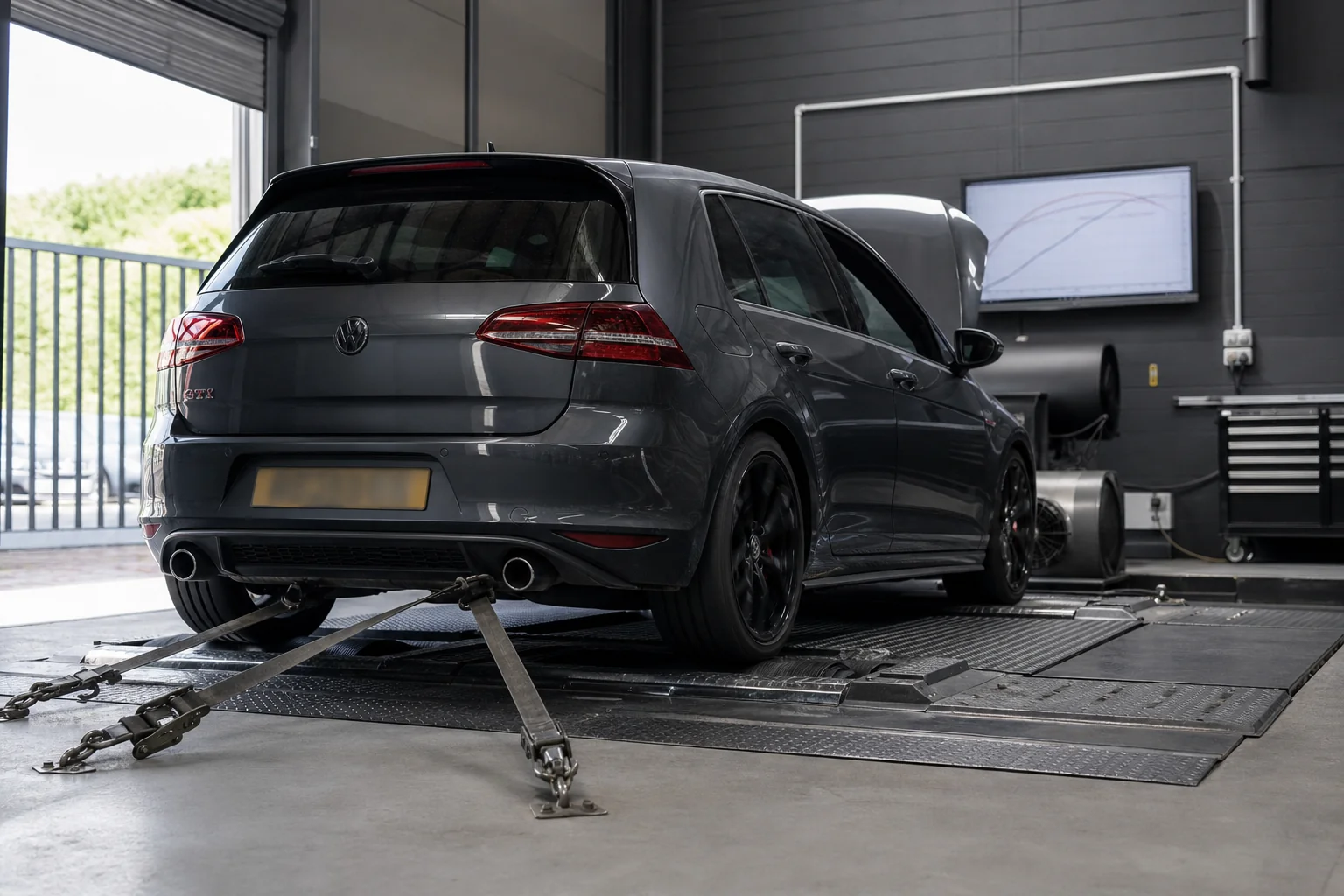
Most remapping myths contain a grain of truth stretched into a blanket rule. Remaps do not blow healthy engines — bad files on unhealthy engines do. Insurance absolutely can find out, and you must declare. Remapping is legal for UK road use when emissions systems stay active; DPF, EGR and AdBlue removal is not. Dyno maps are not automatically better, tuning boxes are not safer, and yes — a properly done remap is fully reversible. Every verdict below comes from real workshop experience, not marketing.
Why Remapping Myths Spread So Easily
Tuning sits in an awkward spot: it is technical enough that most drivers cannot verify claims themselves, and emotive enough that everyone has an opinion. Add forums full of second-hand horror stories, tuners with something to sell, and dealers with something to protect, and you get a fog of confident half-truths.
Our position is simple. We remap cars for a living from our Haslingden workshop, so we clearly believe in the work — but we turn jobs away every week, and we would rather lose a booking than flash a file onto a car that is not fit for it. Every verdict below is written from that seat: the person actually holding the diagnostic lead, not the person writing the brochure.
If you want the deeper safety picture behind several of these myths, our guide on whether ECU remapping is safe is the natural companion to this page.
Engine & Reliability Myths
Myth 1: "Remaps blow engines"
The most repeated claim of all. The truth: a properly written Stage 1 file on a healthy turbocharged engine works well within the tolerances the manufacturer built in. Factory calibrations are deliberately conservative — they have to cover poor fuel, missed services, extreme climates and drivers who never check their oil. A sensible remap claims back part of that margin while keeping knock control, temperature limits and limp-home protection fully active.
Where do the horror stories come from? Almost always one of three places: a generic file flashed blind onto an engine with existing faults, an aggressive map chasing numbers the hardware cannot support, or a car that was already on its way out and the remap simply arrived first. That is why every FLR job starts with diagnostics before anything is written.
Verdict: false — but only when the car is healthy and the file is written properly. Bad tuning genuinely does kill engines, which is exactly why process matters more than price.
Myth 2: "A remap fixes mechanical faults"
We hear versions of this weekly: the car is down on power, hesitating, or stuck in limp mode, and the owner hopes a remap will "sort it out". It will not. A remap changes the instructions the ECU follows; it cannot repair a split boost hose, a lazy turbo actuator or a clogged DPF. Flashing more power onto a faulty engine usually makes the symptom worse and the eventual repair bill bigger.
Verdict: false. Faults need diagnosing and fixing first — which is why we offer standalone diagnostics from £40 for owners who want answers before they decide anything about tuning.
Myth 3: "More boost is always the goal"
Boost pressure is one ingredient among many, and chasing it in isolation is how amateur maps break things. A good calibration balances boost, fuelling, ignition or injection timing, torque limiters and gearbox protection so the whole system works together. On plenty of engines, the biggest daily-driving improvement comes from cleaning up throttle response and torque delivery low in the rev range — not from cramming in maximum pressure at the top end.
Verdict: false. Drivability is the goal. Boost is a tool, not a scoreboard.
Insurance & Legal Myths
Myth 4: "Insurance never finds out"
This one is dangerous. After a serious claim, insurers can and do inspect vehicles — and an engineer's report on a written-off car can include reading the ECU. If undeclared tuning is found, the insurer may reduce or refuse the payout and could treat the policy as invalidated. You would be left with a crashed car, no payout, and potentially a disclosure problem on every future insurance application.
Verdict: dangerously false. A remap is a material modification in the UK and must be declared. Many specialist insurers cover remapped cars at sensible premiums — our remap insurance guide covers how to do it properly.
Myth 5: "Remapping is illegal"
Remapping itself is legal in the UK. Modifying your own vehicle's software is not an offence, provided the car remains road-legal afterwards: emissions systems intact and functioning, and the modification declared to your insurer. What is illegal for road use is removing or defeating emissions equipment — DPF removal, EGR deletes and AdBlue bypasses all fall foul of UK law for road-registered vehicles, regardless of what any tuner tells you. We do not offer illegal deletes, full stop.
Verdict: false — with the important caveat that some things sold alongside remapping are illegal, and you should walk away from anyone offering them for road use.
Myth 6: "Your warranty is instantly void everywhere"
The truth is more nuanced. A remap does not tear up your entire warranty document overnight. What it does is give the manufacturer grounds to decline claims on components the modification could plausibly have affected — engine, turbo, transmission. A remap has no bearing on a claim for a faulty window regulator or infotainment screen. That said, on powertrain claims the manufacturer holds most of the cards, and some brands flag modified software permanently.
Verdict: exaggerated. The real picture — what dealers can decline, what they cannot, and how to weigh the risk on a warranty-age car — is in our warranty guide.
Economy & Everyday Driving Myths
Myth 7: "Remapping always ruins your MPG"
It depends entirely on the map and your right foot. A performance map driven hard will use more fuel — no surprise there. But a well-written Stage 1 on a turbo diesel often improves real-world economy in normal driving, because stronger mid-range torque means fewer downshifts, less labouring and less time at high revs on climbs like Grane Road or the pull up the M66. Plenty of our motorway-commuting customers report modest MPG gains when driving normally.
Verdict: false as a blanket rule. The honest picture, including realistic expectations and why we never promise specific figures, is in our economy remap guide.
Myth 8: "Tuning boxes are safer than remaps"
Tuning boxes feel safer because they plug in and unplug — but think about what they actually do. Most work by intercepting sensor signals and feeding the ECU false readings, typically about fuel rail pressure. The ECU then compensates blind, without knowing the true state of the engine. A remap, by contrast, changes the actual calibration with all factory monitoring still reading true values. One approach lies to the brain; the other rewrites the instructions honestly.
Verdict: false. A quality custom remap is the more transparent, more controlled option. The full comparison is in remap vs tuning box.
Process & Quality Myths
Myth 9: "Dyno maps are always better"
A dyno is a measurement tool, not a magic wand. It is genuinely valuable for high-power builds where you need repeatable load conditions to fine-tune fuelling and timing. But for a standard Stage 1 on a stock car, a custom-written file verified with live data logging on real roads tells you what actually matters: how the car behaves in the conditions you drive it in. A dyno print-out from a rolling road with generous correction factors proves less than tuners would like you to believe.
Verdict: false as an absolute. Dynos have their place; they are not a prerequisite for a safe, well-verified Stage 1.
Myth 10: "All remaps are the same"
Two remaps can differ as much as two rebuilds from two different engine builders. The variables: is the file custom-written for your exact engine code, software version and condition, or a generic file matched only to the model? Was the car health-checked first? Was the original file backed up? Was the result verified with live data afterwards? A £150 remap and a £500 remap can be worlds apart in either direction — price alone tells you very little.
Verdict: false. Nationally, quality remaps average £250–£500; our Stage 1 starts from £150 with diagnostics included because we are workshop-based in Lancashire with low overheads, not because corners are cut. See custom vs generic remapping for what separates good files from bad.
Myth 11: "You can't reverse a remap"
Any professional tuner reads and archives your original factory file before writing anything. At FLR that backup is kept for life, so your car can be returned to its exact factory calibration at any point — before a dealer visit, at resale, or simply because you changed your mind. What you cannot always erase is the evidence that the ECU was once modified, which is a separate question we cover honestly in our dealer detection guide.
Verdict: false. A properly done remap is fully reversible. If a tuner cannot show you their backup policy, that tells you something.
Myth 12: "Cheap maps are the same file anyway"
The cynical version of myth 10, and there is a grain of truth: some budget operators genuinely do buy generic files from a database and flash them unmodified, in which case you are paying for a middleman with a laptop. But the conclusion — that all tuning is secretly the same file — is wrong. A custom-written calibration starts from your car's original file, adjusts it for your engine code, software version, fuel quality and condition, and is verified on your car afterwards. Same starting point as the factory intended; completely different process from a database flash.
Verdict: partly true about the budget end, false as a general rule. Ask any tuner two questions: "is the file written from my car's original?" and "how do you verify it afterwards?" The answers separate the two camps in under a minute.
What We Actually Check Before Any Remap
Because so many myths trace back to bad process, here is the process that prevents them. Every Stage 1 remap we carry out — from £150, diagnostics included — follows the same sequence:
- Diagnostic health check. Fault codes and live data reviewed before anything is written. Boost behaviour, fuel trims, DPF state on diesels. Unhealthy cars get a diagnosis, not a flash.
- Factory file read and archived. Your original calibration is backed up and kept for life. Reversibility is built in from minute one.
- Custom-written file. Calibration adjusted for your exact engine code and software version — never a generic download.
- Verification. Post-flash live data check and a road test on the roads we know — the A56, the M65 corridor, the climbs out of Rossendale.
Follow that sequence and the scary myths stop applying. Skip any step and they start becoming true.
When the Sceptics Are Right — Times Not to Remap
Honesty cuts both ways. There are situations where leaving the car stock is genuinely the right call:
- Active warning lights or limp mode — diagnose first, always
- A slipping clutch or tired turbo — more torque accelerates the failure
- Heavy reliance on manufacturer warranty — weigh the goodwill risk before tuning a nearly-new car
- You will not declare it to your insurer — the financial exposure dwarfs any performance gain
- Non-turbo petrol expecting big numbers — gains are modest; often poor value
If any of those apply, we will tell you before taking your money. That is not a marketing line — turning away unsuitable jobs is the cheapest insurance policy a tuner has.
Next Steps
If this page has cleared the fog, here is where to go next. Browse the rest of our guides and the Knowledge Centre for straight answers on anything we have not covered here. If you are weighing up a specific car, send us your registration through the contact page or call 01706 404 357 — we will tell you honestly whether it is a good candidate, what to expect, and what it costs. No pressure, no hype, and if the honest answer is "leave it stock", that is the answer you will get.
Remapping Myths — Common Questions
Not when the engine is healthy and the file is custom-written with factory protections left active. Damage stories almost always trace back to generic files, skipped diagnostics or cars that already had faults. A proper process — health check, custom file, verification — keeps the work inside the engine's designed tolerances.
No — remapping is legal when the car stays road-legal afterwards: emissions systems intact and the modification declared to your insurer. What is illegal for UK road use is removing or defeating DPF, EGR or AdBlue systems. We do not offer illegal deletes.
They can. After a serious claim, insurers may inspect the vehicle, and engineers can read the ECU. Undeclared tuning discovered at that point can reduce or void your payout entirely. Declare the remap — many specialist insurers cover tuned cars at reasonable premiums.
Not automatically. Dynos are valuable for high-power builds needing repeatable load testing, but a standard Stage 1 verified with live data logging on real roads is a safe, proven approach. The quality of the file and the verification process matter far more than which tool was used.
Yes — we archive your original factory file before flashing anything and keep it for life, so the car can be returned to exact factory calibration at any time. Note that returning to stock does not always erase every trace that the ECU was once modified.
No. Most tuning boxes work by feeding the ECU false sensor readings, so the engine runs on compensated guesses. A custom remap changes the calibration directly while all factory monitoring keeps reading true values — a more transparent and controlled approach.
No. Driven normally, a well-written Stage 1 on a turbo diesel often improves real-world MPG because stronger mid-range torque means less downshifting and labouring. Driven hard, any car uses more fuel. We never promise specific figures — driving style dominates.
Nationally, quality remaps average £250–£500. At Finish Line Remaps, Stage 1 starts from £150 including diagnostics, a custom-written file, lifetime factory backup and post-flash verification. Price alone does not indicate quality — ask about the process behind it.