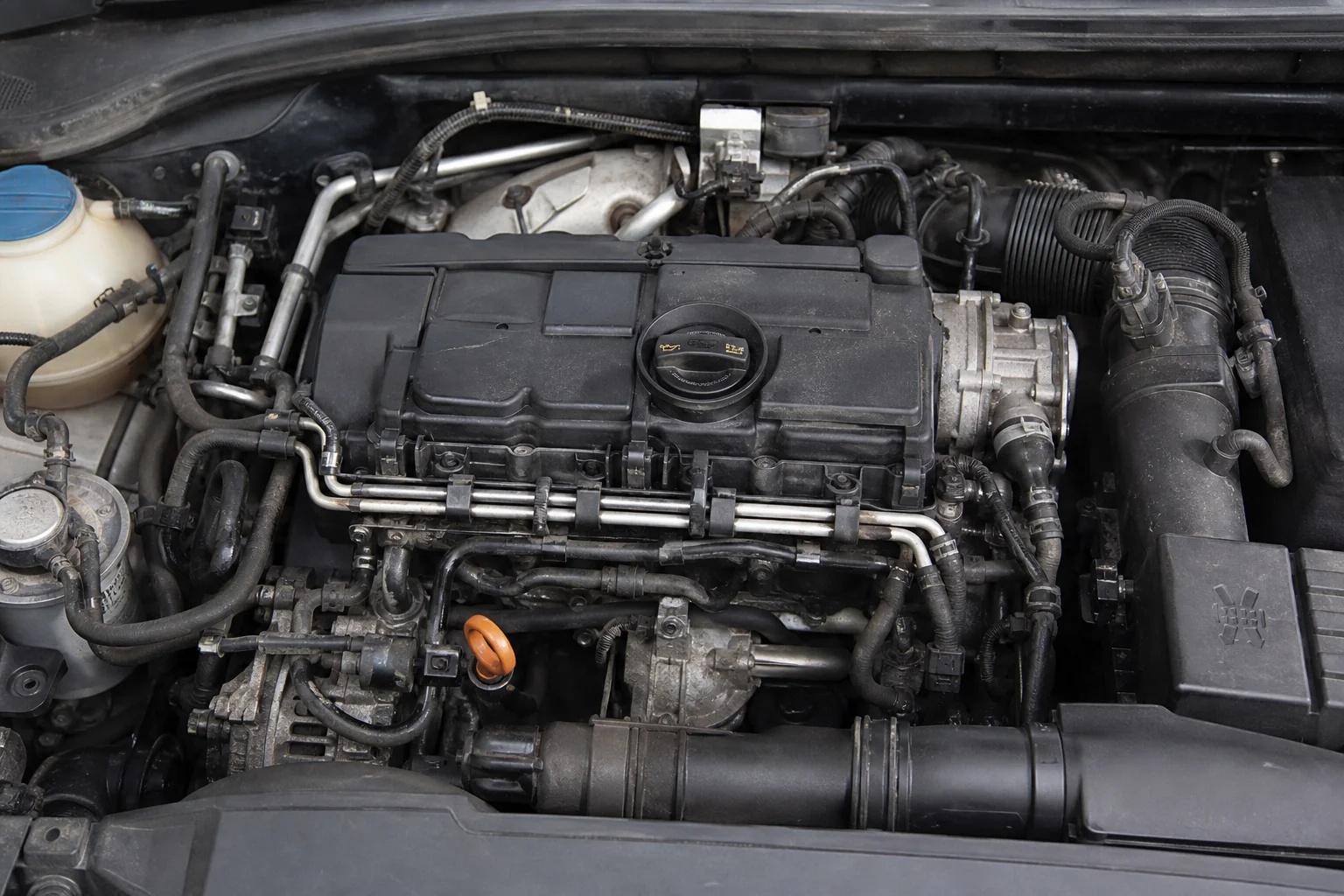
The vehicles where an economy remap genuinely pays: working vans (Transit Custom, Sprinter, Transporter), motorway diesels (Passat/Superb TDI, 320d, C220d) and loaded SUVs that tow or carry. Honest expectation: 1–3 mpg with a sensible right foot — real money at 20,000+ miles a year, irrelevant at 5,000. From £150 at FLR with diagnostics included; economy-biased calibration on request. The mechanism explained: economy remap fuel savings.
Why More Torque Means Less Fuel
The physics is simple and worth thirty seconds. Fuel economy is mostly about how hard the engine works to maintain speed. Add 60–80 Nm of low-rev torque and the vehicle holds sixth gear where it dropped to fifth, pulls hills at 1,800 rpm instead of 2,600, and needs less throttle for the same result. The engine spends more of its life in its efficient zone — that is the entire mechanism, and it is why the effect is strongest on vehicles that work: loaded vans, towing SUVs, motorway mile-munchers. The full explanation lives in our economy remap guide; this page is about which vehicles it pays on.
1. Working Vans — The Clearest Case in Tuning
A van at 25,000 miles a year is where the economy arithmetic stops being marketing and becomes a spreadsheet. The Transit Custom EcoBlue is the UK benchmark — typically ~95 Nm more on the 130 PS van, which means less gear-hunting loaded and 1–3 mpg on sensible routes. The Sprinter and Vito respond identically, as does the VW Transporter 2.0 TDI. For multi-van operators the numbers multiply: see the van & fleet remapping guide and economy calibration service.
2. Motorway Diesels — Passat, Superb, 320d, C220d
The company-car stalwarts. A Passat or Superb 2.0 TDI doing Lancashire-to-London weeks holds its cruise with noticeably less effort mapped, and the 320d and C220d do the same with the ZF8 and 9G-Tronic holding taller gears once the torque supports it. High-mileage private drivers see the same benefit; the 1–3 mpg range holds across this group driven sensibly.
3. Loaded SUVs and Tow Cars
A Tiguan or Kodiaq that spends weekends towing and weekdays full of family works harder than its badge suggests — and working engines are where the economy gain lives. Same engines as above, same result, with the added benefit that the towing experience transforms. The dedicated shortlist: best cars to remap for towing.
The Economy Shortlist at a Glance
| Vehicle | Why it pays | Honest MPG expectation |
|---|---|---|
| Transit Custom / Sprinter / Transporter | High miles, heavy loads, torque-hungry duty cycle | 1–3 mpg, more if currently thrashed loaded |
| Passat / Superb / Octavia 2.0 TDI | Motorway consistency rewards taller-gear cruising | 1–3 mpg |
| 320d / 520d (B47) | ZF8 holds taller gears once torque supports it | 1–2 mpg |
| C220d / E220d (OM651) | Heavy cars that benefit from effortless cruising | 1–2 mpg |
| Tiguan / Kodiaq TDI (towing) | Loaded duty cycle amplifies the torque benefit | 1–3 mpg solo, similar towing |
Who Should NOT Buy an Economy Remap
- Low-mileage drivers — at 5,000 miles a year, 2 mpg saves roughly a tank of fuel annually. Buy the remap for driveability if you want it; do not buy it for the fuel maths.
- Short-trip urban diesels — your fuel problem is the duty cycle, not the calibration, and the DPF agrees. Read the short-trip diesel guide first.
- Petrol city cars — the big repeatable MPG wins are a turbo-diesel phenomenon. We will tell you this on the phone rather than take the booking.
- Anyone promised 15–20% savings by another tuner — walk away. Honest numbers are 1–3 mpg, driving style dependent.
How We Deliver an Economy Calibration at FLR
- VRN quote. Registration, mileage and duty cycle in — honest payback assessment out. If it does not pay, we say so.
- Diagnostics first. DPF, EGR, boost and injector health checked — an inefficient engine needs fixing, not masking. Included with every Stage 1.
- Economy-biased custom file. Low-rev torque and part-throttle refinement prioritised, emissions systems fully active. See the economy remap service.
- Verification. Post-flash live data, road test, and advice on the driving habits that bank the savings.
Next Steps
If your vehicle is on the shortlist and the mileage is there, an economy remap is one of the few tuning products that literally pays for itself — and if it is not, we would rather tell you than tune you. Related reading: how economy remaps actually save fuel, the van & fleet guide, and the best cars to remap in the UK. Ready? Send your VRN via the contact page or call 01706 404 357. Workshop in Haslingden, mobile across Lancashire and the North West.
Economy Remaps — Common Questions
High-mileage turbo diesels doing steady journeys: working vans like the Transit Custom and Sprinter, motorway cars like the Passat TDI and 320d, and towing SUVs. Owners and operators commonly report 1–3 mpg sustained improvement with a sensible driving style — which at van mileages is real money.
It is the torque, not the power. More torque at low revs means the vehicle holds higher gears longer and needs less throttle to maintain speed, so the engine spends more time in its efficient operating zone. An economy-biased calibration pushes this further by prioritising part-throttle refinement over peak output.
Honestly: typically 1–3 mpg on diesels driven sensibly over consistent routes, sometimes more on heavily loaded vans that currently work hard. Anyone promising 20% fuel savings is selling, not calibrating. Driving style remains the biggest variable — the remap gives the engine the ability; your right foot decides.
Same process, different bias. An economy calibration prioritises low-rev torque, smooth part-throttle response and early-upshift friendliness over headline power. Most drivers still feel a quicker vehicle, because usable torque is what daily driving runs on. Stage 1 pricing applies — from £150.
Less dramatically than on diesels. Turbo petrols gain some part-throttle efficiency, but the big, repeatable MPG wins live with turbo diesels doing miles under load. If you drive a petrol city car short distances, a remap will not meaningfully cut your fuel bill — and we will say so.
No — DPF, EGR and AdBlue stay fully active and MOT-compliant. A healthier torque curve can actually help DPF behaviour on motorway vehicles, because the engine reaches efficient regeneration conditions more easily. Systems already struggling get flagged for fixing first.
Worked example: a van doing 25,000 miles a year at 38 mpg uses about 2,990 litres. At 40 mpg it uses about 2,840 litres — roughly 150 litres saved, which at typical diesel prices repays the £150 remap in around year one, with the driveability improvement free forever after. Multi-van pricing improves the maths further.