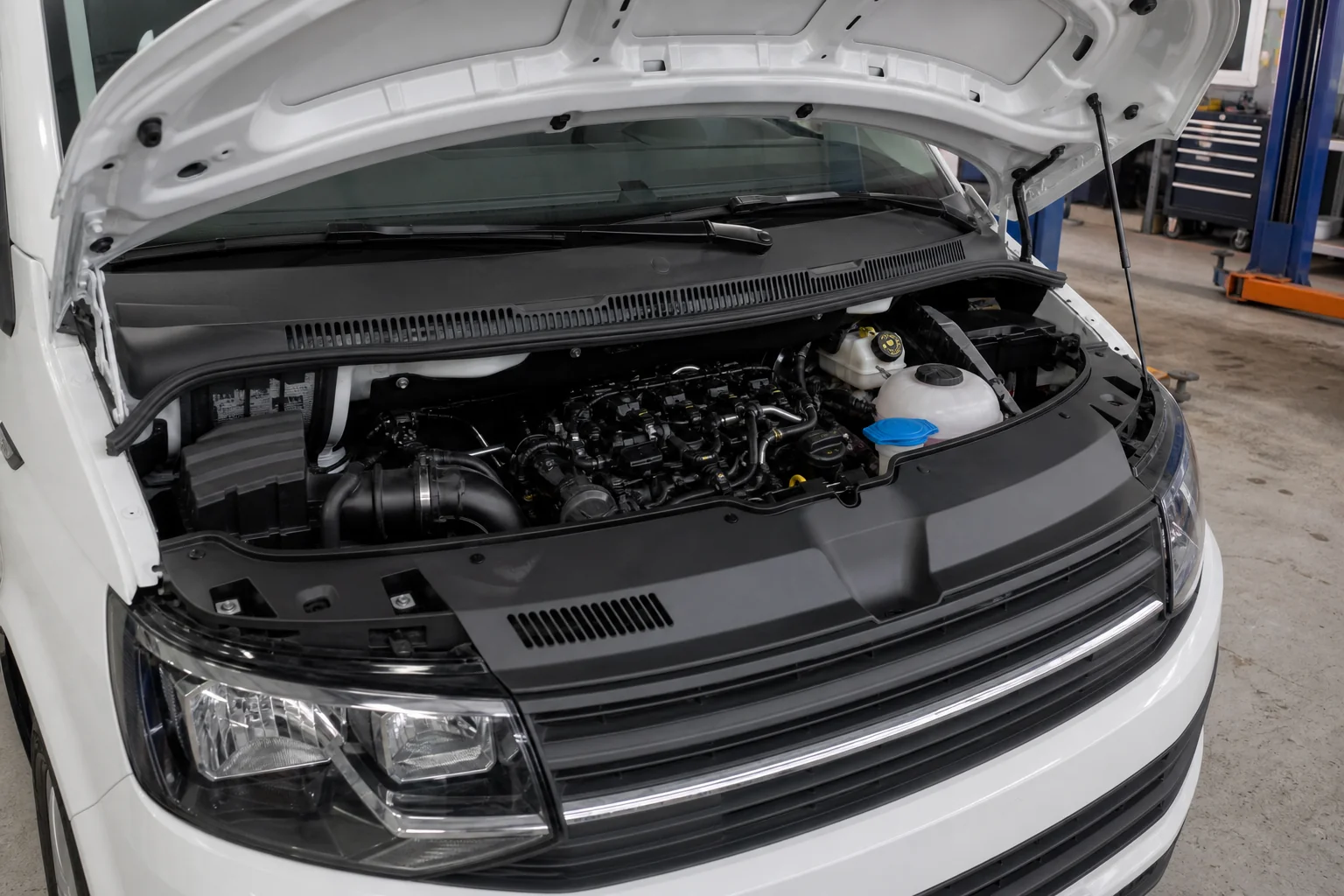
A Transit Custom remap turns the 130 PS EcoBlue into a ~170 bhp / 480 Nm van — from £150 at FLR with diagnostics included. Loaded driving transforms: fewer downshifts, easier hills, calmer motorways, and often 1–3 mpg better on a sensible right foot. DPF, EGR and AdBlue stay fully active. Belt-in-oil servicing history gets checked honestly first. Fleet bookings welcome, mobile across Lancashire. Wider van picture: van & fleet remapping guide.
The Short Answer
Should you remap your Transit Custom? If it earns its living and it is healthy — it is one of the most clearly justified remaps we do. Ford sells the same 2.0 EcoBlue at 105, 130, 170 and 185 PS outputs; the hardware differences are minor and the calibration differences are the product range. A custom Stage 1 on the common 105 and 130 PS vans uses exactly that proven factory headroom — and a van feels torque gains more vividly than any car, because vans live at load.
At Finish Line Remaps, Stage 1 from £150 includes diagnostics, a custom-written file for your exact engine and software version, a permanent factory backup and post-flash verification.
Typical Stage 1 Gains by Output
Figures are typical results on a healthy, standard van. We confirm from your VRN before booking:
| Version | Stock | Typical Stage 1 |
|---|---|---|
| 2.0 EcoBlue 105 PS | 104 bhp / 360 Nm | ~140 bhp / 430 Nm |
| 2.0 EcoBlue 130 PS | 128 bhp / 385 Nm | ~170 bhp / 480 Nm |
| 2.0 EcoBlue 170 PS | 168 bhp / 405 Nm | ~200 bhp / 480 Nm |
| 2.0 EcoBlue 185 PS | 182 bhp / 415 Nm | ~210 bhp / 490 Nm |
The 130 PS van is the one on every trading estate in Lancashire, and it is the one that transforms most: ~40 bhp and ~95 Nm is the difference between planning overtakes and just making them.
What It Feels Like Loaded
Spec-sheet numbers undersell van remaps because the factory figures are measured empty and your van never is. The gains land exactly where a loaded Custom struggles: pulling away from junctions with half a tonne in the back, holding fifth up the A56 instead of dropping to fourth, and keeping 60 on the motorway without the engine thrashing. Drivers describe it as the van feeling half-empty all the time — less shifting, less noise, less fatigue over a working day.
The Economy Case — Honest Version
More torque at low revs means less throttle for the same road speed and fewer downshifts per mile, which is why sensibly driven working vans commonly report 1–3 mpg improvements after mapping. Across a fleet van's 25,000-mile year, that is real money. Two honesty clauses: drive harder and you lose it, and no tuner can promise a specific figure for your routes. Operators who prioritise MPG over pace should ask about an economy-biased calibration — same process, different balance. Background: economy remap fuel savings.
Known EcoBlue Checks Before We Flash
| Item | Why it matters | How we check |
|---|---|---|
| Belt-in-oil servicing history | The EcoBlue's timing arrangement depends on correct oil, changed on time — a working van's service discipline decides its tuning candidacy | Service records, oil condition, belt status vs schedule |
| DPF health | Short-route urban vans clog filters; more torque on a struggling DPF helps nobody | Soot load, regeneration history, differential pressure — see DPF guide |
| EGR valve and cooler | Classic working-diesel restriction — coking blunts response and triggers limp mode | Live data flow analysis — see EGR explained |
| Turbo and boost control | Boost stability underwrites every figure above — high-mileage vans earn a careful trace | Boost trace on road test — see turbo health guide |
| AdBlue / SCR system | Must be healthy and stays fully active after tuning | Fault memory, dosing behaviour — see AdBlue explained |
Fleet and Multi-Van Work
Running more than one van? We schedule around your downtime, come to your yard — mobile across Lancashire and the North West — and calibrate each van to its job: standard Stage 1 for the long-haul vans, economy bias for the urban multidrops. Documented handover per vehicle for your records, and the original file archived for life means any van can return to stock for warranty visits or end-of-lease handback. The full fleet picture: van & fleet remapping guide.
Who Should NOT Remap Their Transit
- Vans with active DPF, EGR or boost faults — fix first, then tune. That is what diagnostics from £40 is for.
- Urban-only vans already fighting regeneration — a remap does not fix a duty-cycle mismatch; see the short-trip diesel guide.
- Vans with no oil service history — belt review first, power later.
- Leased vans without lessor approval — check the agreement; we can return to stock before handback, but tuning without approval is your risk to own.
- Anyone unwilling to declare the remap on the commercial policy — non-negotiable.
How We Tune a Transit at FLR
- VRN quote. Registration in, exact engine and software identified, honest expectations and price out — per van, including fleet pricing.
- Diagnostics first. Fault memory, live data, boost behaviour, DPF and EGR assessment, servicing history review. Included with every Stage 1.
- Custom calibration. Factory file read and archived for life, then a file written for your van and its job — standard or economy bias, never a generic download. See custom tuning.
- Verification. Post-flash live data, road test, written handover for your records.
Next Steps
A healthy Transit Custom plus a custom Stage 1 pays for itself in driver fatigue alone — the economy improvement is the bonus. Related reading: the van & fleet guide, the full Ford remapping guide, the best vehicles to remap for economy, and the best cars to remap in the UK. Ready? Send your VRN via the contact page or call 01706 404 357. Workshop in Haslingden, mobile across Lancashire and the North West.
Transit Custom Remapping — Common Questions
Typically 30–40 bhp and 70–90 Nm on the 2.0 EcoBlue, depending on the factory output. A 130 PS van typically reaches around 170 bhp and 480 Nm — the difference between working the van and the van working for you. We confirm expectations for your exact van from the registration.
For working vans the case is stronger than for most cars: more torque where the load lives means fewer downshifts, easier hills, calmer motorway running and a less tired driver. Driven sensibly, many operators also see a small economy improvement. It is the best money-per-mile upgrade a working Custom can receive.
Stage 1 is from £150 at Finish Line Remaps, including diagnostics, a custom-written file, permanent factory backup and post-flash verification. Automatic vans can add gearbox calibration from £150. Multi-van fleet pricing is available — ask when you enquire.
Often, yes — modestly. More low-rev torque means the van holds higher gears and needs less throttle for the same speed, and operators commonly report 1–3 mpg improvements on sensible driving. An economy-biased calibration pushes the balance further towards MPG if that is the priority.
A properly written Stage 1 keeps DPF, EGR and AdBlue fully active and MOT-compliant. Short-route urban vans already struggling with DPF regeneration need that resolved first — which is exactly what the included diagnostics identifies.
The 2.0 EcoBlue uses a belt-in-oil arrangement with a long but real service interval, so servicing history matters. A documented van is a sound tuning candidate; an unknown history earns a belt and servicing review first. We check during the included diagnostics.
Yes — multi-van bookings are welcome, mobile across Lancashire and the North West, with scheduling that works around your vans' downtime. Economy-biased or standard Stage 1 calibrations per van, documented handover for your records.
Yes — commercial policies are no different. A remap is a material modification and must be declared. Undeclared tuning can invalidate the policy, which on a working van is a business risk, not just a personal one.