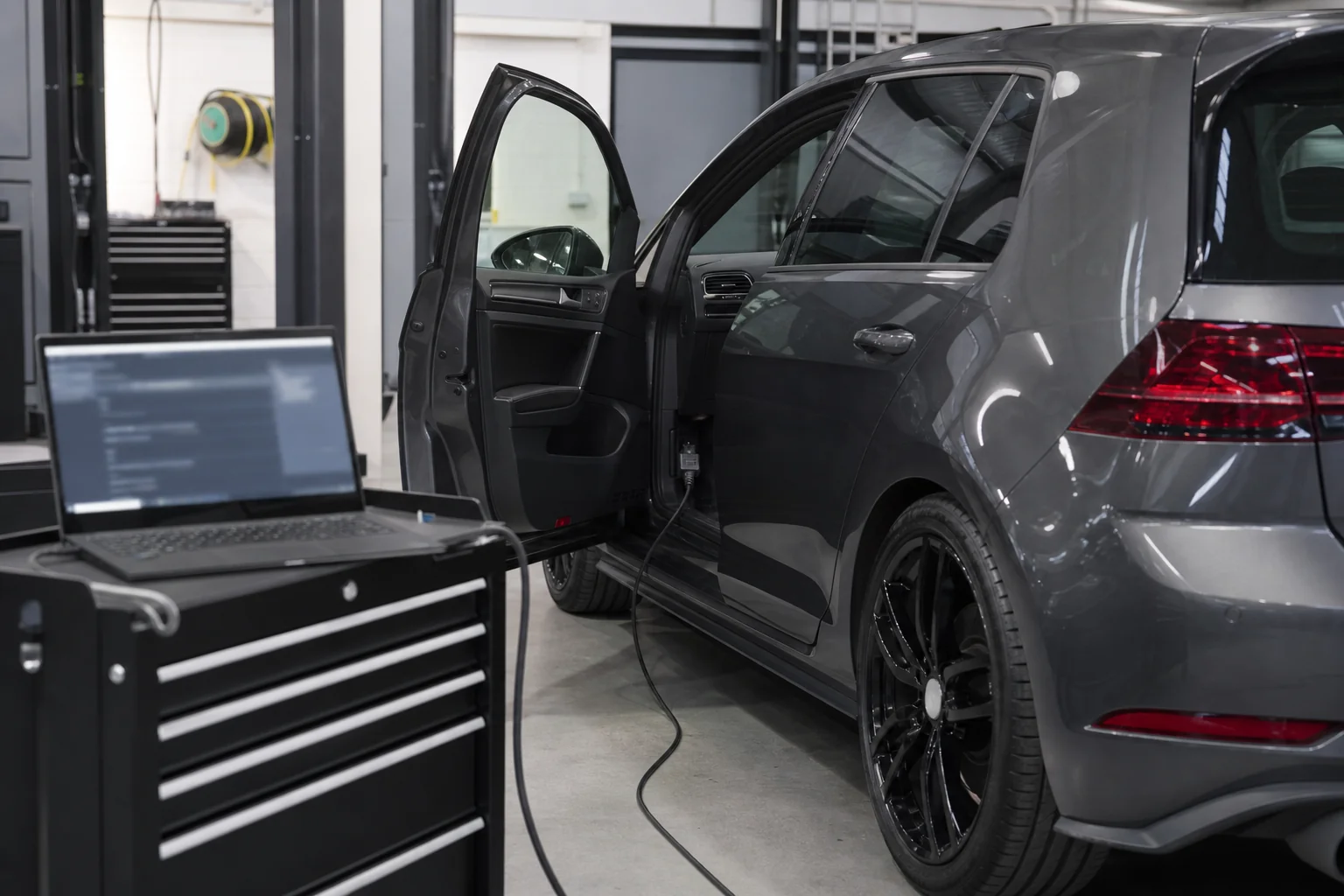
The best cars to remap in the UK are built on five engine families: VW Group's EA888 turbo petrol (GTI, vRS, S3) and EA288 2.0 TDI, BMW's B47 diesel (320d, 520d), Ford's EcoBoost petrols and the Mercedes OM651 diesel. All five gain 15–30% at Stage 1 on healthy, standard hardware — from £150 at FLR with diagnostics included. Skip remapping on naturally aspirated petrols and most hybrids; the gains do not justify the spend. Find your engine below, then send your reg for an exact quote.
Why We Rank Engines, Not Badges
Two things decide how much a remap transforms a car: how much genuine calibration headroom the factory left in the engine, and how common the platform is — because common platforms mean mature, well-proven calibration knowledge. Both of those live with the engine, not the model name. VW detunes the same 2.0 TDI to 115, 150 and 184 bhp outputs largely in software; BMW does the same with the B47. That factory detune is exactly the headroom a custom Stage 1 uses.
Every figure below is a typical result on a healthy, standard car — the kind of honest ballpark we would quote over the phone, not a dyno-day brochure number. Your exact gain depends on engine code, software version and condition, which is why we confirm from your registration before you book. Background on what Stage 1 actually changes: Stage 1 remap explained.
1. BMW B47 — The 320d Family
The modern BMW 2.0 diesel is arguably the best all-round remap candidate in Britain. It is everywhere — 320d, 420d, 520d, X3 20d — it is robust, and BMW sells the same engine at 150, 190 and 224 bhp outputs, which tells you how much is left in the calibration. A 190 bhp 320d typically reaches around 235 bhp and 450 Nm at Stage 1, and the ZF8 automatic most of them carry responds brilliantly to gearbox tuning alongside.
| Engine | Stock | Typical Stage 1 |
|---|---|---|
| B47 — 318d | 150 bhp / 320 Nm | ~190 bhp / 400 Nm |
| B47 — 320d / 520d / X3 20d | 190 bhp / 400 Nm | ~235 bhp / 450 Nm |
Full engine deep-dive, checks and model-by-model figures: BMW B47 remap guide. Wider BMW picture including the N47 era and the B58 petrol six: BMW remapping guide.
2. VW Group 2.0 TDI (EA288) — Golf, Passat, Octavia, A3, Tiguan
The most common engine in this guide by sheer volume. The EA288 2.0 TDI powers half the VW Group range, and the 150 bhp version in particular is a conservative calibration of hardware that comfortably supports more. Typical Stage 1 on the 150 takes it to around 190 bhp and 420 Nm — torque exactly where a daily, a towing car or a loaded family wagon uses it.
| Engine | Stock | Typical Stage 1 |
|---|---|---|
| 2.0 TDI 150 | 150 bhp / 340 Nm | ~190 bhp / 420 Nm |
| 2.0 TDI 184/190 (GTD, vRS) | 184 bhp / 380 Nm | ~215 bhp / 440 Nm |
Full engine deep-dive: VW/Audi 2.0 TDI remap guide. Golf-specific figures: Golf TDI & GTD guide.
3. VW Group EA888 2.0 TSI — GTI, vRS, S3, Leon Cupra
The fun one. The EA888 turbo petrol under the Golf GTI, Octavia vRS, Audi S3 and Leon Cupra is the most-tuned petrol engine in the country, because the factory calibration barely works its turbo. A 217 bhp Mk7 GTI reaches around 295 bhp from software alone; the vRS and A3 2.0 TFSI land in the same territory. On DSG cars, pair the engine map with a TCU tune — the Mk7-era DQ250's clutch limit sits right where Stage 1 torque lands.
| Engine | Stock | Typical Stage 1 |
|---|---|---|
| EA888 — GTI / vRS 245 | 217–245 bhp / 350–370 Nm | ~295–300 bhp / 420–430 Nm |
| EA888 — S3 / Golf R (IS38) | 296–316 bhp / 380–400 Nm | ~360–380 bhp / 460–480 Nm |
Model guides: Golf GTI, Golf R, Octavia vRS and Audi A3.
4. Ford EcoBoost — Fiesta, Focus, Puma, Transit
Ford's turbo petrols respond generously to software — percentage-wise the 1.0 EcoBoost is one of the biggest gainers in this guide, and the ST models are proper performance bargains once mapped. The honesty clause: the small EcoBoosts run a wet timing belt, and servicing history decides whether we tune one. A documented, in-spec car is a great candidate; an unknown history means belt checks come first.
| Engine | Stock | Typical Stage 1 |
|---|---|---|
| 1.0 EcoBoost 125 | 125 bhp / 170 Nm | ~150 bhp / 220 Nm |
| 1.5 EcoBoost 150/182 | 150–182 bhp / 240 Nm | ~185–210 bhp / 290 Nm |
| 2.3 EcoBoost (Focus ST Mk4) | 280 bhp / 420 Nm | ~330 bhp / 500 Nm |
Engine deep-dive including the wet-belt reality: Ford EcoBoost remap guide. Model guides: Focus ST and Fiesta ST.
5. Mercedes OM651 — C220d, E220d, Sprinter, Vito
The OM651 2.1 diesel powered half the Mercedes range for a decade, from C-Class to Sprinter. It responds to careful calibration with exactly what a heavy premium saloon or a loaded van wants: a fat slab of mid-range torque. A 170 bhp C220 CDI typically reaches around 205 bhp and 460 Nm, and the 7G-Tronic automatic pairs well with gearbox calibration.
| Engine | Stock | Typical Stage 1 |
|---|---|---|
| OM651 — 220 CDI / 220d | 170 bhp / 400 Nm | ~205 bhp / 460 Nm |
| OM651 — Sprinter 313/316 | 129–163 bhp / 305–360 Nm | ~165–195 bhp / 400–430 Nm |
Engine deep-dive: Mercedes OM651 remap guide. Brand overview: Mercedes remapping guide.
Best Pick by What You Actually Need
| You want | Best remap candidates | Why |
|---|---|---|
| Effortless daily | 320d (B47), 2.0 TDI 150, C220d | Mid-range torque where you actually drive — the full verdict: is Stage 1 worth it on a daily diesel? |
| Towing | 330d, Passat/Tiguan 2.0 TDI, E220d, Transit | Torque at low revs is exactly what a caravan or trailer needs — see best tow cars to remap |
| Economy / fleet | Transit Custom EcoBlue, Sprinter, Passat TDI | More torque means less throttle for the same speed — see best remaps for economy |
| Fun per pound | GTI, Octavia vRS, Fiesta ST, Focus ST | Big peak-power gains on hardware built to take it |
The Honest "Not Worth It" List
- Naturally aspirated petrols — no turbo means no boost to recalibrate. Typical gains are 5–10 bhp for the same money a turbo car turns into 40+. We will tell you this on the phone rather than take the booking.
- Most hybrids — deeply integrated petrol-electric strategies and patchy tool support mean meaningful gains are rare. Case-by-case exceptions exist; send your reg for a straight answer. More: hybrid and EV remapping.
- Anything with active faults — a remap amplifies what is already there, good or bad. Fix first, then tune. That is why diagnostics comes included with every Stage 1.
- Pre-2008 non-common-rail diesels — limited electronic control means limited gains.
How FLR Tunes Every Car on This List
- VRN quote. Registration in, engine code and gearbox identified, honest expectations and price out.
- Diagnostics first. Fault memory, live data, boost behaviour and platform-specific checks — included with every Stage 1.
- Custom calibration. Factory file read and archived for life, then a file written for your exact engine code and fuel — never a generic download. See custom tuning.
- Verification. Post-flash live data, road test, written handover and aftercare advice.
Next Steps
If your car is on this list, the next step is simple: send your registration via the contact page or call 01706 404 357 and we confirm exact gains and price for your engine code. If it is not on the list, send the reg anyway — most UK turbo petrol and diesel cars are strong candidates, and if yours is not we will say so. Stage 1 from £150, workshop in Haslingden, mobile across Lancashire and the North West.
Best Cars to Remap — Common Questions
For most owners it is a healthy turbo diesel built on one of the big engine families — a BMW 320d (B47), a VW Group 2.0 TDI or a Mercedes C220d (OM651). They gain 60–100 Nm of everyday torque from software alone. For outright fun per pound, the VW Group EA888 cars — Golf GTI, Octavia vRS, Audi S3 — are the benchmark.
They gain differently. Turbo diesels gain huge mid-range torque — perfect for towing, motorways and loaded driving. Turbo petrols gain more peak power and sharper response. Neither is better; it depends on what you want the car to do. Both routinely see 15–30% gains at Stage 1 on healthy examples.
Rarely. Without a turbo there is no boost to recalibrate, so gains are typically 5–10 bhp plus sharper throttle response. On most NA cars we would honestly rather you kept your money or put it towards servicing. Turbocharged engines are where remapping earns its keep.
The Transit Custom 2.0 EcoBlue is the UK benchmark — big torque gains that transform loaded driving — followed by the Sprinter (OM651) and the VW Transporter 2.0 TDI. For working vans the result is less gear-hunting, easier hills and often better economy on a sensible right foot.
Stage 1 is from £150 at Finish Line Remaps, whatever the badge — including diagnostics, a custom-written file for your exact engine code, a permanent factory backup and post-flash verification. Automatic gearbox tuning from £150, engine-plus-gearbox bundle from £275.
Usually not. The petrol-electric control strategies are deeply integrated and tool support varies by platform, so meaningful, reliable gains are rare. Some can be calibrated case by case — send your reg and we will give you a straight answer rather than a sales pitch.
No — condition matters far more than age or mileage. A well-serviced 120,000-mile 320d is a better candidate than a neglected 40,000-mile one. Every Stage 1 at FLR starts with diagnostics, and if your car is not healthy enough we tell you before taking your money.
Send your registration via the contact page or call 01706 404 357. We identify the exact engine code and software version, and quote honest expected gains and price before you book. No obligation, and mobile across Lancashire.