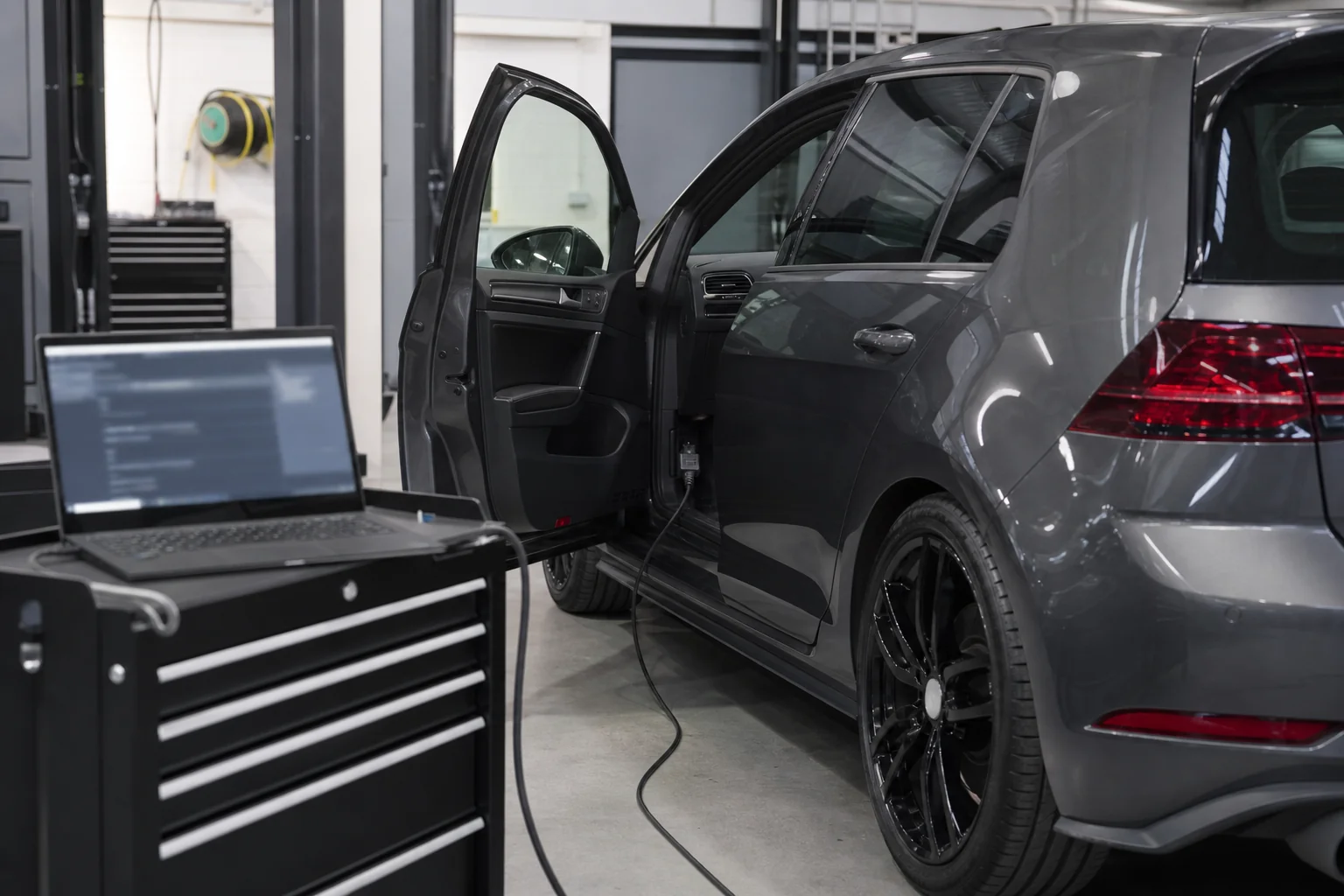
VW and Audi remapping is some of the most rewarding tuning work there is. The EA888 petrol family (GTI, R, S3, Cupra) and the TDI diesel family both respond strongly to a custom Stage 1 — from £150 at FLR, diagnostics included. We check carbon build-up, oil consumption history on early EA888s, turbo health and DSG condition first. Pair engine and DSG tuning in our from-£275 bundle for the strongest result. Be honest with yourself about the TD1 dealer flag if the car is under warranty — we explain it below.
The Short Answer
Should you remap your VW or Audi? On a healthy example — almost certainly yes. VW Group built its entire modern range around turbocharged engines, and turbocharged engines are exactly where software tuning shines. A custom file written for your exact engine code claims back the headroom the conservative factory maps leave behind.
The caveat is the word healthy. VW Group engines are well documented — which means their known weak points are well documented too, and a good tuner checks them before flashing. At Finish Line Remaps in Haslingden, Stage 1 from £150 includes that health check, a custom-written file, a permanent factory backup and post-flash verification.
New to the concept? Read what a Stage 1 remap actually changes first — this page covers the VW/Audi specifics.
The EA888 Petrol Family — GTI, R, S3, Cupra
The EA888 2.0 TSI is arguably the most-tuned engine in the UK. It powers the Golf GTI and Golf R, Audi S3 and countless A4/A5 models, the Leon Cupra, Octavia vRS and more. It has been through several generations since the late 2000s, and the generation matters.
Early EA888 — the oil consumption era
Earlier generations of the EA888 — broadly the pre-2013 cars — have a widely documented history of high oil consumption, generally attributed to piston ring design of the period. Not every car is affected, and many have had remedial work done over the years. But it is exactly the kind of history worth checking before adding load: an engine burning oil is telling you something about ring seal, and we want to know about it before we ask for more boost. On these cars we review oil consumption history and live data carefully before quoting.
Later EA888 — the sweet spot
The later generations that power the Mk7 and Mk8 era GTI, R and S3 are superb tuning platforms — strong internals, capable turbos, and factory calibrations with genuine margin. These are the cars where a Stage 1 feels transformative: the mid-range fills in, the throttle sharpens, and the car finally drives like the hot hatch the badge promises. Typical Stage 1 gains on healthy examples sit in the 15–30% more torque territory, exact figures depending on your specific engine code — we confirm from your VRN before booking. Golf owners: our dedicated Golf GTI remap guide and Golf R remap guide list typical figures in bhp for every generation.
Carbon build-up on direct injection
All FSI/TFSI direct-injection petrols share one trait: because fuel no longer washes over the intake valves, carbon deposits gradually build on them over tens of thousands of miles. It is a known characteristic of direct injection generally, not a VW defect, but it does blunt airflow and response on higher-mileage cars. If live data suggests restriction, we will tell you — a remap on a carbon-choked engine leaves performance on the table. Full explanation in our carbon build-up guide.
The TDI Family — EA189 and EA288
The 1.6 and 2.0 TDI have powered half of Lancashire for two decades. The EA189 generation (roughly the late-2000s to mid-2010s cars) and the later EA288 both remap extremely well — diesel torque from low revs is where software tuning delivers its most usable everyday gains. Driving a diesel Golf specifically? The Golf TDI & GTD remap guide has per-engine figures in bhp, and the full Golf remap guide covers the whole range.
What a TDI Stage 1 feels like
Less downshifting on the climbs out of Rossendale. Overtakes on the A56 that no longer need a run-up. A loaded estate or family SUV that stops feeling breathless. Torque delivery is the whole story on these engines — you feel the difference every single drive, not just at full throttle.
What we check on higher-mileage TDIs
- Turbo and VNT health — variable-vane turbos on high-mileage diesels are prone to sticking vanes, which shows up as overboost or underboost codes. We check turbo health before any remap.
- EGR and inlet condition — diesel EGR systems gradually coke up the inlet tract; heavy restriction needs addressing before tuning.
- DPF state — a DPF struggling to regenerate is a fix-first item, never a tune-around item. Emissions deletes are illegal for road use and we do not offer them.
- Injector behaviour — live data balance checks flag a lazy injector before it becomes a breakdown.
None of these are reasons to avoid a TDI remap — they are the reasons our process starts with diagnostics from £40 rather than a flashing tool.
DSG Pairing — The Strongest Bundle Case on Any Platform
Here is the part many VW Group owners miss: the DSG gearbox has its own computer with its own conservative factory calibration. Remap the engine alone and the gearbox carries on shifting to the old torque assumptions — early upshifts, soft launches, torque limits that clip your new mid-range.
A DSG/TCU remap from £150 recalibrates shift points, response and torque handling to match the tuned engine. On DQ250 and DQ381-equipped cars — most DSG Golfs, Leons, Octavias and S3s — the engine-plus-gearbox combination is transformative in a way neither map achieves alone. That is why our £275 engine + DSG bundle is the most-booked option on VW Group cars. The full technical story is in our DSG remap explained guide.
Known Issues We Check First
Quick reference for the checks that matter most per platform. These are widely documented characteristics worth verifying — not guarantees your car is affected:
| Engine family | Known history worth checking | How we check |
|---|---|---|
| Early EA888 TSI | Oil consumption history (pre-2013 era) | Service history review, live data, honest conversation |
| All TFSI/FSI | Intake valve carbon build-up (direct injection) | Live data airflow analysis, mileage-based judgement |
| EA189/EA288 TDI | VNT vane sticking, EGR coking, DPF condition on high mileage | Boost trace, fault memory, regeneration data |
| DSG cars | Mechatronic and clutch wear on high-mileage boxes | Adaptation values, shift behaviour on road test |
If we find something, you get an honest explanation and a fix-first recommendation.
The TD1 Flag — Honest Talk About VW Dealer Detection
VW Group dealers can and do check for modified software. The group's systems compare your ECU's software against the expected factory calibration, and where a mismatch is logged, VW's internal TD1 marker can be recorded against the vehicle — which can affect goodwill and warranty decisions on powertrain claims.
We will not pretend otherwise, and you should be suspicious of any tuner who claims their map is "undetectable" on a VW Group car. The honest position: if your car is inside its manufacturer warranty and you rely on that cover, understand the risk before you tune. If the car is out of warranty — which describes most of the VW Group cars we tune — the TD1 question is largely academic. We archive your factory file for life and can return the car to stock at any time, but a returned file does not guarantee a previously logged marker disappears. Full detail in our dealer detection guide and warranty facts.
Insurance and Legality
Two non-negotiables. First: a remap is a material modification in the UK — declare it to your insurer, because undeclared tuning can invalidate your policy. Second: emissions systems stay active. DPF, EGR and AdBlue deletes are illegal for road use and we do not offer them. A properly written Stage 1 keeps every factory emissions system and protection strategy fully operational.
Who Should NOT Tune Their VW or Audi
- Cars with active warning lights or limp mode — diagnose first, always
- Early EA888s with confirmed heavy oil consumption — address the mechanical condition before adding load
- High-mileage TDIs with boost or DPF faults on the codes — fix-first, then tune
- Nearly-new cars where warranty goodwill matters more than performance — wait, or accept the TD1 risk with eyes open
- DSG cars with slipping or juddering boxes — more torque accelerates the wear
- Anyone unwilling to declare the remap to insurance — the saving is not worth the exposure
We turn work away when a car is not fit. It costs us a booking and saves you a bill.
How We Tune VW Group Cars at FLR
- VRN quote. Send your registration — we identify the exact engine code and generation and quote accordingly.
- Diagnostics first. Fault memory, live data, boost behaviour, DSG adaptations where fitted. Included with every Stage 1.
- Custom calibration. Your factory file is read and archived permanently, then a file is written for your engine code — never a generic download. See custom tuning.
- Verification. Post-flash live data, road test on the hills we know, written handover and aftercare advice.
Questions we have not covered here are probably answered in our FAQ — including declared-modification insurance questions and reversibility.
Next Steps
If you drive a healthy EA888 or TDI and the factory calibration leaves you wanting, a custom Stage 1 is the best value upgrade available for the car — and if it is a DSG, the £275 engine-plus-gearbox bundle is the version you will not stop talking about. Send your VRN via the contact page or call 01706 404 357. Workshop in Haslingden, mobile across Lancashire and the North West.
VW & Audi Remapping — Common Questions
On healthy turbocharged VW Group engines — EA888 petrols and the TDI diesel family — yes. These are among the best-responding platforms in UK tuning, with typical Stage 1 gains in the 15–30% more torque territory on healthy examples. We confirm expectations for your exact engine code from your VRN.
Stage 1 starts from £150 at Finish Line Remaps, including diagnostics, a custom-written file, permanent factory backup and verification. DSG/TCU tuning is from £150, and the engine-plus-DSG bundle is from £275 — the most popular option on VW Group cars.
If your car has a DSG, strongly consider it. The gearbox has its own conservative calibration — shift points, response and torque limits — and tuning both together delivers a far more complete result than either alone. That is why we offer the from-£275 bundle.
Yes — VW Group systems can compare your ECU software against the expected factory calibration, and a mismatch can result in VW's internal TD1 marker being recorded, which can affect warranty goodwill. No honest tuner promises undetectable tuning. If you rely on manufacturer warranty, understand this risk before tuning.
Earlier EA888 generations — broadly the pre-2013 cars — have a widely documented history of elevated oil consumption. Not every car is affected, and many have had remedial work. We review oil consumption history and live data on these engines before quoting, because adding load to an engine with poor ring seal is bad practice.
All direct-injection petrols gradually build carbon on the intake valves because fuel no longer washes over them. It is a known characteristic, not a defect, but it can blunt airflow on higher-mileage cars. We assess it during diagnostics and tell you honestly if it needs addressing before a remap makes sense.
Often yes — well-serviced TDIs remap well at six-figure mileages. The deciding factors are turbo health, EGR and inlet condition, DPF state and injector behaviour, all of which we check in the included diagnostics before flashing anything.
Yes. A remap is a material modification in the UK and must be declared. Undeclared tuning can invalidate your policy entirely, even on claims unrelated to performance. Declare it — the honest route is always cheaper in the end.