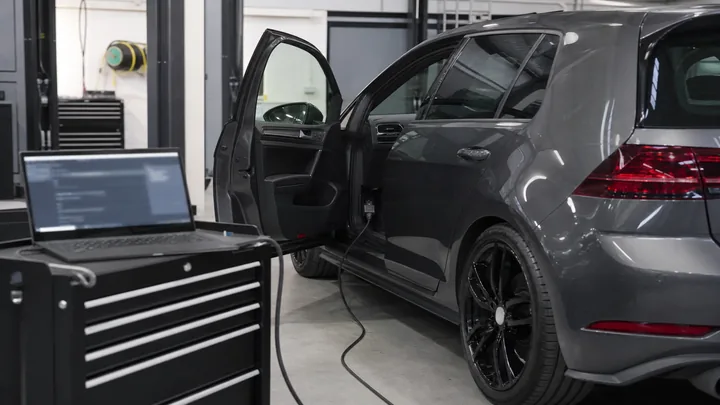
A car remap (also called ECU remapping or engine tuning) rewrites the software in your engine control unit so fuelling, boost and torque limits match what your hardware can safely deliver. At Finish Line Remaps, Stage 1 starts at £150, typical healthy turbo cars gain roughly 15–30% usable power, a standard visit takes 1–2 hours, and the factory file is archived so the work is reversible. This guide explains what that means in plain English — and routes you to deeper posts on cost, safety, stages and gearboxes.
What Is a Car Remap?
A car remap is a software change to your engine control unit (ECU) — the computer that decides how much fuel to inject, how much turbo boost to allow, when to ignite the mixture and how hard the engine is allowed to pull. The factory file is conservative on purpose; remapping replaces those instructions with a calibration written for your exact engine code, fuel and hardware. The same job is called ECU tuning, chip tuning (on older cars), re-flashing or re-mapping — the word “remap” comes from the lookup tables inside the ECU, which tuners call maps.
If you only need a one-line remap meaning: it is not a physical upgrade under the bonnet. Nothing is swapped unless you move to a higher stage that needs hardware. For a longer definitional path through the Knowledge Centre, start with what ECU remapping is and how it works — this article is the full picture in one place.
What Does a Remap Actually Change?
Remapping adjusts the parameters the ECU uses thousands of times per second. On a typical turbo petrol or diesel, a custom-written file may touch boost pressure targets, fuel quantity and timing, injection phasing, smoke or knock control, requested torque and the torque limiters that cap output per gear, throttle pedal mapping, and sometimes speed or rev limiters where the platform allows. What should stay protected — and on a responsible map, does — are over-boost safeguards, exhaust temperature models, DPF regeneration scheduling on diesels, and catalytic converter protection strategies.
| Parameter | What you feel |
|---|---|
| Boost / charge pressure | Stronger mid-range pull; less waiting for the turbo |
| Fuel & injection timing | Smoother delivery; cleaner acceleration |
| Torque request & limiters | More usable shove without the ECU cutting power early |
| Throttle map | Sharper response at part throttle — especially daily driving |
| Gear / RPM limits | Only where safe and legal — not the focus of a Stage 1 |
For the full technical story on what remapping a car does day to day, see Stage 1 remap explained — this section stays definitional so it does not compete with that post.
Why Do Manufacturers Leave Power on the Table?
One turbo engine often powers several badges and outputs — detuned with software for insurance bands, fleet emissions or regional fuel quality. Warranty and reliability targets are met by capping torque in lower gears, holding boost back in hot weather, and keeping identical hardware safe across continents. A remap does not magically create capacity the engine lacks; it uses margin already built into the turbo, injectors and cooling system on healthy cars. That is how a remap increases power without new pistons — and why results vary by engine family, not just by badge.
The same 2.0-litre turbo diesel might ship at 150 bhp in a van, 190 bhp in a family car and 240 bhp in a performance model — often with shared internals. Software, not a completely different engine, sets those outputs. Emissions certification is run on a worst-case drive cycle; manufacturers add buffer so a car still passes after years of soot, heat cycles and marginal fuel. Marketing tiers matter too: if the 320d were as fast as the 330d out of the box, fewer people would pay for the bigger model. Remapping respects that reality — we work inside mechanical limits, not against them.
That is why two identical-looking cars can respond differently to the same stage label. Mileage, service history, turbo health, fuel system condition and even the exact ECU software version change what a safe map looks like. Generic files ignore those differences; custom-written work does not. If you want numbers for your reg before booking, the tuning calculator and a straight conversation beat any generic percentage claim on a forum.
How Is a Car Remapped, Step by Step?
Professional remapping follows a fixed sequence. At FLR every engine job runs the same way whether you visit the workshop in Haslingden or book mobile remapping:
- DiagnosticsFault codes and live data before anything is written. We refuse unhealthy cars — see signs you need a remap versus mechanical faults.
- Read & archiveFactory ECU file saved for life. Reversibility is not a promise unless the stock file exists.
- Custom fileCalibration written for your engine code and software version — not a one-size file from a forum.
- WriteUsually via the OBD port (OBD remap); locked ECUs may need bench or boot mode — longer, quoted upfront.
- VerifyLive-data check and road test. You drive it before we close the job.
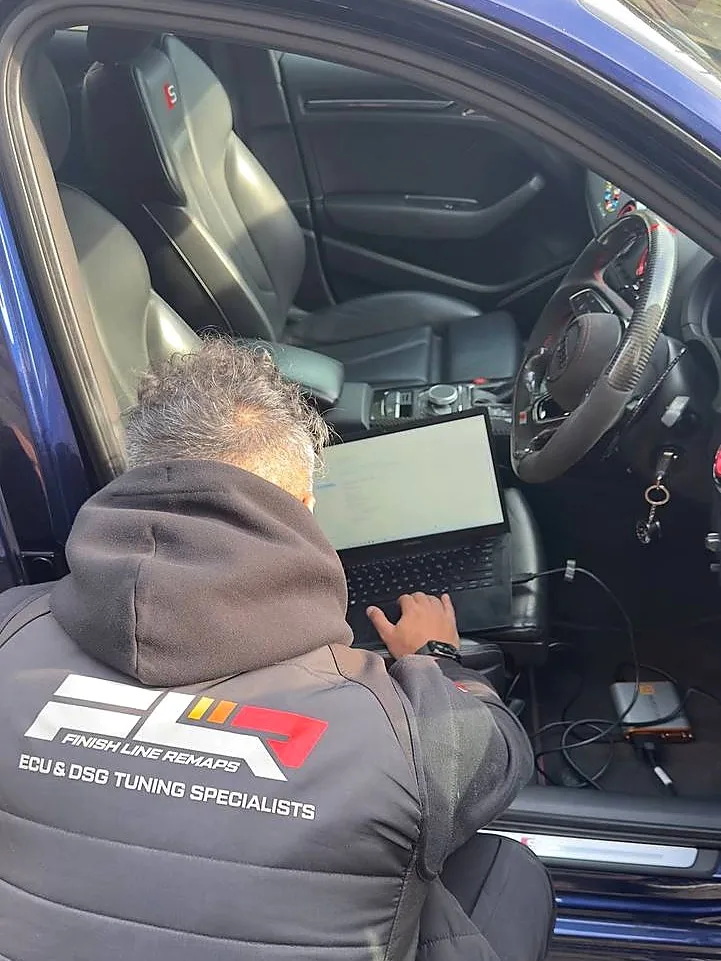
How to remap a car yourself? Consumer-grade tools and remap online file services exist, but they skip the health check, rarely archive your stock file properly, and cannot road-test the result. Learning calibration is a trade skill — we are honest that most owners should use a qualified technician. Appointment detail: what happens on the day and how long it takes.
Types of Remap: Stages, Economy, Gearbox and More
“Stage” is workshop shorthand, not a legal standard — Stage 4, 5 and 7 remap labels mean different things to different tuners. At FLR we use stages to describe software intensity and required hardware. Full stage ladder: Stage 1 vs Stage 2, Stage 2 guide, Stage 1+.
| Type | From | Best for |
|---|---|---|
| Stage 1 ECU | £150 | Software-only on standard hardware |
| Stage 1+ ECU | £180 | Stronger software-only calibration |
| Stage 2 ECU | From £250 | With supporting mods (intercooler, downpipe, etc.) |
| Stage 3 | Custom quote | Hybrid turbo / built engines |
| Custom / dyno | From £350 | Rolling-road development — see dyno vs road |
| Economy remap | £150 | Torque for relaxed driving — fuel savings guide |
| DSG / TCU | From £150 | Gearbox — DSG explained, TCU deep dive |
| Pops & bangs | Enquire | Character map — legal and MOT context |
How Much Power Can a Remap Add?
Healthy turbo diesels and turbo petrols commonly see roughly 15–30% more power and torque at Stage 1 — but usable mid-range torque matters more than a peak bhp figure on a rolling road. Naturally aspirated engines gain little (often single-digit bhp). Petrol vs diesel behaviour: petrol vs diesel remap. Use the remap calculator for reg-specific estimates; best cars to remap ranks engine families honestly.
Which Cars Can Be Remapped?
If it has a controllable ECU and tool support, it can often be calibrated — turbocharged cars reward remapping most. We cover BMW (guide, B47), VW Group (VAG guide, Golf R), Ford (guide), Mercedes (guide), Land Rover / Jaguar (guide) and more. Can you remap a hybrid or electric car? Mostly no for full EVs; some PHEVs have limited petrol-side gains — read hybrid and EV remapping. Unsure? Can any car be remapped and send your reg.
Remap vs Tuning Box vs Dyno Tune
A plug-and-play tuning box intercepts sensor signals; a remap changes the ECU’s own instructions — better coherence and no extra hardware under the bonnet. Dyno tuning develops the file on a rolling road — ideal for unusual builds. Compare in depth: remap vs tuning box, dyno vs road remap. Remap and tune mean the same thing in UK workshop language — both refer to ECU calibration, not a separate mechanical service.
Is a Remap Safe, Legal and Insured?
Remapping is legal in the UK when the vehicle still meets emissions and safety rules for its use — software-only maps on healthy cars typically pass MOT emissions if the car is maintained. The GOV.UK MOT inspection manual governs what testers look for; deleting DPF, EGR or AdBlue functions is not road-legal — see DPF remap facts for the legal line only. Tell your insurer — remap insurance; warranty — warranty guide; MOT detail — remap and MOT; safety — is ECU remapping safe; reversal — can a remap be reversed; detection — is my car remapped. Professional standards: Institute of the Motor Industry (IMI).
Safety is a process, not a slogan. Diagnostics before writing, a map built for your engine code, conservative boost and fuelling on a first visit, and a road test afterwards — that is how you keep reliability. Maps that chase leaderboard numbers on weak hardware cause limp mode, overheating and expensive follow-up jobs. We would rather turn work away than flash a car that is not ready. Dealer main agents may flag non-standard software during updates; restoring the archived stock file before a visit is standard practice for many owners — see dealer detection for a balanced view.
Insurance is the part owners forget. A remap is a modification even when it is invisible under the bonnet. Notify your provider and keep a record of what was done and when. Failure to declare can invalidate cover. Resale is another conversation: some buyers value honest, reversible tuning; others want factory-only — remap and resale covers how to document the work.
How Much Does a Car Remap Cost?
Published FLR prices: Stage 1 £150, Stage 1+ £180, Stage 2 from £250, Stage 3 custom quote, custom/dyno from £350, DSG/TCU from £150, Stage 1 + DSG bundle from £275, Stage 1+ bundle from £300, economy £150, diagnostics £40, coding from £25. Every standard remap includes diagnostics, archived stock file and verification. Full breakdown: UK remap cost guide (updated 2026). What Stage 1 changes in practice: Stage 1 remap explained. By vehicle type: cost by vehicle type.
Is a Remap Worth It — and When It Is Not
Skip or fix first if: the engine is misfiring, overheating or throwing critical codes; the turbo is worn or oil-starved; the DPF is blocked; the clutch or auto box is slipping; you have a high-mileage NA engine wanting big gains; you cannot declare the modification to insurance; or you only want a cheap generic file with no backup. We would rather say no — book diagnostics if the car feels wrong.
Worth-it cases we see every week in Lancashire: healthy turbo diesels used for commuting and towing, where mid-range torque transforms daily driving; hot hatches and performance saloons on Stage 1 for response without bolt-ons; vans and Transits that need load capability without constant downshifts; and paired ECU + DSG jobs where the engine gained torque but the gearbox still short-shifts. Less compelling: tiny-engined NA city cars, neglected high-mileage turbos with unknown history, and owners chasing numbers without budget for maintenance.
Still deciding? Read is Stage 1 worth it, use the calculator, then speak to a human — choosing a remapper matters as much as the stage label.
Car Remapping Near Me
Finish Line Remaps is based in Haslingden (BB4) with workshop and mobile ECU remapping across Lancashire and Greater Manchester. Area pages: all locations, mobile remapping guide. Search car remap near me or ECU remap near me — confirm the tuner archives your stock file and health-checks before writing.
Glossary
- ECU
- Engine control unit — the computer that runs the engine.
- Map / calibration
- Data tables defining fuelling, boost and torque limits.
- Stage 1
- Software-only tune on standard hardware.
- Stage 2
- Software matched to bolt-on hardware.
- TCU / DSG remap
- Gearbox control unit calibration.
- OBD flash
- Reading/writing via the diagnostic port.
- Bench / boot mode
- Direct ECU access when OBD is locked.
- Stock file
- Factory ECU backup for reversal.
New here? Read this page once, then use the Remapping Guides hub for depth on cost, MOT, insurance and stages — or send your reg for a confirmed quote. Call 01706 404 357.
Car Remap & ECU Remapping — Common Questions
A car remap rewrites the engine ECU software so fuelling, boost and torque limits suit your engine’s real hardware. It is the same as ECU tuning or re-flashing — a software change, not a new engine. At FLR, Stage 1 starts at £150 including diagnostics and a lifetime stock-file backup.
It typically increases usable torque and power, sharpens throttle response, and can improve drivability in the rev range you use daily. Peak figures matter less than mid-range pull. Results depend on engine type — turbo cars gain most; many naturally aspirated engines gain very little.
Manufacturers leave margin for global fuels, emissions and warranty. A custom map raises boost and torque requests within safe limits on healthy hardware — using capacity the turbo and fuelling system already have, not inventing new mechanical ability.
Remap and chip tuning (on modern cars) both mean changing ECU software. A tuning box fools sensors instead. Remaps integrate all tables together — usually smoother and easier to reverse if the stock file was saved. See our remap vs tuning box guide.
Only if tool support exists and the car is healthy enough. Turbo petrol and diesel cars are the sweet spot. Many EVs cannot be remapped in the traditional sense. Send your registration — we confirm engine code, options and an honest yes/no before you book.
Full EVs: generally no meaningful ECU remap like a combustion engine. Plug-in hybrids: sometimes limited petrol-side gains depending on platform. Read hybrid and EV remapping — we answer from tool support, not marketing.
A standard Stage 1 typically takes 1–2 hours including diagnostics, backup, flash and road test. Bench or boot-mode ECUs take longer. Full breakdown: how long a remap takes.
Yes — if the original ECU file was archived. We store every customer stock file for life and can restore factory calibration. Insurance and warranty history may still record that a remap happened. Details: can a remap be reversed.
At Finish Line Remaps, Stage 1 is £150, Stage 1+ £180, Stage 2 from £250, economy £150, DSG/TCU from £150, and the Stage 1 + DSG bundle from £275 — all including diagnostics and stock-file backup on standard engine remaps. National context: remap cost UK.